
Foreign portfolio investors (FPIs) turned buyers on September 11, the first time in the month and after five trading sessions.
The reversal of trend comes after FPIs pulled out more than Rs 5,000 crore from the cash segment of Indian equity markets in September itself.
FPIs poured in Rs 1,162 crore on August 30 but since then, they have pulled out Rs 5,194 crore, Moneycontrol.com data shows.
On the other hand, domestic institutional investors (DIIs) were net buyers for more than Rs 6,000 crore in the same period.
FPIs have pulled out nearly Rs 15,000 crore in August, Rs 17,000 crore in July, nearly Rs 700 crore in June and at least Rs 2,000 crore in May.
They have been in a selling mode despite the government rolling back increased surcharge, with macro-economic concerns taking the centre stage. Foreign investors are cautious in the global market with a risk-off mode, suggest experts.
“It looks like FPIs are in a risk-off mode. Equity indices of US, Euro, and emerging market are flat-to-negative in the last three months. This is due to the slowdown in the global economy,” Vinod Nair, Head of Research at Geojit Financial Services, told Moneycontrol.
“The last quarter GDP growth of countries like the US, Euro areas, China and India got deeply subdued, post which the estimates for CY2019 have been lowered substantially,” he said.
There were fears that the slowdown could get extended to calendar year 2020, given the uncertainty over the US-China trade war, Brexit, and geopolitical issues, Nair said. During such times, the performance of emerging markets gets reduced, as per historical data.
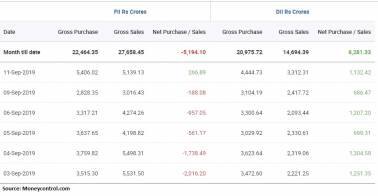
The quantum of FPI selling has come down, which is a bullish sign, but it is too early to say if they will turn net buyers for September.
Two big events are lined up. The European Central Bank (ECB) meeting and US Fed policy meeting that will direct flows in the near term.
India Ratings and Research (Fitch Group), in a report in early September, said the FPI flow into India will continue to face headwinds over the near-to-medium term despite the accommodative global monetary policy stance and the government’s efforts to alleviate uncertainty over the surcharge.
“There are a gamut of factors such as slower-than-expected demand growth in major economies, geopolitical and trade tensions and a gradual weakening of the economic growth prospects in India that have contributed to a build-up of risk aversion, which has impeded the demand for emerging market debt instruments,” the report said.
Ind-Ra believes that the shift in global monetary policy conditions to a relatively accommodative stance is unlikely to revive capital flows into emerging markets like India.
Despite the US Fed’s decision to restrict the contraction of its balance sheet and the ECB decision to conduct a fresh round of targeted long-term refinancing operations (TLTROs), Ind-Ra expects the cumulative liquidity infusion by the four major central banks (US Fed, ECB, Bank of England and Bank of Japan) in 2019 to be significantly low at around USD186 billion compared with the $353 billion in 2018 and $1.45 trillion the year before.

Discover the latest Business News, Sensex, and Nifty updates. Obtain Personal Finance insights, tax queries, and expert opinions on Moneycontrol or download the Moneycontrol App to stay updated!
Find the best of Al News in one place, specially curated for you every weekend.
Stay on top of the latest tech trends and biggest startup news.