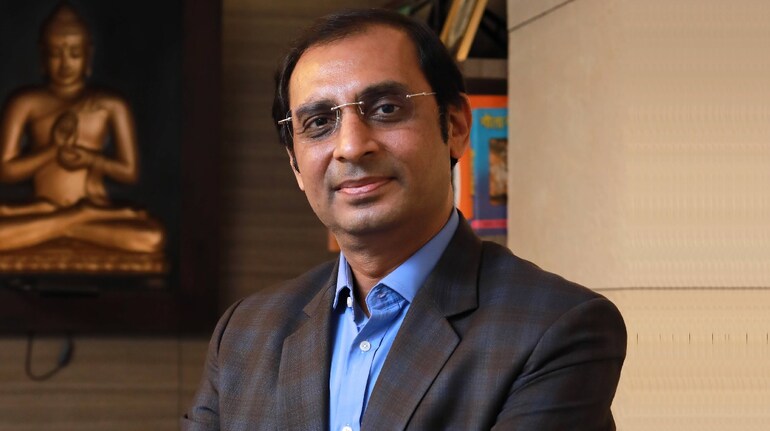

According to Pradeep Gupta, the Chairman & MD at Anand Rathi Share & Stock Brokers, the Budget 2026 is likely to focus on three themes--public capex continuity, jobs and human capital, fiscal credibility.
Together, these priorities reflect an emphasis on durable, domestically driven growth rather than short-term stimulus, he said in an interview to Moneycontrol.
He believes the real estate can indeed be a dark horse as unlike past cycles, the current upturn is largely end-user driven, not speculative. IT, on the other hand, is a credible contrarian bet, he said.
Will India’s journey beyond a $4 trillion economy be supported by new-age digital companies?
Yes, but their contribution should be seen less as a standalone GDP engine and more as a force multiplier for productivity, efficiency, and formalisation across the economy. India’s digital economy has already reached a low-teens share of GDP, and its growth rate is meaningfully higher than headline GDP growth.
Platforms such as digital payments, e- commerce, SaaS, logistics-tech, and enterprise software are lowering transaction costs, improving compliance, and expanding market access for MSMEs.
The most visible example is digital public infrastructure. UPI has scaled to over 20 billion monthly transactions, bringing millions of small merchants and households into the formal financial system. This improves tax compliance, credit underwriting, and consumption visibility.
Similarly, digital lending, GST-based invoicing, and cloud adoption are improving capital efficiency in traditional sectors. In that sense, new-age digital companies will not replace manufacturing or services as growth drivers—but they materially raise the economy’s potential growth rate by improving productivity across sectors.
What is the pecking order in terms of the top three sectoral bets for the current year?
The first and most compelling bet remains domestic cyclicals linked to capex and manufacturing. India’s growth continues to be domestically driven, supported by sustained public capital expenditure in infrastructure, defence, railways, energy transition, and logistics. Manufacturing growth has stabilised at healthy levels, and the crowding-in of private capex is gradually becoming visible. Balance sheets in capital goods and industrial companies are significantly stronger than in previous cycles.
Second are financials, particularly well-capitalised banks and select insurers. Credit growth remains robust, driven by retail, MSMEs, and services. Importantly, asset quality is benign, capital adequacy is comfortable, and return ratios are structurally higher than a decade ago. Financials also remain the most direct beneficiary of formalisation and rising financial penetration.
Third is select consumption, rather than broad-based consumption. Premiumisation trends in autos, travel, discretionary retail, and services remain intact, while mass consumption is recovering gradually. Companies with pricing power, brand strength, and efficient distribution are better positioned than those dependent purely on volume growth.
Do you expect a pickup in momentum in pharma stocks, which have faced an overhang from US policy changes?
A selective recovery in pharma is likely, rather than a broad-based rally. India’s pharmaceutical exports continue to grow at a steady high single-digit pace, with the US accounting for roughly one-third of exports. Structural drivers—ageing populations, chronic therapies, and cost pressures in developed markets—continue to favour generics and complex formulations.
That said, the overhang from US policy changes, pricing pressure, and regulatory scrutiny has not disappeared. Therefore, leadership will likely come from companies with complex generics, specialty products, strong compliance records, and diversified revenue streams, rather than commodity-style players. The sector’s earnings visibility is improving, but differentiation is critical.
Is real estate a dark horse and IT a contrarian bet?
Real estate can indeed be a dark horse. Unlike past cycles, the current upturn is largely end-user driven, not speculative. Residential registrations in key markets are at multi-year highs, inventory levels are moderate, and developers’ balance sheets are significantly cleaner.
Consolidation has benefited organised players, improving pricing discipline and return ratios. With urbanisation, premiumisation, and better financing access, the sector’s earnings cycle looks structurally healthier.
IT, on the other hand, is a credible contrarian bet. Growth expectations are already low, valuations have normalised, and headcount growth has slowed. Any stabilisation in global IT spending—particularly in BFSI and discretionary tech—can lead to operating leverage and earnings upgrades. However, recovery will likely be gradual and uneven, with greater divergence between companies aligned with cloud, data, and AI versus legacy application maintenance.
Do you expect, by any chance, the RBI to slash interest rates up to the 4 percent mark in the current year, considering growth is a top priority?
This is unlikely under normal conditions. While growth is a priority, a move to 4% would imply an additional 125 basis points of rate cuts, typically seen only during periods of severe growth or financial stress. Inflation dynamics, global financial conditions, and currency stability remain important constraints.
A more realistic scenario is measured easing, where monetary policy remains supportive without becoming excessively accommodative. The RBI’s approach has consistently emphasised balance—supporting growth while anchoring inflation expectations and safeguarding financial stability.
Do you see a continuation of strong money flows into quick commerce companies?
Yes, but the nature of capital deployment will change. Early-stage growth-at-any-cost funding is giving way to selective capital allocation focused on unit economics, density advantages, and customer retention. Quick commerce has demonstrated strong consumer adoption in urban India, driven by convenience and high-frequency use cases.
Going forward, market leadership will depend on store-level profitability, logistics efficiency, and repeat consumption, rather than headline GMV (gross merchandie value) growth. Flows are likely to continue, but with sharper differentiation between leaders and marginal players.
Do you expect copper to surprise in the current year as demand outpaces supply?
Copper has credible upside risk over the medium term. Electrification, renewable energy, electric vehicles, and grid investments are all copper-intensive, while supply additions face long gestation periods and geopolitical constraints. Even modest demand surprises can tighten the market.
That said, near-term prices will remain volatile, influenced by global growth, China’s demand cycle, and inventory movements. The more plausible surprise is sustained tightness rather than a straight-line rally.
What could be the key focus areas in the upcoming Union Budget?
The Budget is likely to focus on three themes. First, continuity in public capex, particularly in infrastructure, defence, energy transition, and logistics, to sustain the investment cycle. Second, jobs and human capital, including skills, MSME productivity, and urban infrastructure, to translate growth into employment.
Third, fiscal credibility, maintaining the consolidation glide path while preserving growth support. Together, these priorities reflect an emphasis on durable, domestically driven growth rather than short-term stimulus.
Disclaimer: The views and investment tips expressed by investment experts on Moneycontrol.com are their own and not those of the website or its management. Moneycontrol.com advises users to check with certified experts before taking any investment decisions.Discover the latest Business News, Sensex, and Nifty updates. Obtain Personal Finance insights, tax queries, and expert opinions on Moneycontrol or download the Moneycontrol App to stay updated!
Find the best of Al News in one place, specially curated for you every weekend.
Stay on top of the latest tech trends and biggest startup news.