

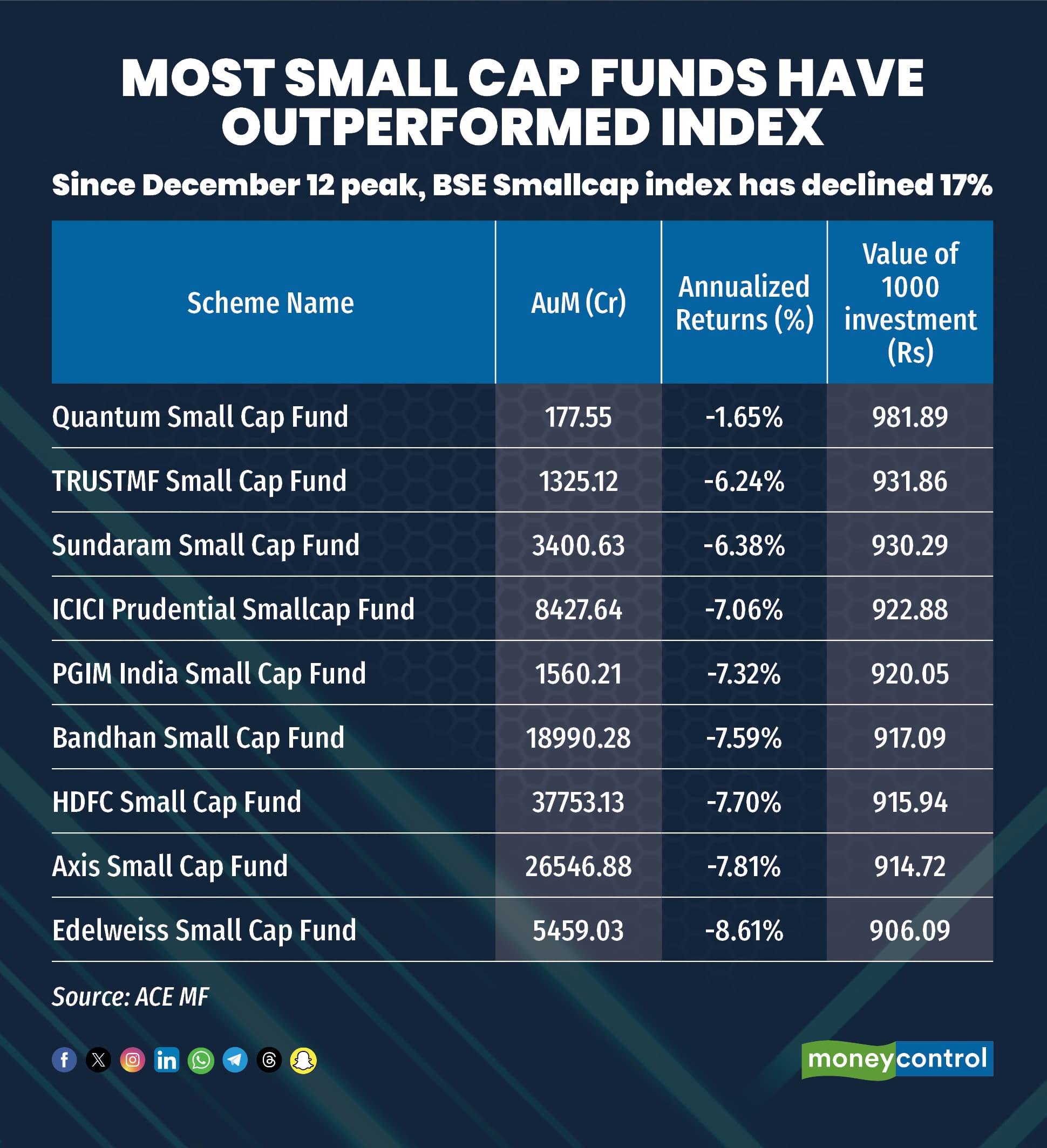
Even as there has been a sharp 21% decline in the BSE SmallCap index since December 2024, nearly 90% of small-cap mutual funds have managed to outperform the benchmark, strengthening the case for active investing in small-caps. While the broader index struggled, several schemes cushioned investor losses with relatively smaller declines. For instance, Quantum Small Cap Fund delivered an annualised return of –1.65%, meaning a Rs 1,000 investment would still be worth Rs 982. TRUSTMF Small Cap Fund and Sundaram Small Cap Fund limited losses to around 6%, preserving Rs 930 per Rs 1,000 invested.
Among larger, widely held funds, ICICI Prudential Smallcap Fund, HDFC Small Cap Fund, and Axis Small Cap Fund posted annualised returns between –7% and –8%. In contrast, JM Small Cap Fund, Kotak Small Cap Fund, Tata Small Cap Fund, HSBC Small Cap Fund, and LIC MF Small Cap Fund were more exposed to the downturn, with losses of 15%–20%.
Experts have repeatedly said for the past two years that in a market where there is across the board overvaluation, a careful stock-specific strategy will be key to outperformance. The performance of mutual funds only proves this thesis.
While investors can take solace in the fact that their funds have beaten the indices, it does not take away the losses. Not a single small-cap fund delivered a positive return.
More importantly, experts say the problem of overvaluation may not be over yet. Despite the sharp decline in small-cap stock prices, the BSE SmallCap index still commands a P/E ratio of 24.06, higher than its long-term average of 19.62. Axis Small Cap Fund has a portfolio P/E of 49.46, ICICI Prudential Smallcap Fund 34.17, Bandhan Small Cap Fund 35, HDFC Small Cap Fund 36.07, and Invesco India Smallcap Fund an elevated 54.38. A few remain more reasonably valued — Quantum Small Cap Fund at 29.19 and PGIM India Small Cap Fund at 61.81. While higher P/Es reflect strong growth expectations, they also increase vulnerability to earnings disappointments or market corrections; lower valuations may provide some downside protection but could trail during rebounds.
Despite the turbulence, opportunity remains within the category. Tejas Sheth, Fund Manager at Axis Mutual Fund, notes that small-cap funds are inherently high-risk, high-return products. “They tend to generate 200–300 basis points more than mid-cap funds over the long term, while mid-caps usually outperform large caps by a similar margin,” he explains. Long-term small-cap returns typically average 18%–20% CAGR, and while the 2020–2024 phase saw outsized gains due to strong GDP growth, markets are now normalizing toward historical averages.”
Financial advisors, however, continue to emphasize discipline and asset allocation. Sachin Jain, Managing Partner at Scripbox, prefers large caps for most investors, suggesting that “small- and mid-cap allocation should be limited to aggressive investors and assessed individually.” He adds that the rapid growth in assets under management makes disciplined investing even more critical: “Many investors are still chasing past returns rather than following a structured plan.” Jain recommends that new investments align with asset allocation goals rather than market momentum: “Small caps suit very aggressive investors with a five- to seven-year horizon. Staggered SIPs or STPs work better than lump sums,” he said.
Anand Rathi Wealth's Shweta Rajani added that, "Small caps are still a looked at like a return engine for the long term, but the segment is in a repricing phase. One more thing to keep in mind is this segment undergoes mean reversion for 3-5 years after delivering strong performace. We have also seen that such corrections in small cap segment are normal, and historically, we have seen drawdowns of 20–25% from peak levels several times and usually within 18-24 months the recovery periods begin," she said. Rajani added that from an investor standpoint, our outlook for small-cap funds remains the same. "Importantly, valuations have corrected meaningfully and are now trading at a negative froth of around -12.8, suggesting that the segment is currently at attractive valuation levels," she said.
Disclaimer: The views and investment tips expressed by investment experts on Moneycontrol.com are their own and not those of the website or its management. Moneycontrol.com advises users to check with certified experts before taking any investment decisions.Discover the latest Business News, Sensex, and Nifty updates. Obtain Personal Finance insights, tax queries, and expert opinions on Moneycontrol or download the Moneycontrol App to stay updated!
Find the best of Al News in one place, specially curated for you every weekend.
Stay on top of the latest tech trends and biggest startup news.