
India is looking to aggressively promote wheat exports after the Russia-Ukraine war left countries urgently seeking alternative suppliers. Russia is the largest exporter of the grain and Ukraine is the sixth largest (going by 2021 numbers).
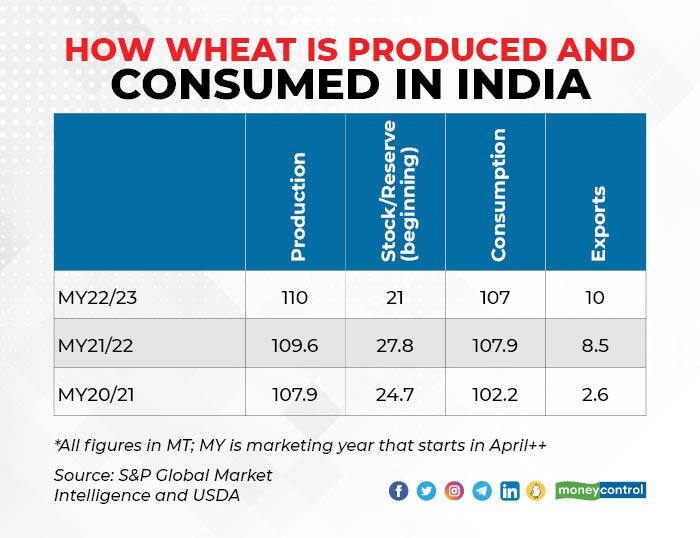
In FY22, India exported a record 8.5 million tonnes (mt). In the current fiscal, the country has a target of 10 mt.
But a heat wave has swept through the bigger wheat-producing states, reducing yields of a crop that had already borne the brunt of excess rains in January. “Yield losses could be anywhere between 10 and 15 percent depending on the time of sowing,” said Ajay Jakhar, chairman of Krishak Samaj, based on conversations he had with farmers in different states. Jakhar had sown his crop early, which means it would have matured earlier and seen less damage from the heat wave, and yet he saw a 10 percent fall in yield. All these factors combined have led to speculation that the country may face a shortage in the grain which could increase inflation–wheat prices are trading 5-7 percent over minimum support price (MSP). Experts Moneycontrol spoke to say that nothing could be further from the truth.“We believe India’s food inflation in general will be largely insulated from the consequences of the European conflict,” said Rahul Bajoria, managing director and chief India economist at Barclays. “India’s food production has increased dramatically over the past decade, and is more than sufficient to meet both the domestic demand and incremental exports… since exports as a proportion of total production will be minimal, it isn’t unlikely to have any major impact on domestic food prices.”
Also read: Wheat inflation becoming hard to stomach for Indian households
If domestic concerns do arise from greater exports, the former is unlikely to be compromised to favour the latter, according to him.
Going by Pranay Shukla, associate director at S&P Global Market Intelligence, the country can still expect a record harvest in wheat at 110 mt for FY23. "Indian wheat production is expected to be at record levels in anticipation that good weather conditions are expected to prevail while harvesting during April/May," said Shukla.
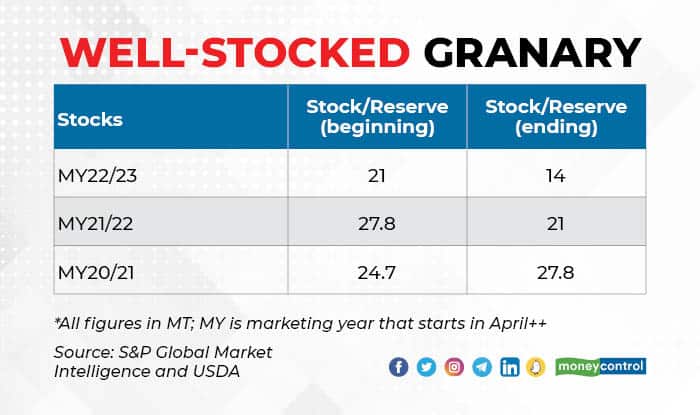
Sources inside the ministries of commerce and agriculture too said that there is no concern about food security. While the commerce ministry seems upbeat about the export opportunity, the agriculture one expressed concern about the yield loss. Neither expected any export restrictions to be placed.
The export plan is good for farmers and for the country, said Gulati, and Jakhar agrees with him. “Let the farmer avail of this opportunity and let India play a larger, more global role… the farmers are getting good prices after 8 to 10 years and if prices fall below MSP, everything will be on the government’s head to procure everything and keep for two to three years, which we have been doing anyway,” said Gulati.
“I would say the target of 10 mt for wheat exports is too conservative… the government should be aiming for more,” he added.
The price rise from this isn’t going to be long lasting, as far as Gulati can see. It will last only till the geopolitical tensions last and after that Indian wheat–supported by the MSP system–will return to being uncompetitive in global markets. “Today wheat is trading at $350 and $400 per tonne. When it falls below $300 per tonne, the country’s wheat will become unviable again for exports,” he said.
Gulati sees no reason to worry about inflation. “800 million people in this country get free food in rice and wheat, so they are protected. As for the rest… if people can buy cars in lakhs, they can definitely afford Rs 2-3 more to buy wheat,” he said.Also read: Why are wheat prices rising despite record harvest?
If there is any blowup in food prices this summer, it could have larger consequences. “Low food inflation has been one of the main reasons behind lower headline inflation in India over the past five years,” said Bajoria. “India’s MPC (monetary price committee) has been slightly ‘lucky’ to have favourable food prices helping it keep price inflation dynamics in check. Any sharp blowup in food prices this summer could pose upside risks to inflation – and constrain support provided by the central bank,” he added. Barclays is expecting Consumer Price Index (CPI) to average 5.8 percent in FY23, factoring in higher food and energy rates.
Discover the latest Business News, Sensex, and Nifty updates. Obtain Personal Finance insights, tax queries, and expert opinions on Moneycontrol or download the Moneycontrol App to stay updated!
Find the best of Al News in one place, specially curated for you every weekend.
Stay on top of the latest tech trends and biggest startup news.