The attractiveness of an exchange business is that once it is set up there are no incremental investments required. What is more, as the business grows it can generate more and more cash without commensurate increase in costs such as employee and technology, thus producing huge amount of distributable cash.
For the same reason, if one invests early, exchanges could be hugely rewarding as incremental growth brings in more cash and improved profitability.
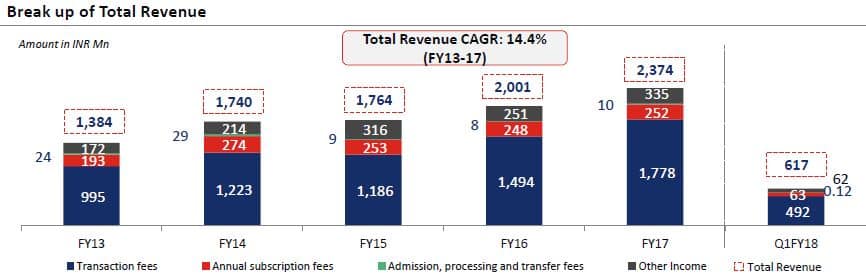
Indian Energy Exchange (IEX), which provides the platform for trading in power, could be one such opportunity. During FY13-17, its fixed assets have fallen from Rs 12 crore to Rs 9 crore whereas profits have risen from Rs 66 crore to Rs 113 crore. IEX does not need money. In fact, because of surplus cash flows, it is sitting on a cash equivalent of close to Rs 530 crore.
In fact, the entire issue of close to Rs 1000 crore is an offer-for-sale from the existing shareholders who are selling their stake to the public through IPO.
Globally, as high as 50 percent of the total power consumed in many of the Western and European countries is traded through exchanges. In India, IEX is the first such exchange which commenced operation in 2008. Just like any other exchange, the seller, which is mostly a power producer and a buyer (distribution companies like state utilities and others) come on the IEX platform and bid according to their requirements. Once the deal is done, IEX makes its commission or brokerage which is about 4 paisa per unit (both from the buy and sell side). This accounts for 87 percent of revenue.
In India, only 3 percent of the total power produced is traded through the exchanges and IEX claims to control 98.6 percent of this market. An exchange operates on the premise of providing a platform in order to drive market efficiency for both buyers and sellers.
IEX has broadened its base from 2839 participants in FY13 to 5900 as on August 31, 2017 spreading across the 29 states and 5 Union territories. Because of the exchange, the buyers and sellers irrespective of the location, pricing, requirements and other factors are able to enter a transaction. This is largely a part of the short-term market, where buyers and sellers are interested in short duration contracts which they enter through the exchanges or through a bilateral agreement.
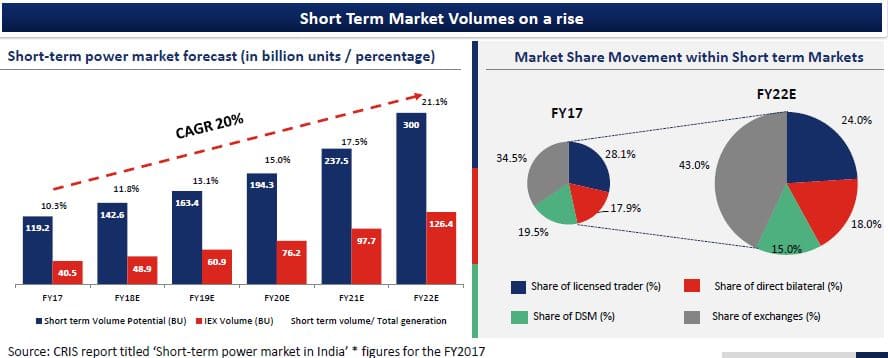
Exchanges: Emerging alternativeNevertheless, exchanges are gaining their share of short-term power trade market. In India, since 2010-17, the short-term power volumes have almost doubled from 66 billion units to about 119 billion units. Interestingly, in this period, the exchange business or volumes have moved up 6 times to 41 billion units or 34.5 percent of the total short-term power volumes traded. In future also, while IEX does not see huge scope for improvement in the realisations, the volume growth will continue to grow at a decent pace as a result of the expansion of client base in new geographies, gaining market share, improving infrastructure and growth in the generation.
Today, one big hindrance is T&D infrastructure. It is observed that buyers and sellers are not able to match the terms because of the lack of transmission line that could connect the buyer or the seller. With the government speeding T&D network in the country the rejections will reduce and more and more buyers and sellers will get hooked to the exchange, thereby driving volumes further.
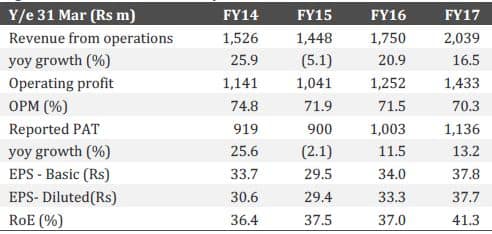
At an upper band of issue price at Rs 1645-1650, IEX will have a market capitalisation of close to Rs 5000 crore, which is about 34 times our estimated earnings in FY19. Over the last three years, the company has seen its earnings grow at close to 8 percent. However, factoring in lower technology costs (acquired technology rights in May 2017 for Rs 130 crore) we have estimated earnings growth at a little higher rate (12-14 percent) in the coming years.
Compared with the other two listed exchanges namely Bombay Stock Exchange and MCX that are trading at 22-24x estimated earnings of FY19, IEX looks expensive. Even if one factors the higher return on equity (42 percent) reported by IEX, the issue is priced to perfection and investors should not have very high return expectations in the near-term.
However, what is interesting is the low balance-sheet risk given the low capex requirement and huge cash in the books. Apparently, the biggest risk is the free cash that it generates from the business because it is difficult to redeploy the same in the business at such high RoE. This would compel the company to return the cash to shareholders as dividend. Hence, this company is ideal for risk-averse long-term investors, who want steady cash flow of a debt instrument but do not want to invest in debt and at the same time fear taking excessive risks of investing in equity.
For more research articles, visit our Moneycontrol Research Page.
Discover the latest Business News, Sensex, and Nifty updates. Obtain Personal Finance insights, tax queries, and expert opinions on Moneycontrol or download the Moneycontrol App to stay updated!
Find the best of Al News in one place, specially curated for you every weekend.
Stay on top of the latest tech trends and biggest startup news.