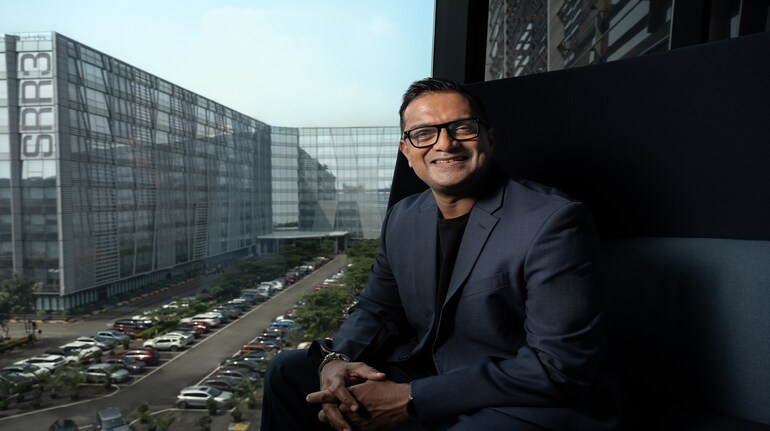

US-based chipmaker Intel believes India’s AI journey cannot simply replicate Western models, arguing that the country needs AI that is scalable, frugal and accessible across devices and sectors.
In an interaction with Moneycontrol, Santhosh Viswanathan, Vice President and Managing Director for the India Region at Intel Corporation said that the company’s strategy is focused on building technology that works not just in hyperscale data centres but also at the edge — from classrooms to small businesses — making AI compute pervasive rather than concentrated.
Pointing to Intel’s partnership with Tata in semiconductor manufacturing and affordable AI PCs, Santosh said the bigger opportunity lies in expanding India’s computing footprint, where household PC penetration is still under 10 percent. As the government pushes to expand GPU and data centre infrastructure, he emphasised that the real challenge is ensuring distributed, accessible infrastructure across the country — positioning AI PCs and locally run AI models as the next default layer of India’s digital ecosystem.
Edited excerpts —
Q: You’ve said that the Western AI model may not work for India. What do you mean by that?
For AI — the same model that is applied in the West — will not work for a market like India. India needs a model that is scalable, that is frugal, that is everywhere.
Intel’s strategy is to make that happen by building key technologies that not just work great for data centres, but also work great at the edge, great in your hands, in classrooms — great everywhere.
Q: Tata recently signed up Intel as one of its first customers. Can you shed some light on that partnership?
Our partnership with Tata is on two fronts. One is: how do we support semiconductor manufacturing that India has? That’s one area we are supporting with them.
The second is: how do we start building electronic devices that are more meaningful? The affordable AI PC is one of the key areas where we have begun that journey. We are very excited about the possibilities and what we can unfold.
Q: Last time we spoke, you said high-end GPUs are not required for many AI applications. Are you seeing more real-world applications now powered by Intel?
For any AI application, you need the right blend between GPU, CPU, and even NPU when you have it on the AI PC. It’s a breadth of technologies applied in the right combination so that it’s frugal and affordable.
If you look at Xeon, which is our server CPU, it’s powering a number of smaller models. It supports multiple agents running on devices and supports concurrent users at low latencies.
You have an infrastructure that enabled UPI and the digital revolution in India — that same infrastructure can enable the AI revolution India is going to drive.
Q: How is Intel supporting Indian startups, enterprises, and MSMEs in their AI journey?
A couple of ways. For example, we took education as a key vector. We believe AI can change the way education in India is shaped.
We are working with education startups to optimise solutions on platforms like vPro so that it becomes a two-way and not a one-way education mode.
More importantly, we support them on go-to-market — ensuring reach, connecting them with ecosystem partners. Intel touches a broad ecosystem, and we help take that to market.
So we partner not just on technology, but also on business growth.
Q: On AI PCs — is adoption picking up, or are enterprises still evaluating?
When you buy a PC, customers don’t check if there’s Wi-Fi in it. That’s what AI PCs are going to be. Running agents and AI models locally will be default. In six months, we won’t even have this question.
Q: India is a major R&D hub for Intel. Will we see more investment in talent and innovation here?
We’ve been in India for about 25 years as an R&D centre, and 37 years in the market overall. Even before the term GCC existed, we were effectively a GCC.
We’ve consistently invested in building capability, and that journey continues. As talent and capabilities grow, we will continue to expand.
Q: How do you see the laptop and AI PC market in India? Is it contracting or reviving?
There are two parts. The phone has built the communication and payment engine of the country. That ecosystem has thrived.
But the PC is the most productive device across education, healthcare, and small businesses — and India lags here.
PC penetration per household in India is less than 10 percent. In the US, it’s 95 percent. In China, it’s over 60 percent.
We cannot leave a device like that out. It must be integral to education and business. That’s a growth opportunity for us.
Q: The government plans to order 20,000 more GPUs. Will Intel be part of that?
The government’s step to build GPU infrastructure and make it accessible to startups is fabulous — that’s step one.
Step two is scalable data centres everywhere, so when we produce 20 percent of the world’s data, we don’t have just 2 percent of the world’s server infrastructure. The tax benefits announced are foundational.
Step three is infrastructure everywhere — because agents run on infrastructure. AI-first classrooms and modern education systems are key.
The real question isn’t just about large data centres and GPUs. It’s about making infrastructure pervasive and frugal.
Q: The global industry is facing memory chip shortages due to AI buildouts. How should India respond, especially when countries like the US and China are prioritised?
I can’t speak for memory players, but for us, it’s not about prioritising one customer over another. All customers are important.
We’re working on building new products, increasing capacity, and optimising the supply chain.
The journey will be tighter because everyone realises this infrastructure is critical. India needs tighter partnerships, more collaboration, and products that work for us. That will help us in the long run.



Discover the latest Business News, Sensex, and Nifty updates. Obtain Personal Finance insights, tax queries, and expert opinions on Moneycontrol or download the Moneycontrol App to stay updated!
Find the best of Al News in one place, specially curated for you every weekend.
Stay on top of the latest tech trends and biggest startup news.