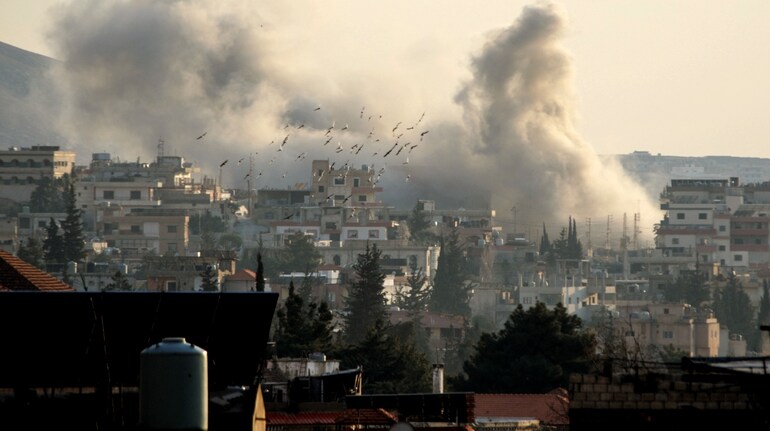

West Asian countries caught in the middle of the current US-Israel and Iran conflict have significantly increased spending on imported weapons over the past two decades, reflecting rising security concerns across the region.
Data on global arms transfers from the Stockholm International Peace Research Institute (SIPRI) shows that West Asia’s share in global arms imports (excluding Israel and Iran) rose sharply from 8 percent in 2007-2012 to 19.2 percent in 2013–2018, and further to 21.1 percent in 2019-2024, underscoring the region’s growing militarisation amid recurring conflicts and strategic rivalries.
Aircraft and missiles dominate imports
Aircraft remain the single largest category of weapons imports in West Asia. Their share stood at 58 percent in 2007-2012, declined to 41 percent in 2013-2018, and then rose again to 51 percent in 2019-2024, reflecting large procurement programmes by Gulf countries.
Missile systems have also steadily gained importance. Their share rose from 15 percent in 2007-2012 to 19 percent in 2013-2018 and 20 percent in 2019-2024, indicating increasing focus on precision-strike capabilities and air defence networks.
Naval capabilities are becoming more prominent as well. The share of ships in West Asia’s arms imports increased from 1.2 percent to 10 percent over the same period, highlighting growing investment in maritime security along critical shipping corridors.
By contrast, the share of air-defence systems fell sharply to 2.6 percent in 2019–2024 after peaking at 13 percent in the previous period, suggesting that several countries had already completed large procurement cycles earlier in the decade.
UAE and Saudi Arabia reshaping procurement
Among individual countries, the United Arab Emirates has significantly shifted its procurement profile. Missiles accounted for 46 percent of its imports in 2019-2024, up sharply from 19 percent in 2007-2012, while the share of aircraft dropped from 60 percent to 14 percent over the same period.
Saudi Arabia, one of the world’s largest defence importers, continues to prioritise aircraft purchases. Aircraft accounted for 53 percent of its imports in 2019-2024, while missile imports increased to 18 percent.
US remains dominant supplier
The US remains the dominant supplier of arms to the Gulf region. Its share of weapons imports stood at 44 percent for the UAE, 74 percent for Saudi Arabia, 45 percent for Qatar, and 64 percent for Kuwait during 2019–2024.
Other suppliers, such as Russia, China, and Turkey, maintain smaller but growing roles in certain markets, reflecting diversification in defence partnerships.
Turkey’s presence has expanded particularly rapidly in some countries. Its share in Oman’s imports rose from 1.6 percent in 2013–2018 to 85 percent in 2019–2024, while in the UAE, Turkish arms accounted for 9.5 percent of imports in 2019–2024, compared with just 0.7 percent in 2007–2012.
The long-term data highlights how persistent geopolitical tensions and strategic competition have steadily increased military spending across West Asia, making the region one of the world’s fastest-growing arms markets.
Discover the latest Business News, Sensex, and Nifty updates. Obtain Personal Finance insights, tax queries, and expert opinions on Moneycontrol or download the Moneycontrol App to stay updated!
Find the best of Al News in one place, specially curated for you every weekend.
Stay on top of the latest tech trends and biggest startup news.