

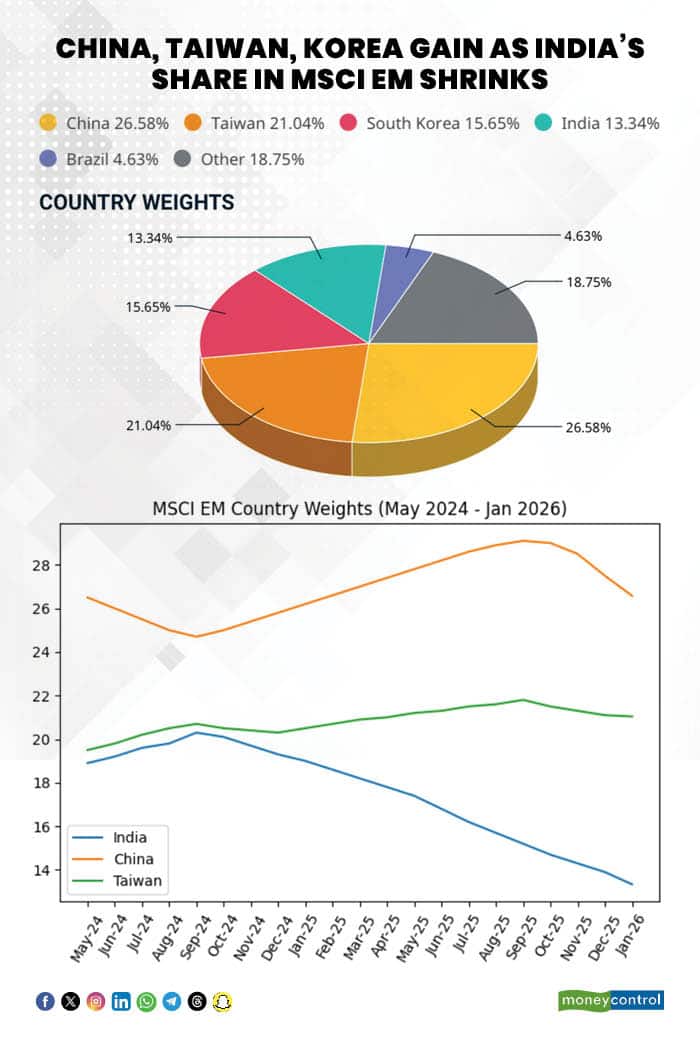
India’s weight in the MSCI Emerging Markets Index has slipped to fourth place from its earlier second rank over the past year, as investor flows shifted toward AI and semiconductor-driven firms in China, Taiwan and South Korea, reducing India’s share within the benchmark.
After peaking at close to 21 percent around September 2024, India’s weight fell to below 14 percent by January 2026. In 2020, the country’s weight in the MSCI EM Index was about 9 percent.
China currently holds the largest weight in the index at 26.58 percent, followed by Taiwan at 21.04 percent and South Korea at 15.65 percent.
Sahil Kapoor of DSP Mutual Fund said the reduction has been largely concentrated in BFSI, IT, FMCG and other large-cap sectors, which carried significant weights in passive foreign indices. He noted that a portion of discretionary foreign portfolios also pursued a short Indian IT and long Korea or China technology trade.
Market participants attribute the decline in India’s weight to both cyclical and structural factors. On the cyclical side, China’s late-2024 stimulus triggered a sharp rally that diluted India’s share, while earnings disappointments, slower growth, foreign institutional investor outflows and rupee depreciation reduced India’s market capitalisation in dollar terms.
Structurally, Taiwan and South Korea gained from AI-driven demand led by companies such as TSMC, Samsung and SK Hynix, which expanded globally in scale and reach. In contrast, Indian equity benchmarks remain dominated by financials, consumer staples and IT services companies rather than AI hardware or platform firms.
Experts say the risk of a further decline is real but not inevitable. Akshay Chinchalkar, Managing Partner and Head of Markets Strategy at The Wealth Company, said cyclical headwinds can reverse and many global funds remain overweight India by conviction. However, he noted that without domestically listed AI or semiconductor plays, India may find it difficult to keep pace if AI continues reshaping global market capitalisations.
Indian markets have seen volatility since the start of 2024, with benchmark Sensex and Nifty gaining 4.6 percent and 7.6 percent respectively in dollar terms. Over the same period, China’s Shanghai Composite rose 46 percent, Taiwan’s market gained 96 percent and South Korea’s Kospi advanced 116 percent in dollar terms.
Ajay Garg, Director and CEO at SMC Global Securities, said JP Morgan’s inclusion of Indian government bonds in its EM bond index creates a separate debt flow channel that supports rupee stability. He added that geopolitical risk in the Taiwan Strait could trigger a reallocation into India as a large and liquid alternative within emerging markets.
Discover the latest Business News, Sensex, and Nifty updates. Obtain Personal Finance insights, tax queries, and expert opinions on Moneycontrol or download the Moneycontrol App to stay updated!
Find the best of Al News in one place, specially curated for you every weekend.
Stay on top of the latest tech trends and biggest startup news.