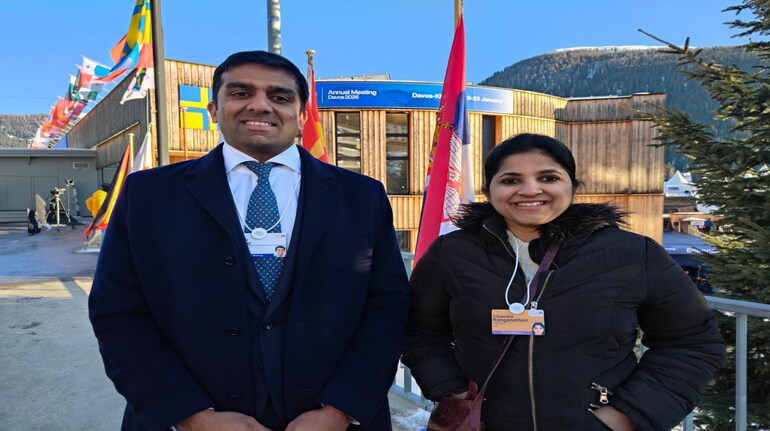
The mood at this year’s World Economic Forum meeting in Davos is unusually sombre and tense, with European business leaders angry over geopolitical developments and investors turning risk-averse amid global uncertainty, Parth Jindal, Managing Director at JSW Paints and JSW Cement, told Moneycontrol.
Speaking on the sidelines of the annual summit, Jindal said conversations at Davos have been overtaken by geopolitics, fears around capital flows and anxiety over the direction of global markets.
“The mood in Davos is definitely very sombre,” Jindal said. “I have never actually seen the Europeans so angry before — this is the first time I’m seeing them unified and angry.”
He said tensions across the Atlantic and anticipation around US President Donald Trump’s address had heightened nervousness among delegates. “Everyone is very anticipative of President Trump’s address tomorrow. I think there are going to be some fireworks in store,” he said.
Capital fleeing risk, investors turn defensive
Jindal said the geopolitical backdrop is already reflecting in investor behaviour, with money moving rapidly into safe-haven assets and away from emerging markets.
“Look at what’s happening with metals and precious metals — prices are skyrocketing. It shows investors are flocking towards safer assets,” he said.
For Indian companies, the biggest immediate concern is the sharp reversal in foreign capital flows, he added.
“The big concern for us is mainly on FDI and FPI flows, which have kind of dried up into India. A lot of money is actually leaving India, and you can see that in the rupee depreciating,” Jindal said.
The rupee’s recent weakness, he warned, could directly hurt import-dependent sectors by raising input costs. “When the rupee goes to 91, whatever you import becomes more expensive, and that is a risk that I see,” he said.
Domestic economy remains resilient
Despite global turbulence, Jindal said JSW Group’s diversified portfolio remains largely insulated as most of its businesses are domestically oriented.
“Whether it’s steel, power, cement, paint or cars, everything is largely domestic and the domestic economy continues to be very robust,” he said, noting that only about 20 percent of steel production is exported.
He added that easing geopolitical tensions could quickly revive risk appetite and bring foreign capital back to India.
“If geopolitics eases and things stabilise, you’ll start seeing foreign investors take more risk and come into high-yield countries like India, which would help the Indian economy a lot,” Jindal said.
‘Spirit of dialogue’ under pressure
Jindal said the intensity of political divisions at this year’s forum stands in sharp contrast to the World Economic Forum’s traditional emphasis on cooperation and consensus.
“When you look at the title of Davos, the spirit is dialogue,” he said. “That is honestly what is required today.”
But with wars, trade tensions and election politics dominating boardroom discussions, he said business leaders are struggling to look beyond near-term risks.
As one of India’s largest conglomerates with exposure across steel, cement, power, paints and automobiles, Jindal said navigating volatile capital flows and currency movements would remain a key challenge in the months ahead.

Discover the latest Business News, Sensex, and Nifty updates. Obtain Personal Finance insights, tax queries, and expert opinions on Moneycontrol or download the Moneycontrol App to stay updated!
Find the best of Al News in one place, specially curated for you every weekend.
Stay on top of the latest tech trends and biggest startup news.