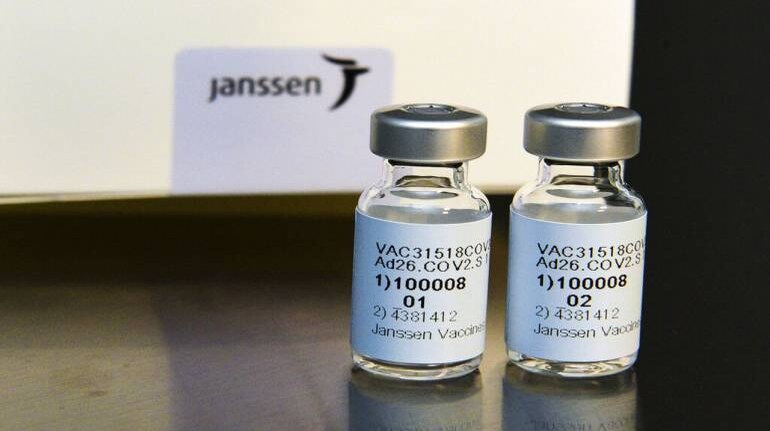
Johnson & Johnson (J&J) said it was engaged in discussions with the Indian government to launch its single-dose COVID-19 vaccine and the reports about the company withdrawing its proposal for speedy vaccine approval in India is untrue.
J&J also said that there was no link between indemnity and the withdrawal of its application for bridging study.
"Johnson & Johnson remains committed to bringing its single-dose COVID-19 vaccine to the people of India. Since the Drugs Controller General of India (DCGI) recently directed that there is no longer a requirement to conduct bridging clinical studies of COVID-19 vaccines in India, Johnson & Johnson withdrew its application to conduct these studies," J&J said in a statement.
"We look forward to ongoing discussions with the Government of India and will continue to explore how to accelerate availability of the Johnson & Johnson COVID-19 vaccine in India,” J&J statement added.
In order to speed up access to COVID-19 vaccines, DCGI earlier said that COVID-19 vaccines approved for restricted use by USFDA, EMA, UK MHRA, PMDA Japan or which were listed in WHO Emergency Use Listing (EUL) and which were well established vaccines from the standpoint that millions of individuals had already been vaccinated with the said vaccines, the requirement of conducting post approval bridging clinical trials and the requirement of testing of every batch of the vaccine by the Central Drugs Laboratory (CDL), Kasauli was exempted.
J&J's vaccine was approved by USFDA, EMA and UK MHRA for emergency use, and was listed by WHO. The US drug maker has also tied-up with Hyderabad-based vaccine maker Biological E to manufacture the vaccine.
Recently Moderna's COVID-19 vaccine was approved by DCGI in June.
What is holding up approval?J&J declined to comment on what is holding up talks for the launch of the vaccine in India.
Moneycontrol reported here that the Indian government was in talks with pharma majors such as Pfizer, Moderna and Johnson & Johnson (J&J) to iron out legal issues around indemnity, to enable India to import COVID-19 vaccines through the UN-backed COVAX inoculation programme and US bilateral donations.
Pfizer, Moderna and Johnson & Johnson (J&J) are insisting on indemnity, or legal protection against any product liability claims, as the vaccines are approved for emergency use in record time due to pandemic situation, and there could be unexpected serious adverse events (SAEs).
Indemnity has emerged as a sticky issue for India to get its share of COVID-19 vaccines from COVAX and US government bilateral donations. US companies such as Pfizer, Moderna and Johnson & Johnson are insisting on indemnity to supply vaccines to India.

Discover the latest Business News, Sensex, and Nifty updates. Obtain Personal Finance insights, tax queries, and expert opinions on Moneycontrol or download the Moneycontrol App to stay updated!
Find the best of Al News in one place, specially curated for you every weekend.
Stay on top of the latest tech trends and biggest startup news.