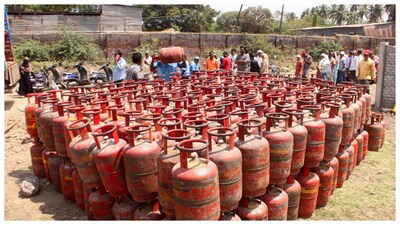
LPG Cylinder Rates Today (March 16): Energy supplies set to improve as Indian tankers Shivalik, Nanda Devi cross Strait of Hormuz; check city-wise rates
In its daily situation update, authorities said oil marketing companies have not reported any supply shortages at petrol pumps or LPG distributorships

Oil market set for tumultuous week as Kharg attack raises stakes
Crude benchmark Brent rallied 11% last week, hitting a high of $119.50 a barrel — back toward levels seen after Russia’s invasion of Ukraine — before closing just above $103.
Prolonged Iran conflict to keep commodity markets on edge ahead of FOMC, China data
Looking ahead, markets will focus on the upcoming policy decision from the Federal Reserve, where rates are widely expected to remain unchanged but updated economic projections will be closely watched.
Geopolitical tensions rise, but why aren’t gold prices?
A combination of stronger dollar and higher inflationary environment in turn leading to probable rise in interest rates by the US Federal Reserve are hindrances for gold prices moving higher, despite the geo-political risk arising out of the war.
Gold set for second weekly loss on reduced rate cut bets, higher dollar, yields
Spot gold was up 0.2% at $5,087.61 per ounce, as of 0927 GMT, but was set for a 1.7% weekly drop. U.S. gold futures for April delivery fell 0.16% to $5,092.60
Partial flight resumptions restore some gold flows from key hub Dubai
Deliveries of physical gold to and from Dubai - a major hub supplying Switzerland, Hong Kong and India - have been affected since the start of the US–Israeli war on Iran on February 28
Gas crisis: Why India was taken by surprise
The West Asia conflict has disrupted nearly 30% of India’s total gas supply, prompting the government to implement a priority allocation framework
LPG cylinder rate today March 12: Amid supply concerns, PM Modi assures fuel availability; check city-wise LPG prices
LPG cylinder price today on March 12: To manage the situation, the Ministry of Home Affairs has established a round-the-clock control room staffed by nodal officers from the ministries of information and broadcasting, as well as petroleum and natural gas.
The Iran War and the return of strategic commodities
The war with Iran is accelerating a global shift towards strategic stockpiling of oil, metals and minerals, turning commodities into instruments of national power
Oil blows past $100 despite record reserve release as traders bet the shock isn’t over
Oil prices surge past $100 despite record global reserve release as traders worry about supply disruptions through the Strait of Hormuz.
India re-routes crude through Saudi, UAE pipelines to bypass Hormuz but supply gap persists
Aramco’s East-West pipeline can transport 5 million barrels per day to the Yanbu port on the Red Sea, while Abu Dhabi National Oil Company’s Fujairah pipeline is funnelling 1.5 mbpd directly to the Gulf of Oman
LPG price today, March 11: Restaurants hit panic button as Iran war deepens energy crisis across India - Check city-wise LPG cylinder rates today
LPG Rates Today: Industry representatives say the hospitality sector has been among the hardest hit by the sudden LPG supply restrictions.
IEA proposes largest-ever oil stockpile release: Report
The proposed release, circulated during an emergency meeting of energy officials on Tuesday, would exceed the 182 million barrels that member countries released in two tranches in 2022, after Russia invaded Ukraine.
Gold steadies as traders digest uncertainty over Middle East war
For gold, the spike in energy prices has increased concerns over inflation, in turn reducing expectations that the Federal Reserve and other central banks will cut interest rates.
Global LNG hunt intensifies as Middle East conflict cuts supply
The situation is diminishing the odds that a long-awaited LNG supply glut will materialize this year.
Oil drops on reserve release report, stocks gain
The release would exceed the 182 million barrels of oil that IEA member countries put onto the market in two releases in 2022 when Russia launched its full-scale invasion of Ukraine
Oil sinks 11% as Trump predicts Middle East de-escalation
Brent futures were down $10.45, or 10.6%, at $88.51 a barrel by 1504 GMT (11:04 a.m. EDT), while U.S. West Texas Intermediate (WTI) crude was down $10.61, or 11.2%, at $84.16
LPG gas cylinder rate today (March 10): As West Asia war escalates, LPG shortage fears grow in India - Check city-wise rates
Commercial LPG, widely used in hotels, restaurants and eateries, has seen a sharp increase, while domestic cooking gas prices have also gone up.
'Downright panic': Traders tested to limits on oil’s wild Monday
Benchmark contracts for oil — the world’s most traded commodity — surged as much as 29% on Monday following a weekend of unrelentingly negative news from the deepening crisis in the Middle East.
India invokes Essential Commodities Act to ensure LPG supply as West Asia crisis worsens
To manage the impact of LNG supply disruptions, oil refining companies have been asked to absorb part of the strain by reducing gas allocation to refineries to around 65% of their past six-month consumption, depending on operational feasibility
Gold rises after Trump signals Iran conflict may be nearing end
Bullion rose as much as 0.9% to top $5,180 an ounce, wiping out a decline in the previous session.
Oil's sudden shock: How a diplomatic standoff turned into a global supply crisis
Any renewed geopolitical escalation or prolonged disruption to tanker traffic could keep prices elevated, while sustained high oil prices also risk fuelling inflation and increasing diplomatic pressure to restore stability.
Oil prices plunge from $119 to $86 after Trump says Iran war nearly complete
After jumping overnight, U.S. crude briefly touched levels near $119 per barrel before reversing course.
Gold slips on stronger dollar, higher rate expectations
Spot gold was down 1.7% at $5,080.99 per ounce at 11:10 a.m. ET (1510 GMT). U.S. gold futures for April delivery were down 1.3% at $5,089.80
G-7 ready to release oil stockpiles if needed to help supply
Brent oil futures surged as much as 29% at one stage on Monday before sharply paring their gains when it emerged that the G-7 would discuss a possible stockpile release