






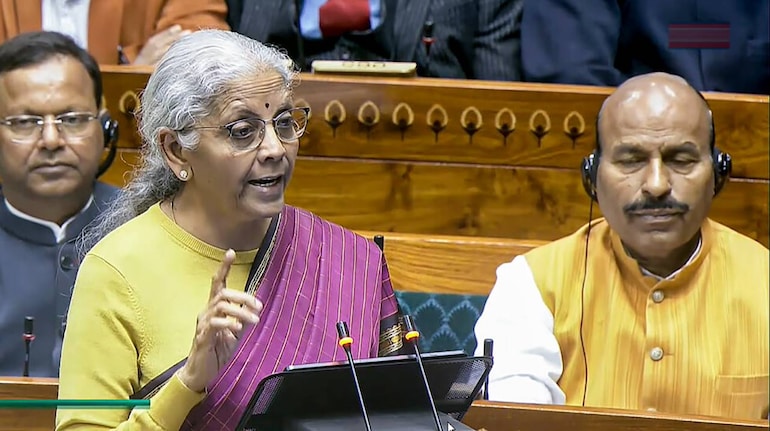
Union finance minister Nirmala Sitharaman said the central banks around the world are responsible for the surge in gold price. “Gold price spike because central banks globally buying a lot of it,” Sitharaman said at press briefing after addressing the RBI Central Board on February 23.
Gold prices continued their upward climb, buoyed by escalating geopolitical tensions and renewed global tariff threats from US President Donald Trump. On the Multi Commodity Exchange (MCX), gold opened the February 23 session at Rs 160,049 per 10 grams for 24-carat purity, marking a 2.02% jump from the previous close.
In international markets, bullion maintained its strength, with gold trading at $5,182 per ounce on Comex during morning deals — up 2% over the past 24 hours.
Silver ETFs jump over 6%, gold ETFs gain 2% as Trump tariff ruling, softer dollar lift bullion
Domestic benchmarks reflected a similar trend. The Indian Bullion Jewellers Association (IBJA) quoted standard gold (999 purity) at Rs 155,066 per 10 grams, up 0.33% from the previous session. These IBJA rates serve as the reference price for the Reserve Bank of India’s Sovereign Gold Bonds (SGBs), which are valued based on the average closing price of the preceding week.
Sitharaman said the Centre is keeping a close watch on gold prices, observing that the metal typically witnesses seasonal upticks during festive demand but has not breached “certain limits.”
“Gold has traditionally been a household investment and often sees seasonal spikes around festivals. We are monitoring the trend, but prices have not gone beyond a particular threshold,” she said at a press briefing.
Sitharaman attributed the sharp global price movements to official-sector demand rather than purely consumer behaviour. “Most countries today, particularly their central banks, are buying gold and silver and storing them. International price of gold or silver, which used to be because of China and India being large consumers of gold, now the spike is largely due to central banks also buying and storing,” she said.
She also underlined that the recent rally differs from historical price cycles. “Increase in gold and silver prices, which are much beyond the usual increases and fluctuations which happen in the gold and silver market,” the Finance Minister said, adding that higher international prices inevitably affect import-dependent markets such as India.
“So, my observation to bring in the central bank is for saying as to why globally it is shooting up,” Sitharaman said.
Separately, RBI Governor Sanjay Malhotra said that while gold prices have risen, the overall value of gold import orders has not increased in recent months.
Malhotra noted that import dynamics have so far cushioned the impact of rising prices on India’s external balances. “If you look at numbers from April to December, the quantity of gold — in value terms there was hardly any increase. Whatever was the increase in prices was offset more or less by the decrease in the volumes of imported gold,” he said.
The Governor added that a deviation was visible only in the latest month. “It is only in January -- we are still analysing those numbers -- that there has been a sudden spurt in value as well as in volume,” Malhotra said, emphasising that gold demand patterns remain subject to fluctuation and seasonality.
Despite the recent uptick, the RBI signalled comfort on macroeconomic risks. “We are not unduly concerned about that, especially because our external sector continues to be very robust and strong. The current account deficit is still very, very manageable as per our projections. We have sufficient reserves. So, external side is very strong,” the Governor said.
IDBI Bank
On IDBI Bank, Sitharaman clarified that there was “no systemic issue,” reiterating that the government, as a matter of policy, does not comment on specific companies. She added that liquidity conditions remain comfortable.
Credit growth
“The Reserve Bank of India has adequate liquidity. Credit availability is assured for up to five years. We will meet whatever requirements the country has,” she said.
Capital Outflows
Moreover, the minister said global and political reasons might be behind the lack of funds flowing into India.
"Global capital flow is based on macroeconomic stability, predictability for businesses, expect flow of funds to move to such an economy. Expect funds to flow to India, but it doesn't happen in that sense. Wonder what other reasons, not economic and commercial reasons, but maybe Global and political reasons guiding funds flows. We will have to see what's holding them back," Sitharaman said.

Discover the latest Business News, Sensex, and Nifty updates. Obtain Personal Finance insights, tax queries, and expert opinions on Moneycontrol or download the Moneycontrol App to stay updated!
Find the best of Al News in one place, specially curated for you every weekend.
Stay on top of the latest tech trends and biggest startup news.




