With the Centre’s renewed thrust on defence indigenisation after Operation Sindoor, shipbuilding PSU Cochin Shipyard Limited (CSL) has emerged as a key player in strengthening India’s maritime capabilities. The company is working on several major naval projects while deepening global partnerships and advancing into new technologies such as autonomous and green vessels. In an interview to Moneycontrol, CSL Chairman & Managing Director (CMD) Madhu S Nair spoke about ongoing defence projects, global collaborations and readiness to build the next aircraft carrier for the country. Excerpts:
Cochin Shipyard has been targeting several big-ticket defence projects, including the next-gen fast patrol vessels and survey vessels, along with some smaller projects in the RFP stage. Could you give us an update on the progress of these projects and what timelines the shipyard expects for their execution?
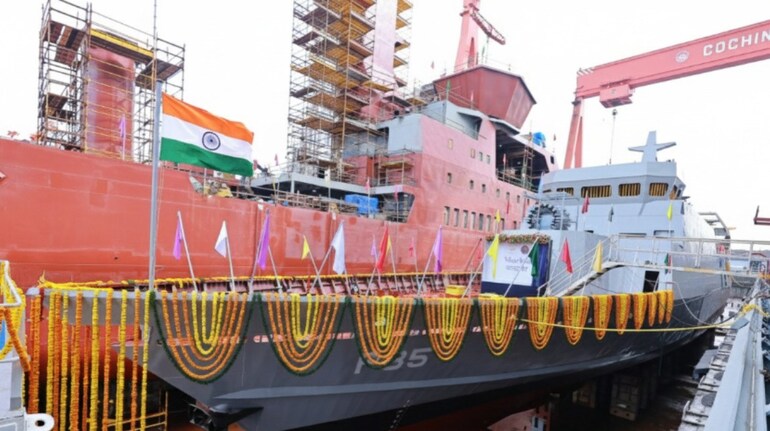
We are currently executing two naval projects on the shipbuilding side — the eight-vessel Anti-Submarine Warfare Shallow Water Craft (ASW-SWC) corvettes and the six-vessel next-generation missile vessels. The ASW-SWC vessels are in advanced stages. The first vessel should be delivered to the Navy as early as next week. In fact, we launched the sixth vessel of the ASW series (Magdala) today. The first vessel, which was launched earlier, will be delivered to the Navy within the next 10 days or so and is expected to be commissioned in November.
The Next Generation Missile Vessels (NGMV) project is in advanced stages of design, engineering and equipment procurement. We expect to move into the fabrication stage shortly. That project will take some more time to build up.
CSL shares recently surged to 52-week highs post-Operation Sindoor due to the sector’s push for domestic naval production and your company’s strong track record. Could you tell us about the role Cochin Shipyard has played since Operation Sindoor in boosting India’s naval capabilities? Has anything new been initiated following the Centre’s focus on the Indian Navy?
As I mentioned, these two projects are our key contributions. While I wouldn’t say it is directly connected with Operation Sindoor, it so happens that the ASW vessel series — which we’ve been working on for some time — is now progressing rapidly. We faced challenges earlier, but they’ve been overcome.
The first vessel will be delivered very shortly. With all the learnings factored in, the subsequent vessels will be completed much faster. In terms of India’s naval capability, the ASW vessels — 8 in total — will roll out quickly as we move forward. That’s one major role we are playing. The NGMV vessels are also entering the construction phase. So, I wouldn’t say we are doing anything drastically different, but our ASW-SWC vessels are coming on stream at just the right time.
And we are trying to fast-track these things?
Yes.
CSL also signed a contract with the US Navy last year for ship repair and maintenance. Could you elaborate on the scope and business potential from this agreement? Are there more contracts from foreign navies in the offing?
This is a Master Ship Repair Agreement (MSRA), an over-arching five-year agreement with the US Navy. However, within this agreement, we haven’t yet executed specific refit contracts. These cover refits of US naval assets in the region.
We’ve been in discussions but haven’t concluded any contracts yet — mainly because we wanted to ensure the first project we handle is executed flawlessly. The MSRA remains valid, and we expect to secure the first contracts soon. That said, the decision on vessel deployment lies entirely with the US Navy.
Last year, CSL also signed a contract with the Defence Ministry for the short refit docking of INS Vikramaditya. This was the first time a major refit of Vikramaditya was undertaken by an Indian shipyard. What does this mean for the Centre’s push for Atmanirbhar Bharat in defence? And does India now have the domestic capabilities in MRO and carrier maintenance?
Cochin Shipyard is the only shipyard in India that has handled aircraft carrier refits for over 30 years now. This includes INS Viraat, INS Vikramaditya and even the new INS Vikrant. From a carrier refit perspective, we have deep experience and critical infrastructure in place. In terms of MRO for Indian naval assets, Cochin Shipyard can handle practically all platforms of the Indian Navy — except submarines.
We’re also re-engineering the Brahmaputra-class frigates. This ecosystem — comprising CSL, the Navy, defence PSUs and private vendors — demonstrates that India now possesses comprehensive MRO capabilities.
As you mentioned, CSL also has an ongoing contract for six next-generation missile vessels for the Navy, with deliveries expected in 2027. How will these vessels enhance India’s naval strength?
This is a set of six sophisticated missile vessels — agile, fast, and equipped with Indian-made missiles. I can’t share detailed specifications, but they’re complex platforms with significant indigenous content.
With defence spending on the rise globally, how are CSL’s international partnerships helping the company strengthen its shipbuilding and repair capabilities?
CSL’s defence business is currently focused on the Indian Navy. Our partnerships are primarily domestic when it comes to naval shipbuilding and refits. We are among the Navy’s most trusted partners.
Though we are not a defence PSU, our origins in the commercial space, experience with the indigenous aircraft carrier and over 300 naval refit projects make us a strong and reliable partner — thanks to our infrastructure, people and technology.
After building INS Vikrant, is CSL ready to construct another aircraft carrier?
We would be extremely happy and privileged to build the next aircraft carrier. We hope that our experience from Vikrant and over three decades of carrier refit work will be fully leveraged. Cochin Shipyard — along with the engineering and design ecosystem that has evolved in India — is well-prepared for the next challenge. We await the Ministry of Defence’s decision, and we’ll be ready when the opportunity comes.
What role do emerging technologies like artificial intelligence, unmanned platforms and green propulsion play in CSL’s future defence ship designs?
Autonomous and green technologies will play a significant role in the future — both in defence and the commercial space.
Cochin Shipyard has already built autonomous platforms for Norwegian clients, which are operational in Norway. We are now investing in developing a fully indigenous autonomous surface vessel in-house. AI will also have multiple applications across operations, though not one overarching use case.
Green propulsion, like methanol-fueled systems, will feature more prominently in our commercial projects. In fact, one of the vessels we launched today — a CSOV (Commissioning Service Operation Vessel) for a Cyprus-based client — runs on methanol.
Finally, could you tell us about the significance of the anti-submarine shallow water craft that was launched recently?
The ASW-SWC is designed for compact submarine detection and warfare. It is equipped with advanced sensors to detect submarines. Today we launched the sixth vessel in the series, though some work remains before delivery. The first vessel in the class, Mahe, has completed trials and is ready for delivery this month. These are called the Mahe-class vessels.
Discover the latest Business News, Sensex, and Nifty updates. Obtain Personal Finance insights, tax queries, and expert opinions on Moneycontrol or download the Moneycontrol App to stay updated!
Find the best of Al News in one place, specially curated for you every weekend.
Stay on top of the latest tech trends and biggest startup news.