




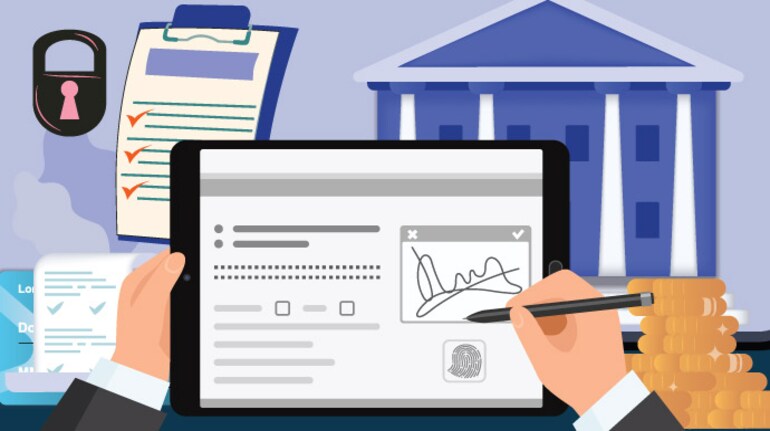
Private lender HDFC Bank issued India’s first electronic bank guarantee (e-BG) on September 4 in partnership with National E-Governance Services Ltd (NeSL).
The e-BGs will be issued on the NeSL portal and the bank said it will migrate to e-BGs to deliver quick, digital and paperless services to all customers.
ICICI Bank issued an e-BG on September 5 on behalf of an Indian client in partnership with NeSL. With e-BGs, there is no need for re-authentication of manual signatures and no physical maintenance of records, making it easy to issue. It also enhances the working capital efficiency of applicants, the bank said.
Also read: Chinese loan apps: ED freezes over Rs 46-crore worth funds in Easebuzz, Razorpay, Paytm, Cashfree accounts
1 What is a bank guarantee?
A bank guarantee typically signifies that the bank ensures that the liabilities of a debtor will be met. If the debtor fails to perform an obligation, the bank will cover it. The bank guarantee enables the debtor to acquire goods and equipment, or draw down a loan.
Businesses typically ask for bank guarantees to counter the risk from cheque defaults. This helps them minimise risks and/or safeguard their investments. The bank, on the other hand, has to provide the necessary deposits or create buffers that can be used to set off the guarantee.
2 Why are banks switching to e-BGs?
An e-BG is a substitute for paper-based guarantees. The electronic version can be processed, stamped, verified and delivered instantly, compared with the time-consuming paper-based process.
Issuing a paper-based bank guarantee typically takes three to five days as the process requires an applicant to physically pick it up from the bank, courier it to the beneficiary, stamping and re-verifying.
An e-BG, on the other hand, eliminates physical issuance and stamping, re-authentication and paper-intensive record maintenance.
To obtain an e-BG, companies or individuals have to go for text-generation of the BG, e-stamping by NeSL, e-signing and hosting of the final e-BG on the NeSL portal. The beneficiary can view the final e-BG on the NeSL portal within minutes of issuance.
“The move saves time and brings efficiency for all the three parties involved in the process–the bank, the applicant and the beneficiary,” said Jaikrishnan G, partner, financial services consulting, at Grant Thornton Bharat. “A process that used to take three-to-five days can now be completed in a single day with enhanced security.”
In a nutshell, an e-BG saves time, eliminates incidents of fraud or manipulation, allows for ease of doing business, and saves costs such as printing, couriering and travelling, added Jaikrishnan.
3 Will e-BGs replace paper guarantees?
Given that the banking sector is going through a technological and digital transformation, experts said that the e-BG has the potential to replace the paper-based process over the coming years. More banks are likely to start offering e-BGs soon, they added.

“Extrapolating on how businesses have undergone a digital transformation, their internal processes, too, will pave the way for e-BGs with time,” said Namita Shah, cofounder of Presolv360, an online dispute resolution firm. “It could replace the majority of the physical bank guarantees.”
Shah said there have been several instances of fake bank guarantees issued that resulted in losses for lenders. Since e-BGs have the potential of eliminating human intervention, several loopholes can now be plugged and probably reduce the extent of bank frauds, she said.
4 Are e-BGs completely secure?
No. Although e-BGs reduce the risk of fraud, they are not completely secure. For one, there could be a compromise on the integrity of data, data privacy and confidentiality, experts said.
“Once all the information is online, there is always a chance that someone might retrieve the information and misuse it,” said Bharat Chugh, an advocate at the Supreme Court of India and a former judge. “The security risk of e-banking also arises from hacking threats and unauthorised access to the bank’s systems.”
Further, if the bank has an outdated system that is not upgradable, it can turn out to be an investment loss for the bank and could also lead to inefficient service, said Chugh. Banks always carry the risk of choosing the wrong system design or technology or have inadequate control processes, he said.
Sonam Chandwani, managing partner at KS Legal & Associates, agreed with Chugh. Chandwani added that there are legal risks associated with e-BGs.
“There is a lot of uncertainty and ambiguity with regard to laws surrounding e-BGs,” she said.
Also read: Nirmala Sitharaman asks private sector to clear MSME dues in 45 days
5 How can the risks be mitigated?
According to experts, banks and NeSL need to be vigilant of the cybersecurity risks involved due to multiple points of vulnerability that arise after an e-BG is issued as these are tri-party transactions.
“Banks should also take up the responsibility of educating and helping customers and beneficiaries in transforming to the new digital process,” said Grant Thornton Bharat’s Jaikrishnan.
Apart from this, various protocols should be adopted to make the process safer, said experts. For instance, attachments should be password-protected.
For greater transparency, a list of guarantees could be published on online trade platforms. Also, automated e-mail triggers can be adopted to ensure safety, added Chugh.

Discover the latest Business News, Sensex, and Nifty updates. Obtain Personal Finance insights, tax queries, and expert opinions on Moneycontrol or download the Moneycontrol App to stay updated!
Find the best of Al News in one place, specially curated for you every weekend.
Stay on top of the latest tech trends and biggest startup news.