Moneycontrol PRO
Black Friday Sale
Black Friday Sale
HomeNewsBusinessAs exports rise, container prices increase at major Indian ports

As exports rise, container prices increase at major Indian ports

The average price of a 20-ft dry container in Mundra at the end of May stood at around $1,550 compared to $1,163 in June 2020, while for Nhava Sheva in Navi Mumbai, it was at $1,700 in May against $1,075 in June 2020, market sources told Moneycontrol.

June 09, 2021 / 18:55 IST
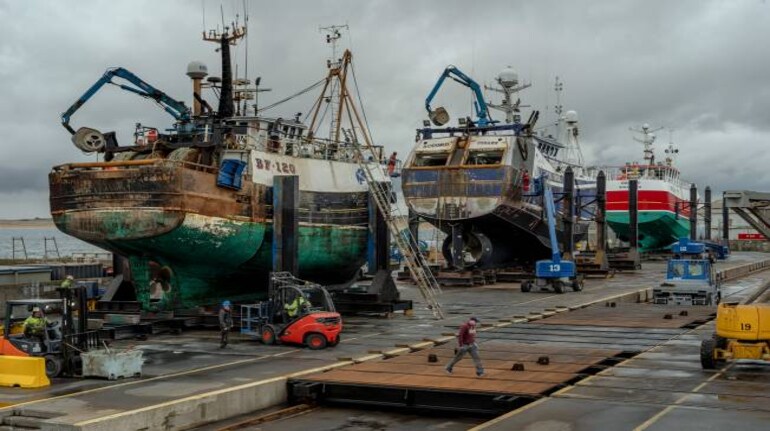
Ships undergoing repair on April 27, 2021, at the port of Fraserburgh, one of the United Kingdom's main ports for Whitefish. Many of Scotland’s fishing areas, like Fraserburgh, voted for Brexit, thinking it would free them from European Union rules. Instead, they lost markets, and many are facing ruin. (Andrew Testa/The New York Times)

As the world economy recovers from COVID-19 disruptions and demand for exports rises, container prices at major ports, such as Chennai, Mundra and Nhava Sheva, remain high.

The average price of a 20-ft dry container at the Chennai port stood around $1,600 (Rs 116,736, at Rs 72.96 to the dollar) at the end of May, compared to around $1,083

(Rs 79,015) in May 2020, multiple shipping companies told Moneycontrol.

The average price of a 20-ft dry container in Mundra at the end of May stood at around $1,550 compared to $1,163 recorded in June 2020, while for Nhava Sheva in Navi Mumbai, it was at $1,700 in May against $1,075 in June 2020, market sources told Moneycontrol.

Trading volumes expected to remain high

India’s exports grew by 67.39 percent to $32.21 billion in May from $19.24 billion in the same month last year, driven by healthy growth in sectors such as engineering, pharmaceuticals, petroleum products, and chemicals, according to government data released on June 2. Exports were at $29.85 billion in May 2019.

COVID-19 Vaccine

Frequently Asked Questions

View more
How does a vaccine work?

A vaccine works by mimicking a natural infection. A vaccine not only induces immune response to protect people from any future COVID-19 infection, but also helps quickly build herd immunity to put an end to the pandemic. Herd immunity occurs when a sufficient percentage of a population becomes immune to a disease, making the spread of disease from person to person unlikely. The good news is that SARS-CoV-2 virus has been fairly stable, which increases the viability of a vaccine.

How many types of vaccines are there?

There are broadly four types of vaccine — one, a vaccine based on the whole virus (this could be either inactivated, or an attenuated [weakened] virus vaccine); two, a non-replicating viral vector vaccine that uses a benign virus as vector that carries the antigen of SARS-CoV; three, nucleic-acid vaccines that have genetic material like DNA and RNA of antigens like spike protein given to a person, helping human cells decode genetic material and produce the vaccine; and four, protein subunit vaccine wherein the recombinant proteins of SARS-COV-2 along with an adjuvant (booster) is given as a vaccine.

What does it take to develop a vaccine of this kind?

Vaccine development is a long, complex process. Unlike drugs that are given to people with a diseased, vaccines are given to healthy people and also vulnerable sections such as children, pregnant women and the elderly. So rigorous tests are compulsory. History says that the fastest time it took to develop a vaccine is five years, but it usually takes double or sometimes triple that time.

View more
Show

“Trading volumes have risen in the past two months, and they are expected to remain high for the next few months as a number of companies look to supply the pent-up demand in other countries,” a Mumbai-based shipping analyst said.

Demand for exports, especially vaccines, medical equipment like masks, personal protective equipment kits, and oxygen concentrators, has risen in the past few months, shipping companies said.

“Many companies are likely to get into bidding wars to extradite their export and import cargo, and this is likely to lead to higher tariffs,” another Mumbai-based shipping analyst said.

Demand for white goods has also picked up in the last few months, companies said.

“As the world economy opens up, especially the US and European markets, people aren’t able to spend on holidays because of the pandemic, and they have built up quite nice disposable incomes, and that has gone into consumer goods,” the second analyst added.

Furthermore, as the world economy reopens in the aftermath of COVID-19, a growing shortage of raw materials is also wreaking havoc on global supply chains, thereby creating pent-up demand, market experts said.

The shortage of computer chips, used in electrical appliances and vehicles, seen in January-March, has now created a pent-up demand in the export market.

This can be seen as Pune-based two-wheeler maker Bajaj Auto Ltd in May reported a 113 percent growth in exports, while white goods makers like Whirlpool have reported around 25-30 percent growth in exports in May.

Yaruqhullah Khan
first published: Jun 9, 2021 06:53 pm

Discover the latest Business News, Sensex, and Nifty updates. Obtain Personal Finance insights, tax queries, and expert opinions on Moneycontrol or download the Moneycontrol App to stay updated!

Subscribe to Tech Newsletters

  • On Saturdays

    Find the best of Al News in one place, specially curated for you every weekend.

  • Daily-Weekdays

    Stay on top of the latest tech trends and biggest startup news.

Advisory Alert: It has come to our attention that certain individuals are representing themselves as affiliates of Moneycontrol and soliciting funds on the false promise of assured returns on their investments. We wish to reiterate that Moneycontrol does not solicit funds from investors and neither does it promise any assured returns. In case you are approached by anyone making such claims, please write to us at grievanceofficer@nw18.com or call on 02268882347