






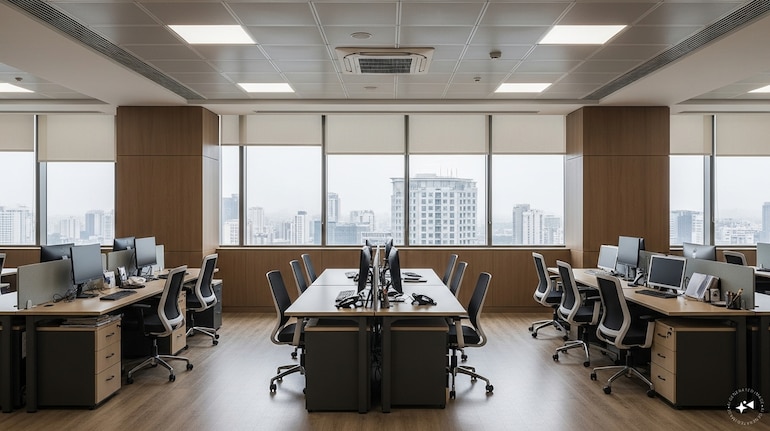

India’s return-to-office conversation has moved beyond mandates. Many organisations are encouraging a greater in-office presence, but the real shift lies elsewhere. The office itself is changing.
Jay Kularia, Executive Director at ANJ Group told Moneycontrol, “It is no longer a seating solution but has become more of a performance platform designed to drive culture, productivity and growth.”
Kularia shared six trends that explain how the future workplace is already taking shape.
Spaces are now being designed to foster creativity and growth through collaboration and interaction. Hence, rows of desks are now being replaced with townhall staircases, project studios, client labs, maker zones and social cores.
Also read | 10 home office design ideas that will make you more efficient
“As back-to-office culture gathers momentum, workspaces must earn the commute with purpose and energy. Real estate spend is moving from capacity to capability, where culture, innovation velocity and employer brand define return on investment,” said Kularia.
Advanced tech is making buildings smart, as they now use AI and sensors for a variety of functions. This includes smart booking tools, occupancy-led layouts, auto-tuned lighting and air-conditioning, real-time indoor air-quality displays, and predictive maintenance dashboards are becoming standard.
Kularia noted, “The workplace is shifting from opinion-led decisions to data-led management, with utilisation, comfort and energy tracked as rigorously as finance or supply chains.”
Future offices are being designed for large global teams that need to move fast. Companies want spaces that are ready quickly, easy to adapt, and built to handle growth without disruption.
"In Q4 2025, global capability centres accounted for 39 per cent of India’s office absorption, with tech and BFSI driving nearly half the activity. This scale of demand puts pressure on speed, quality and consistency. Workplaces are strategic platforms for growth, where talent density and execution certainty matter as much as rent,” Kularia said.
Also read | The power of colour: Boost creativity and productivity in office with the right choice of colours
Flexible and managed offices are now an important part of how companies plan their workspace. Businesses are increasingly using ready-to-move-in flex floors, temporary spaces for growing teams, project-based work areas, and offices that can expand easily.
By 2025, flex offices will make up a significant share of office leasing in India, showing that flexibility is a long-term shift, not a short-term trend. Today, companies plan their office space like a portfolio, keeping permanent headquarters for stability, flexible offices to handle change, and managed spaces to move quickly.
Kularia said, “Low-carbon materials, circular interiors, energy dashboards, water-positive thinking and waste-smart fit-outs are being embedded into workplace design. As occupiers continue their flight to quality, the office is becoming a part of the company’s risk and resilience framework, where energy volatility, reporting requirements and brand trust converge.”
“Focus rooms, recovery pods, calmer acoustics, meaningful biophilia, circadian-supportive lighting and sensory zoning are reshaping how offices function. The workplace is emerging as an operating system for human performance supporting attention, collaboration quality and burnout prevention,” Kularia said.
The workplace of the future is already here. The organisations pulling ahead are treating the office as a performance platform, i.e., data-led, brand-led and built to change. For leaders planning their next workplace move, the way forward is to design for people, build for scale and execute with intent.
Discover the latest Business News, Sensex, and Nifty updates. Obtain Personal Finance insights, tax queries, and expert opinions on Moneycontrol or download the Moneycontrol App to stay updated!
Find the best of Al News in one place, specially curated for you every weekend.
Stay on top of the latest tech trends and biggest startup news.





