






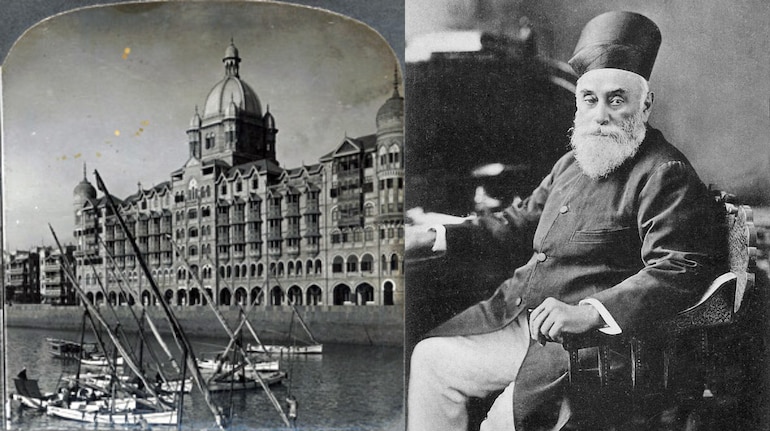

On a warm March morning in 1839, in the quiet town of Navsari, a young boy was born into a modest Parsi family. Few could have imagined that Jamsetji Nusserwanji Tata would one day help sketch the industrial blueprint of a nation that did not yet exist formally as independent. Nearly two centuries later, his shadow still falls across India’s economic landscape. It reveals something deeper about why India repeatedly returns to its industrial pioneers for guidance, reassurance, and inspiration.

Jamsetji Tata, JRD Tata, Dhirubhai Ambani, and the founding families of Birla, Bajaj, Mahindra, Kirloskar, Burman, Murugappa, TVS are reference points in a national conversation about scale, legitimacy and purpose.
The instinct to revisit them intensifies during periods of uncertainty. When markets are volatile, when regulation tightens, when global competition sharpens, India looks back at those who built when the odds were steeper and the ecosystem far less forgiving. What did they understand about building institutions that many modern enterprises still struggle to internalise?
The measure of these giants was never merely the scale of what they built, but the depth of the future they made possible for others. Long after the founders have departed, it is their quiet architecture of trust, courage and institution-building that continues to light the way for India’s next generation of enterprise.
Consider Jamsetji Tata’s early years. In 1868, at the age of 29, he started a trading firm with capital of Rs 21,000. Six years later came Empress Mills in Nagpur. But the real measure of his leadership was not the mill’s output. It was the philosophy embedded into its functioning. Long before labour codes became statutory, Tata introduced the 8-hour workday, provident fund, accident compensation and free medical aid. They were acts of strategic foresight rooted in human dignity.
This combination of commercial clarity and social imagination explains why Tata is still described as the Father of Indian Industry. He built legitimacy for Indian enterprise at a time when colonial structures did little to encourage indigenous industrial ambition. His decision to build the Taj Mahal Hotel in Bombay in 1903 was similarly symbolic. It was not only India’s first luxury hotel, it was also a statement of confidence that Indian enterprise could match global standards even before India had the policy environment of a modern market economy.
If Jamsetji Tata represented institutional patience, Dhirubhai Ambani represented entrepreneurial velocity. Born in 1932 in a modest Gujarati household, the son of a school teacher, Dhirubhai did not inherit an industrial platform. He constructed one. Starting with two assistants and Rs 50,000, he built Reliance into a business phenomenon within three decades. Yet his enduring influence lies less in the balance sheet and more in the psychological shift he triggered.
Dhirubhai democratised aspiration. He spoke directly to small investors, to first generation traders, to ordinary Indians who had never seen themselves as stakeholders in corporate growth. He understood that scale in India would not come only from capital markets or policy access. It would come from public participation. In doing so, he redefined the relationship between Indian enterprise and the Indian middle class.
This is why the debate around such figures, however spirited across generations, rarely diminishes their stature. India recognises complexity. It understands that institution builders often operate in imperfect environments and make decisions under constraints that are easy to critique in hindsight. Yet what endures is their ability to move the national economic frontier forward.
There is another, subtler reason why India keeps returning to these leaders. They built for time horizons that far exceeded their own tenures. JRD Tata expanded aviation, automobiles and scientific research when India’s domestic market was still shallow. The Bajajs nurtured manufacturing depth when import substitution defined policy. The Mahindras and Kirloskars invested in engineering capabilities long before the vocabulary of global supply chains entered Indian boardrooms. They prepared their enterprises for a global future even when India itself was not fully market-ready. That strategic patience is increasingly rare in an era of compressed executive tenures and activist investor pressure.
Equally important was their ability to carry stakeholders along without diluting ambition. Jamsetji Tata embedded worker welfare into industrial growth. JRD Tata institutionalised professional management while preserving group values. Dhirubhai Ambani cultivated retail investors alongside institutional capital. Lupin founder Desh Bandhu Gupta built pharmaceutical credibility through trust in quality and distribution reach. Ramkrishna Dalmia operated in an era of severe capital scarcity yet managed to create industrial scale.
These leaders understood that in India, legitimacy compounds faster than leverage. Enterprises that ignore social context may scale quickly but rarely endure across generations.
For today’s corporate and policy leadership, the lessons are both reassuring and cautionary. Reassuring because India has repeatedly demonstrated its capacity to produce institution builders who think beyond immediate cycles. Cautionary because the current economic moment is arguably more complex than the eras these pioneers navigated. Global capital is more mobile. Technology cycles are shorter. Public scrutiny is more intense. Trust, once lost, erodes faster than ever.
Yet the fundamentals that made these leaders enduring remain strikingly relevant.
First, moral imagination matters. Jamsetji Tata’s labour reforms were not regulatory responses. They were leadership choices. Second, narrative matters. Dhirubhai Ambani understood the power of communicating ambition to ordinary Indians long before investor relations became a formal discipline. Third, institutional continuity matters. The old business houses invested deeply in governance structures that could outlive charismatic founders.
Perhaps most importantly, they balanced national purpose with global aspiration. They built with the confidence that India would eventually integrate more deeply with the world economy. In retrospect, that conviction appears prescient. At the time, it required unusual strategic courage.
Today, as India marks another birth anniversary of Jamsetji Tata, the exercise is not ceremonial remembrance. It is strategic reflection. The country stands once again at an inflection point where scale, trust, innovation and social legitimacy must move in tandem. The temptation in such moments is to chase speed alone. History suggests that endurance belongs to those who combine speed with stewardship.
In boardrooms across the country, the names may change, the sectors may evolve and the capital pools may deepen. But the core question remains constant. Can Indian enterprise grow rapidly without losing the moral and institutional ballast that gives it public legitimacy?
If these early titans were to distill their journeys into counsel for today’s industrial leaders and business families, their advice would likely be both sobering and forward edged.
- Build institutions, not empires of personality, for endurance always outlives charisma.
- Treat trust as core capital, because in India legitimacy compounds faster than leverage.
- Invest ahead of the market’s comfort, since true scale belongs to those who prepare for demand before it becomes visible.
- Professionalise early and empower widely, recognising that generational continuity depends on the strength of systems, not the brilliance of founders.
- And finally, carry society with you as you grow, for enterprises that widen the circle of prosperity earn a permanence that balance sheets alone can never secure.
That is why India keeps going back to them. Not out of reverence alone, but out of continuing relevance.
Disclaimer: Moneycontrol is a part of the Network18 group. Network18 is controlled by Independent Media Trust, of which Reliance Industries is the sole beneficiary.
Discover the latest Business News, Sensex, and Nifty updates. Obtain Personal Finance insights, tax queries, and expert opinions on Moneycontrol or download the Moneycontrol App to stay updated!
Find the best of Al News in one place, specially curated for you every weekend.
Stay on top of the latest tech trends and biggest startup news.





