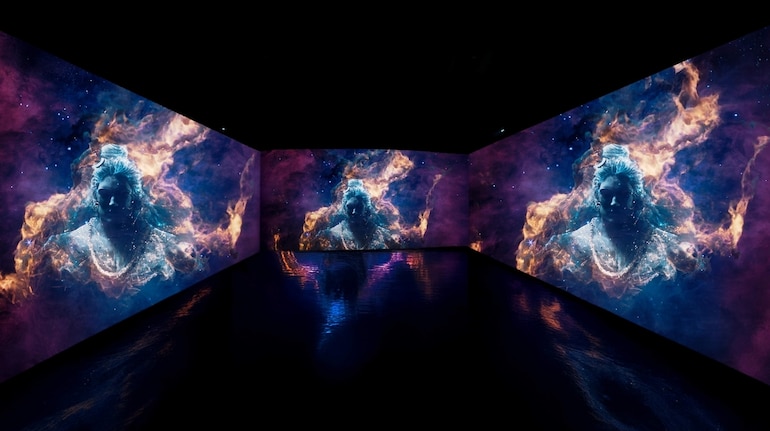

Walk into a new-age exhibition today and you’re no longer just a spectator, you are inside the story. Light moves with you, sound follows your footsteps, the temperature shifts with the mood, and the space itself seems to respond to your presence. At the heart of this shift is the intelligent integration of technology. While technology itself isn’t new, what’s new is how it’s being applied. What’s shifted is the intent and the content – as AI tools are now being used to tell layered, emotionally resonant stories rather than just create spectacle.
Immersive formats are fundamentally changing audience behaviour. Instead of passively consuming content, viewers now inhabit narrative environments. As Samit Garg, Co-Founder and MD of E-Factor Experiences Limited, explains, “Instead of sitting back and watching a screen, audiences are placed inside a narrative environment where light, sound, temperature and spatial movement work together to create a full-body experience. This multi-sensory integration activates multiple neurological pathways at once, making the experience more memorable and emotionally impactful than traditional visual storytelling. Immersive infotainment blurs art, entertainment and storytelling because that’s how modern audiences engage with culture, holistically. People no longer want to simply “watch” mythology, history or art; they want to experience it.” These formats transform stories into lived moments, where meaning is felt rather than explained.
One of the most significant trends shaping 2026 is the boom in touring immersive exhibitions. What makes these shows powerful is their accessibility. They can be staged in warehouses, malls, heritage structures, or pop-up venues. They run multiple shows a day, adapt content linguistically and culturally, and travel seamlessly across borders. For many visitors, these spaces feel less intimidating than traditional museums and far more emotionally engaging.
Shows like Van Gogh Alive, which has toured more than 80 cities worldwide, or TeamLab Borderless in Tokyo prove that immersive formats can attract millions without relying on original artefacts or celebrity performers, informs Garg. He adds, “In the US, Meow Wolf’s Omega Mart has shown that immersive environments can function as permanent, profitable entertainment anchors, competing directly with traditional attractions like Cirque du Soleil. In Europe, venues such as Bassins des Lumières have transformed massive industrial spaces into digital art environments capable of hosting large audiences daily. Similarly in India, immersive formats like Shiva Immersive mark a clear departure from passive consumption. Instead of observing art from a distance, here audiences become participants within it.”
Immersive, AI-enabled storytelling is rapidly creating a middle ground between high culture and mass entertainment and here are the five technologies to watch out for:
Analyses emotional pacing, story beats, and engagement patterns to optimise when moments should peak, pause, or transition. It enables branching narratives in interactive formats.
Turns physical environments into responsive interfaces, where rooms react dynamically to movement and presence rather than relying on screens alone.
Add tactile feedback, allowing audiences to physically feel elements of digital experiences.
Also Read: Latest nail art designs: Here's how to flaunt your mood on your fingertips
Reduces dependence on heavy local hardware, making high-end immersive experiences more scalable and accessible.
Blur the boundary between physical and digital worlds, enabling layered experiences without fragmenting shared spaces.
Discover the latest Business News, Sensex, and Nifty updates. Obtain Personal Finance insights, tax queries, and expert opinions on Moneycontrol or download the Moneycontrol App to stay updated!
Find the best of Al News in one place, specially curated for you every weekend.
Stay on top of the latest tech trends and biggest startup news.