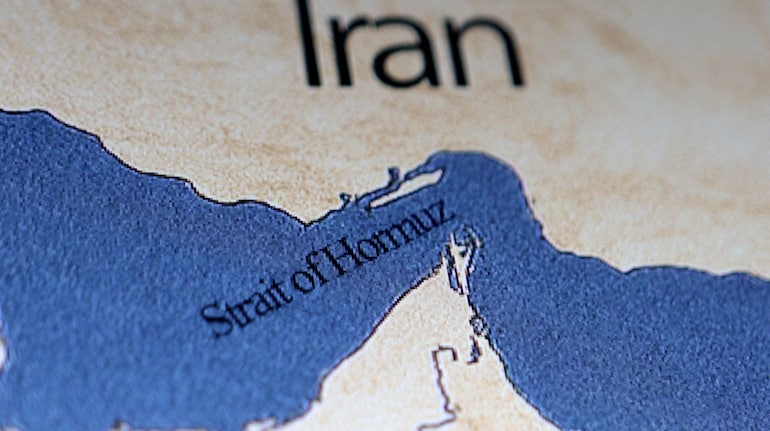

As the war involving the United States, Israel and Iran intensifies, the world’s shipping industry has become one of the conflict’s most vulnerable front lines. Merchant vessels and oil tankers traveling through the Persian Gulf and the Strait of Hormuz have increasingly come under attack, raising fears of a wider maritime crisis that could disrupt global energy supplies and trade routes.
Several ships have already been damaged in incidents linked to the conflict, and shipping companies are scrambling to adjust routes and safety protocols as risks in the region escalate.
A strategic waterway under threat
At the center of the crisis is the Strait of Hormuz, a narrow waterway between Iran and Oman that connects the Persian Gulf with the Arabian Sea. It is one of the most important shipping lanes in the world.
Roughly 20 percent of global oil shipments pass through the strait, making it a critical chokepoint for energy supplies.
The war has transformed the waterway into a dangerous zone. Multiple merchant ships have been struck by projectiles or damaged in attacks in recent days. In one incident, a Thai-registered bulk carrier caught fire after being hit, forcing the crew to partially abandon the vessel while nearby ships sustained damage.
These attacks are part of a broader escalation that began after US and Israeli strikes against Iranian targets, which triggered retaliatory threats and actions from Tehran.
Commercial shipping caught in the crossfire
The rising danger has forced shipping companies to rethink operations in the region.
Some vessels have attempted unusual measures to avoid being targeted. According to shipping data analysed by the Associated Press, several commercial ships passing through the Strait of Hormuz began identifying themselves as China-linked vessels by broadcasting messages such as “CHINA OWNER” through their tracking systems.
The tactic reflects an attempt by ship operators to signal neutrality and avoid attacks, since vessels linked to China are generally not seen as adversaries in the conflict.
At least 19 commercial vessels have been damaged since the conflict escalated, highlighting the growing risks for ships operating in the region.
Insurance costs and shipping risks surge
The danger has also triggered a dramatic increase in maritime insurance costs.
War risk insurance premiums for ships traveling through the Gulf have surged by more than 1,000 percent in some cases, reflecting the heightened threat environment.
For large tankers valued at hundreds of millions of dollars, the cost of insurance for a single voyage through the region can now reach several million dollars.
Shipping companies must weigh these risks carefully. Many vessels have delayed voyages or rerouted shipments, while others are waiting in the Gulf for conditions to stabilize.
Oil markets react to the crisis
The disruption to shipping routes has had immediate consequences for global energy markets.
Oil prices have surged amid fears that the conflict could choke off supplies from the Gulf. Brent crude prices have climbed above $100 per barrel, and analysts warn that prices could rise significantly further if the Strait of Hormuz remains disrupted.
More than 85 tankers have reportedly been trapped in the Persian Gulf, unable to safely pass through the strait.
Even the possibility of a sustained disruption has rattled markets, since energy shipments through the Gulf are critical for countries across Europe and Asia.
Iran’s leverage over shipping routes
Iran has long viewed the Strait of Hormuz as a strategic tool in its confrontation with Western powers.
During the current conflict, Iranian officials have signaled that control over the waterway could be used as leverage. Tehran has even suggested that ships should coordinate with Iranian naval authorities when passing through the strait, highlighting the country’s influence over the route.
Such statements have heightened fears that the conflict could escalate into a full-scale blockade or a broader naval confrontation.
A maritime conflict with global consequences
The attacks on ships show how quickly regional wars can spill into global economic systems.
Shipping through the Gulf underpins much of the world’s energy trade, and disruptions there ripple through international markets. Rising fuel prices, soaring insurance costs and longer shipping routes are already affecting economies far beyond the Middle East.
If the attacks on ships continue, analysts warn that the maritime dimension of the Iran war could become one of its most consequential battlegrounds, reshaping trade flows and energy markets worldwide.
Discover the latest Business News, Sensex, and Nifty updates. Obtain Personal Finance insights, tax queries, and expert opinions on Moneycontrol or download the Moneycontrol App to stay updated!
Find the best of Al News in one place, specially curated for you every weekend.
Stay on top of the latest tech trends and biggest startup news.