






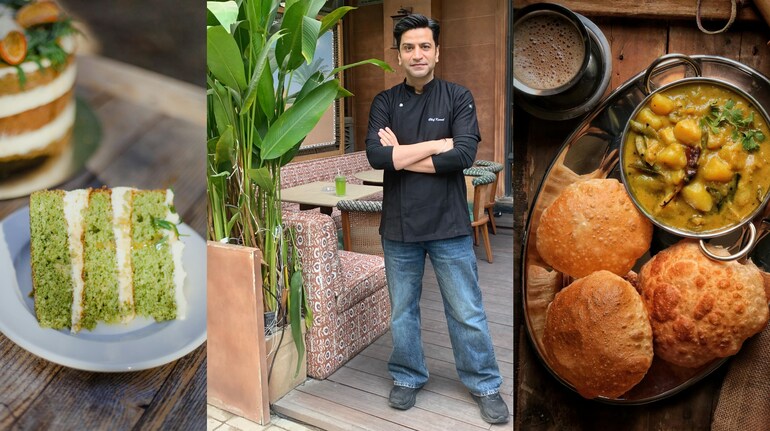
Growing up in Delhi, Chef Kunal Kapur remembers going down the road to the local tandoor-iya on weekends. "My sister and I would carry pede (kneaded-dough balls) down the road to the tandoor-iya, and come back with freshly made tandoori rotis. Every neighbourhood had a tandoor-iya back then," he recalls.
We are talking about food trends and food memories on the sidelines of 'The Saudi Table', a hosted lunch that Chef Kapur, now 46, has prepared with ingredients like za'atar spice, zireshk berries, pomegranate molasses, sultana raisins and black lumin flown in from Saudi Arabia. And Kapur is responding to a question about the enduring appeal of breads in the increasingly protein-oriented world of the affluent, among other questions about food trends that will stick around in 2026 and others, like matcha in everything, that will lose steam after 2025.
"Regional Indian cuisine will be the king... the entire concept of having a dish where there's a whole lot of smoke or molecular gastronomy will become passe. And real food, real flavours, where chefs or establishments concentrate on getting the produce from a certain state and region or a community, and highlighting that on the menu will be trending" in 2026, Kunal Kapur says.
Edited excerpts from an interview with Moneycontrol:
You probably answer this question every year, but since we are curious: what's the biggest food trend you see developing or carrying forward into 2026?
What I had mentioned two years back about food trends, is kind of coming to fruition. I had spoken about how regional Indian cuisine will be the king. How the entire concept of having a dish where there's a whole lot of smoke or molecular gastronomy will become passe. And real food, real flavours, where chefs or establishments concentrate on getting the produce from a certain state and region or a community, and highlighting that on the menu will be trending. And over a period of time, if you see, the entire sensibilities have moved towards that direction in India and outside of India also. If you see how Semma, for example, got a Michelin: It does not do anything innovative; it does South Indian food right. The way it's supposed to be done, concentrating on the way it is cooked and the ingredients that are sourced. In a nutshell, it's about celebrating the regional or the local Indian food which is now already mainstream (world over).
As Indian cuisine, we are typecasted as dal makhani and garlic naan and tikka people and biryani. But there is so much more to the cuisine. If you talk about Bihar or Uttar Pradesh or Gujarat or Indore, there are these specific dishes - whether vegetarian or non-vegetarian - that are the highlights that you would now see in good restaurants as well... There was a time when you would find chaat-papdi and gol gappe on the street. How chefs took it over many years ago, you can expect to get gol gappe or a chaat in a five-star hotel as well (since). There have been so many renditions of it done; it's been taken over by chefs (in that way too).
What I'm enjoying these days is that let's say if I'm a chef from a small town or village or a city, and I'm cooking like my nani or dadi did, and I'm educating people, and people are very receptive. They'll eat a khichdi and try to understand pehle yeh dalte the, aise banta hai (ingredients and methods used by previous generations). It's so much more engaging. And it's a whole new learning curve for the entire country as well, to see accha yahaan pe aise banta hai (this is cooked so in this region), to understand from each other. That's what I also see transpiring into the next year and coming out much stronger.
You will see regional food becoming mainstream.
We see this in top restaurants, perhaps. But will this idea of serving something from, say, the interiors of Madhya Pradesh or Mizoram, and trying to convey something of its origins and history - spread to more popular or more massy restaurants?
What I'm experiencing is that a top-level chef or restaurant, their thought process kind of trickles down... Whether it's highlighting a dish from a certain coastal town or remote village, it's not done in seclusion. I've gone to certain restaurants that do chocolate with Indian cacao, Indian tree and Indian origin chocolates. That could be one dessert, and the rest of the menu could be very different, but that gives me confidence that there is a newfound interest on both sides: from the person who's cooking, the establishment that is cooking, and from the public in general, to come together and celebrate that. So it's not only limited to Michelin star or top-level restaurants or chefs, so to speak. Also because the new thought wave is that how am I different? How am I different, is not by trying to reinvent the wheel all over again. It's also about doing the dish which were never mainstream. Let's say, mutton -- when we think of mutton, most people will think of a mutton curry or a Rogan Josh. But then Champaram (mutton) came from nowhere and took over, right? So whether you're in India or outside of India, you can see a Champaran mutton everywhere.
Let's take another step: mutton korma. But mutton korma is a very generic term. Now people want to know which state is this korma from, which community (typically cooks it like this)? Mutton korma from Lucknow is different from Hyderbadi korma. If you go to Bengal, the rizala is so different from what you get in Lucknow or Kashmiri or Andhra -- where it is called kurma, and where some ingredients are different -- people are becoming more specific. When you say mutton korma on the menu, they want to know kahan ka, konsa, kiska (from where, which one and by whom)? I feel that is the true essence or the thread that binds Indian food -- our culinary repertoire is so diverse, ab dhire dhire dhire daire bante ja rahe hain (slowly, we are starting to appreciate regional differences and categories) and that's improving our understanding of it.
You've told us about a trend that you hope continues into 2026. What's a food trend that you hope dies out in 2025?
This entire fad of Instagram food where you see, for example, matcha. All of a sudden there has to be a matcha (dish / drink) on the menu for everything: from gol gappe to kulfi. I mean, I'm not a fan...
Not a fan of matcha or matcha shakes, kulfi and gol gappe, etc.?
Matcha on its own is great. But there are grades of matcha. There are qualities of matcha. Most people don't realize that if you are getting an inferior-quality matcha and you are consuming it in excess with a lot of artificial colouring thrown in, it's pointless. Good quality matcha is very expensive, and to the degree that it's being used, it's possibly not the real thing that you're having. You have to be very mindful of what you're eating. Sometimes people just want it because it's cooler to get a picture clicked (holding the matcha-flavoured drink or food), but these trends come and die. I'm somebody who tries it out... because sometimes you discover something (interesting), but mostly I'd like these things to kind of die off. It's better to try it out (real matcha tea) than zabardasti (per force) introducing matcha into everything or an ingredient or a trend into everything.
This entire thing of copying what's happening abroad, it should be in reverse. Hum jo kar rahein, woh bhi toh koi copy kare (let others also copy what we are doing in India).
You've done lots of TV, of course; MasterChef India Season 9 starts on January 5, 2026. But there's another series that you did on pickling, which came to mind because we are talking on the sidelines of The Saudi Table at One8 Commune where you've used black lemons, among other ingredients. Now, black lemons are made by blanching the lemons in brine and then sun-drying them. That sounds very much like how we make achaar? What prompted that series - what excites you about pickling? And what is the most fun pickle you've ever had?
If you look at coffee, if you look at wine, if you look at cheese... in the West, they've celebrated people who make them, those who are known connoisseurs. In India, somehow, we never celebrate our trade and people who are actually pioneers in these trades. Pickling is considered unhealthy; too many calories, very oily, very spicy, highly salted. But, on the other hand, we don't talk the same narrative for olives. They are pickled, they are high on salt, some are pickled in oil, some are pickled in brine. Sardines, if somebody is eating sardines or somebody is having Asian food, a lot of Asian food is very high in salt or sodium as well. So while in Japan if somebody makes a soy sauce, he's known as a craftsperson for soy sauce; somebody does a stinky cheese, and boom, we say he just knows the craft, we've not celebrated pickle makers (in that way). The artisans or the hands who make it, we have never really taken it up and talked about them. That's why pickle as a topic (for the show). And I think we all relate to it. At least me and my generation, we can relate to a thandi paranthi with aam ka achar gutli ke saath in our lunchboxes. It's something still very tasty and close to my heart, whether it is roti with achar or mathri with achar and garam chai in sardi (pickle with roti or savoury, flaky crackers and hot tea in the winters). It hits the spot.
The idea is that we need to bring out these hidden jewels, whether it's in the form of ingredients, produce or the people who are producing them, and celebrate them. Once we start celebrating them, the world celebrates and then we reap the benefits. (Imagine the conversation then): Arrey, this is something we know. Arrey, this is how my mom would make it. Arrey, this is my Dad's family's recipe.
This also ties in with what you were saying about regional foods... What's the most fun pickle you've had? There are so many varieties, from seafood achars down India's massive coastline to pickles made with fruits, vegetables, even aromatics like garlic...
One of the fun moments of pickling that I saw was in Meghalaya. They have this simple bamboo and chili pickle. It's a very common pickle there; common as an aam ka achar (mango pickle) is to a Punjabi. But the interesting part is that I was with this tribe who have this age-old practice of making the pickle. It is made by the husband and wife. In the old days, access to good food wasn't that easy (all year round). In a certain season, tender bamboo shoots were taken, cut, fermented in a certain way and then pickled so that in winters (when access to vegetables can be even harder in these mountainous regions), you had a source of nutrition, energy, everything. And if that pickle went bad, you had to spend the winters not having a very important source of nutrition for you and for your tribe.
Back then they figured that if you write down a recipe and pass it on, people may forget. So they devised a dance form which celebrates the onset of when the bamboo shoots start coming out. That's when you go to the forest and take out those shoots and make the pickle. It's all woven into a dance form: where the man goes (to pick the shoots), what the woman prepares; as they're dancing, they reveal the recipe of the pickle. I think this is so brilliant.
I'd never heard of anybody or any community celebrating pickling in this way or remembering how to pickle in this way; and it's passed on from one family to the other. And because it involves the husband and wife, and lots of them dancing together, doing the actions of pickling the same way, it is also very communal, very Indian, very endearing. There is music, there is fun, there is laughter, and that's how they start the dance. And then they go into the forest and start pickling together.
That is such a fun way to remember a recipe. There's a lot of discussion around food and memory now. You mentioned Japan earlier; Japanese novels exploring this connection are quite popular right now. For instance, 'The Kamogawa Food Detectives' by Hisashi Kashiwai is about "food detectives" who recreate recipes with just people's memories around a dish that's important to them. They go into great detail, like the customs, climate and quality of water in the particular prefecture where it was made. And that's just one example of a recent Japanese novel about food. Do you also see this food-memories connection being talked about in different spheres?
Yes, yes, yes. Food is soft power... In this day and age, it's very important to have some control and influence as a country, as a society or a community. And food is something that we are very rich with. If I can say that in not-a-bad-way, we're a little late to the party. But we've realized that we hold a whole lot of power. For centuries, people have been looking at us and coming from every part of the world to have a slice of what we have, whether it's for spices, whether it's for resources. And we have to an extent shaped the world that we see now.
Like Himanshu (Saini, of Trèsind Studio in Dubai), who got three Michelin stars (in 2025). He's the only Indian chef to get three-stars in the world, and that makes me super-proud. There's so much as influence that you can have over people, over a country, over the world where your entire image of who India is to who was to turn to look at what India is -- there's so much to offer. I totally believe that food is a superpower. And cooking is a superpower.
In terms of food and memories, how do you see the loss of food traditions and knowledge. In places like Gaza where there is political uncertainty, but also elsewhere as both recipes and ingredients are lost to factors like changing lifestyles and climate change? Is there a way around that?
One thing I've realized, very late in life, is that when we refer to the old, forgotten, age-old, hamare toh purwaj khate the (our ancestors ate this)... that notion is broken for me. Because I'm realizing that whatever we're eating now is not very old. Food is a living thing. Like how we have evolved from what we used to be. Let's say what my grandfather used to wear, or the lifestyle he had or the kind of houses they built or kind of infrastructure or kind of opportunities or the kind of food that he was exposed to. We are not the same, and the next generation will be totally different. Just like us, food also evolves and it evolves very fast. There is a certain loss. That has always happened in terms of food knowledge In India, because our documentation -- though it is very strong -- wasn't readily available. Also, it is so vast, and it has kept on changing hands so often, that you really don't have a ready place where you can go and access it.
For example, French cooking is well-documented. Except possibly in Japan and China, (training of chefs in) the entire world also starts by learning the French style of cooking in culinary school. But you've seen something very different as a kid; you realize your cuisine is so different. You don't cook like that (at home). You don't have courses like that. Rather, you sit on a big table, whether it's a dastarkhwan or a community table, and you break bread together. There's no left-hand side, right-hand side, wine vs water glass and different types of forks. We have a very different style. There are reasons to it. You kind of learn and unlearn, but it's a progression. And whatever you can keep together as documentation to pass on, it's always great.
We spoke briefly about food memories and food knowledge that are getting lost. What's your take on what happens to breads when most people who can afford to, seem to be going protein-crazy?
It's a good thing that people are going protein-crazy... (with) the protein-deficiency that we have (in Indian). It's not about turning non-vegetarian or vegetarian. Vegetarian food also has enough and more protein. It's just that our habits of food have changed dramatically.
When you go to a restaurant, you don't think nutrition, you think from your taste buds. You meet friends in a coffee shop, someone gets a pizza, someone likes to have Asian noodles, someone wants a bruschetta, so you all share. There is no synergy or thought process (behind what we are consuming)... but that's how it's become.
It is important to understand that there is a certain amount of protein that we need; especially kids who are growing up and who may not have access to a decent meal. But at the same time, bread is what completes this. Like any other cuisine in the world, your carbs are what completes a meal (in India). Your carbs become the carrier of all the other things that are required for the body: your proteins, vitamins, minerals. Whether it is a roti, or rice, or dosa, they are all important.
And to a certain extent, the more regional we are going, we have access to all kinds of breads. Like tingmos (Tibetan rolls made with rice flour) came out of nowhere. Now every Asian restaurant in Delhi NCR has tingmos like someone discovered them! They are easy to do, too. The other day I had a stuffed tingmo... almost in the shape of a croissant, and stuffed it with meats. It works brilliantly. I ate it, and was like 'Wow, this is like a nice sandwich with soft, moist bread and northeastern spicy chillies.'
So, breads are also evolving. Staples will remain, but (some things are different). Like the neighbourhood tandoor-iya is not there. Those fresh bread shops are mostly gone...

Discover the latest Business News, Sensex, and Nifty updates. Obtain Personal Finance insights, tax queries, and expert opinions on Moneycontrol or download the Moneycontrol App to stay updated!
Find the best of Al News in one place, specially curated for you every weekend.
Stay on top of the latest tech trends and biggest startup news.




