






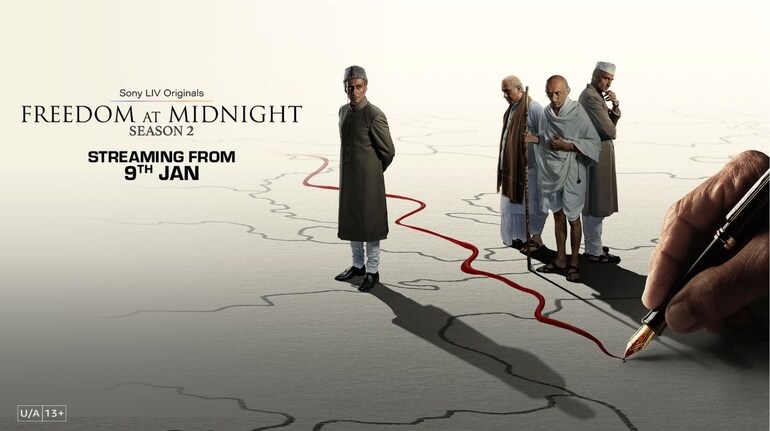

‘Freedom at Midnight,’ Season 2 directed by Nikkhil Advani began streaming on Sony LIV on 9 January and stars Sidhant Gupta, Arif Zakaria, Rajendra Chawla, Chirag Vohra, Luke McGibney, and Ira Dubey.
A grand yet polished retelling of a defining moment
The second season of ‘Freedom at Midnight’ focuses on the period when negotiations were taking place between British officials and leaders of undivided India and concludes with the assassination of Mahatma Gandhi. Spread across seven episodes, director Nikkhil Advani attempts to give the series a wide canvas and present the era with as much realism as possible.
It makes for engaging viewing, and the director makes a sincere effort to highlight episodes and incidents that are not widely known to the general public. At times, however, the series appears overly glossy and sanitised, which raises questions about the choice of presentation. Still, despite these issues, credible performances and an honest attempt to recreate history make it a compelling watch.
Power plays and the making of borders
The series opens with Lord Mountbatten, Cyril Radcliffe, Jawaharlal Nehru, Sardar Patel, and Mohammad Ali Jinnah gathered in a room to discuss the complex details of drawing the dividing line between the two nations.
Mountbatten suggests that the army should remain united for one year under a British Supreme Commander, but Jinnah rejects the proposal and insists that if he is to leave, he will do so with his own troops. As the story progresses, we witness Sardar Patel’s tireless efforts to bring the princely states into the Indian dominion.
The narrative focuses on Junagadh, Hyderabad, and Kashmir, all of which remain contentious. Kashmir even declares that it will align with neither India nor Pakistan. The series then turns to Gandhi’s growing disillusionment after riots erupt in Punjab and Kolkata, leading eventually to his assassination.
Alongside these developments, the show highlights Jinnah’s increasingly megalomaniac behaviour and the underlying tension between Patel and Nehru.
Lesser-known episodes add texture
Based on Larry Collins and Dominique Lapierre’s book ‘Freedom at Midnight,’ the series draws attention to several incidents that rarely feature in mainstream discussions. One such moment shows that when 15 August was chosen as Independence Day, a group of sadhus confronted Nehru in his office and demanded a change of date, claiming it was inauspicious.
Another episode depicts an assassination attempt on Jinnah while he was on his way to a parade with Mountbatten. And then we also get to see a conversation between Patel and Gandhi on the day of Gandhi’s assassination.
The inclusion of these moments adds texture and depth to the narrative. Perhaps the most striking aspect of the series is its portrayal of leaders as ordinary individuals, stripped of the larger-than-life aura later attached to them.
Nehru is shown as someone constantly seeking balance, which stands in contrast to Patel’s direct and solution-driven approach. Jinnah is portrayed as arrogant and abrasive, while Gandhi is shown as a figure whose stubborn decisions ultimately created serious difficulties for the nation.
Performances seeped in emotions
The series also deserves credit for its casting. Most actors look convincing and deliver sincere performances. Sidhant Gupta as Nehru effectively conveys his lingering doubts about Jinnah and shows how his devotion to Gandhi pushed him to take decisions that once seemed unthinkable. Arif Zakaria delivers a strong portrayal of Jinnah and captures the sense of entitlement and resentment shaped by his education and worldview.
Jinnah’s open disdain for the incompetence of Liaqat Ali Khan, Pakistan’s first prime minister, adds another layer to his character. The supporting cast, including those playing Mountbatten, Menon, and Maulana Azad, provide solid support throughout.
However, it is Rajendra Chawla as Sardar Patel who stands out among the cast. Beyond the physical resemblance, Chawla captures Patel’s presence and restraint with great control. The performance suggests a man with a firm resolve and a deep commitment to protecting the country’s interests.
Compelling history with room for greater depth
‘Freedom at Midnight’ succeeds in smoothly blending key historical moments with strong performances, and its pacing makes it easy to watch in one stretch. While the second season remains an absorbing series, a few shortcomings prevent it from reaching a higher level.
Several events are touched upon only briefly, with the Kolkata riots lacking depth, Suhrawardy’s role largely ignored, and the bond between Nehru and Edwina barely explored. The series remains closely tied to the book and rarely ventures beyond its boundaries.
Rating: 4/5
Discover the latest Business News, Sensex, and Nifty updates. Obtain Personal Finance insights, tax queries, and expert opinions on Moneycontrol or download the Moneycontrol App to stay updated!
Find the best of Al News in one place, specially curated for you every weekend.
Stay on top of the latest tech trends and biggest startup news.





