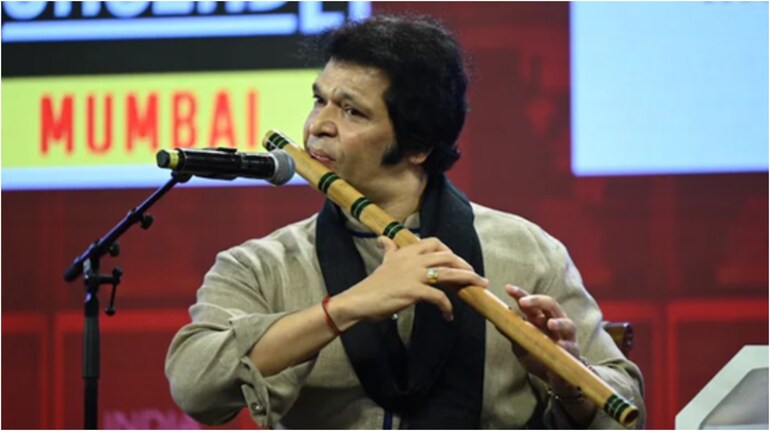

When two towering traditions of Indian classical music come together, the result is less about spectacle and more about conversation.
For the first time, sitar maestro Ustad Shujaat Husain Khan and two-time Grammy Award–winning flautist Rakesh Chaurasia shared the stage as part of Strings & Wind, a new intellectual property that brought the sitar and bansuri into an intimate musical dialogue.
In this conversation with MoneyControl, Rakesh Chaurasia reflects on the philosophy behind the collaboration, the delicate balance between legacy and improvisation, and why listening, rather than virtuosity, has become the most important element of music at this stage of his journey.
This marks the first time you are sharing the stage with Ustad Shujaat Husain Khan. What finally aligned, artistically or philosophically, for this collaboration to happen now, at this moment in your respective journeys?
This collaboration feels timely because both Ustad Shujaat Khan and I have arrived at a place where music is more about listening than asserting. Artistically, we’re drawn to dialogue rather than display, and philosophically, to honesty over expectation. The alignment now is in our shared readiness to let the flute and sitar speak as equals—rooted in tradition, yet open, reflective, and unhurried
Both of you carry towering legacies of Imdadkhani and Maihar gharanas. When two such distinct traditions meet, what guides the balance between preserving purity and embracing spontaneity?
When two legacies meet, the guiding force has to be shraddha—deep respect for where the music comes from. The purity of each gharana is preserved through intention, not rigidity. At the same time, spontaneity arises naturally when there is trust. We don’t try to merge traditions or dilute them. Instead, we allow each gharana to stand in its own strength and let the conversation unfold honestly. When listening becomes the priority, spontaneity doesn’t disturb purity—it deepens it.
Ustad Shujaat Husain Khan is known for infusing khayal-like lyricism and even Sufi influences into instrumental music. Whereas your flute playing often feels meditative yet expansive. How do these contrasting temperaments complement each other on stage?
The meditative and the expansive are not opposites for me—they are part of the same breath. Stillness creates space, and within that space, expansion becomes meaningful. On stage, this contrast allows the music to breathe: moments of quiet reflection invite Ustad Shujaat Ji’s expressive, searching phrases, and his expansiveness, in turn, opens new horizons for my own responses. It becomes a shared flow—sometimes inward, sometimes outward—but always connected through listening and trust.
This tour spanned four cities with diverse classical audiences. Do you consciously adapt your raga choices or approach depending on the city, or does the music decide its own path each night?
The music largely decides its own path. While we are aware of the audience and the energy of each city, we don’t pre-plan the ragas to suit them. The performance is a living conversation—responsive to the moment, the space, and the listeners—so each night unfolds organically and uniquely.
Indian classical music today exists in a world of short attention spans and digital consumption. How important is an IP like Strings & Wind in re-contextualising classical concerts for contemporary audiences without diluting their depth?
I think it is very important—especially today—to create thoughtful contexts without compromising the soul of the music. An idea like Strings & Wind is not about packaging or simplification; it’s about framing. It invites newer audiences in through curiosity, while allowing the music to unfold in its full depth and integrity. Indian classical music doesn’t need dilution, but it does need space to be experienced afresh. When the intent is honest and the roots are strong, such platforms help listeners slow down, listen deeply, and discover that timelessness still speaks—even in a fast-moving world.
Both of you are torchbearers of your gurus’ legacies. In moments of improvisation on stage, do you feel their presence guiding you, or do you consciously step away to find your own voice?
The guru’s presence is never something we step away from—it’s something we carry within us. In moments of improvisation, their guidance is instinctive, almost subconscious. It shapes our sense of discipline, restraint, and aesthetics. At the same time, finding one’s own voice is also part of the guru–shishya tradition. When the foundation is strong, freedom doesn’t feel like departure—it feels like continuation. What emerges on stage is not a choice between guidance and individuality, but a natural flow where both coexist.
Jugalbandi often walks a fine line between dialogue and duel. For you, is it about challenge, surrender, or discovery? And what excites you most about that shared musical risk?
For me, jugalbandi is never a duel—it is a dialogue rooted in discovery. There is no sense of challenge in the competitive meaning of the word, but there is a gentle surrender to the moment and to each other’s ideas. That surrender itself becomes a kind of risk. What excites me most is not knowing where the music will go next. When both artists are fully present and listening, the music begins to lead us. In that shared uncertainty, something truthful can emerge—something neither of us could have planned alone.
Looking beyond this tour, do you see Strings & Wind as a one-time confluence, or the beginning of a longer artistic conversation that could evolve into recordings, global tours, or future collaborations?
I see Strings & Wind not as a conclusion, but as an opening. When a musical conversation begins with trust, curiosity, and shared values, it naturally wants to continue. Whether it takes the form of recordings, future tours, or other collaborations will unfold in its own time. What matters to me is that the dialogue remains alive and sincere. If the music continues to reveal new spaces to explore together, then this is certainly the beginning of a longer journey.
Discover the latest Business News, Sensex, and Nifty updates. Obtain Personal Finance insights, tax queries, and expert opinions on Moneycontrol or download the Moneycontrol App to stay updated!
Find the best of Al News in one place, specially curated for you every weekend.
Stay on top of the latest tech trends and biggest startup news.