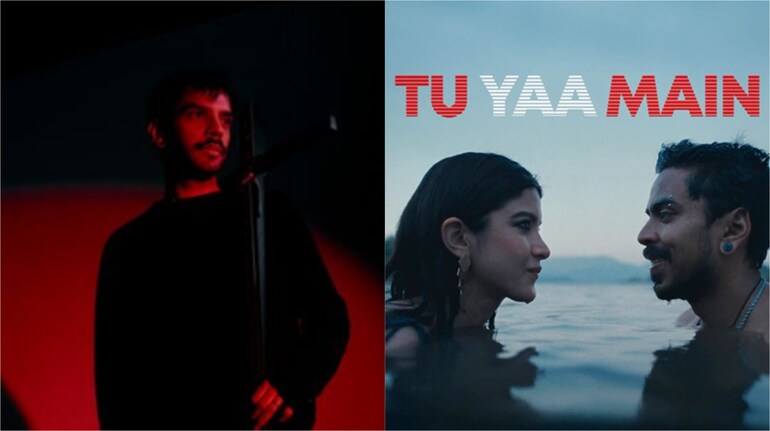

After quietly building an impressive body of work in Los Angeles by collaborating on global franchises like The Mandalorian and projects backed by DreamWorks and A24, Prateek Rajagopal is stepping into a new creative phase that feels both expansive and deeply personal.
The composer-producer is now making his Indian cinema debut with Tu Yaa Main, Bejoy Nambiar’s genre-bending upcoming feature starring Adarsh Gourav and Shanaya Kapoor, slated for a February 2026 release. Drawing from a transnational life shaped by India, Oman, and the US, Prateek brings a distinctive sonic language that blends analog synth nostalgia, orchestral intimacy, and experimental intensity.
In this interview with MoneyControl, Prateek reflects on finding his footing in Hollywood, learning leadership through collaboration with boundary-pushing artists, and why Indian cinema, especially in the OTT era, is ripe for more daring, narrative-driven scores.
You’ve worked on some of the biggest global franchises, from The Mandalorian to DreamWorks and A24 projects. When you look back at your Hollywood journey so far, what moments made you feel, “I’ve really arrived here”?
That’s a great question. I’ve worked on several studio projects in Hollywood with some of the most sought-after and boundary-pushing composers. When I started working on Ludwig Göransson and Joe Shirley’s projects, I slowly built a community - music executives, orchestrators, people at scoring stages. Later, when I joined Bobby Krlic’s team and reconnected with that same community on a completely different set of projects, it really hit me. I remember thinking, “Damn - people do remember me, they’re looking out for me, and they’re rooting for me.” Those are the moments where I feel like, okay, I’m on my way.
Collaborating with artists like Ludwig Göransson, Bobby Krlic, Lizzo, and Eric André exposes you to very different creative temperaments. What have these collaborations taught you about adaptability and creative leadership in large-scale productions?
When you put it like that, it really highlights how different all of them are. But what they share is that they’re always in service of something larger than themselves. I’ve learned how open you have to be to truly get to the other side of an idea or vision. Leadership is tricky, especially for artists - we often just want to make the music. But what I’ve learned from all of them is how much leadership comes from example. It’s less about talking and more about doing. My biggest takeaway is that they all fight for their musical vision - just in very different ways. That’s helped me feel more confident about standing up for my own vision too.
After building a strong career in Los Angeles, you’re now making a significant creative homecoming with Tu Yaa Main. What made this the right project to mark your debut in Indian cinema?
It was really a combination of factors. Adarsh (Gourav) and I have been friends for over ten years, with a lot of mutual respect for each other’s work. Bejoy Nambiar is a brilliant filmmaker who takes risks and deeply understands collaboration. And the producers at Color Yellow have made one of my favourite films - Tumbbad. So for me, this was a complete no-brainer.
You’ve described the score for Tu Yaa Main as blending 70s and 80s analog synths, chamber orchestra, and modern production techniques. How did you arrive at this sonic palette, and how does it serve the emotional and narrative world of the film?
A lot of the musical storytelling definitely came from the instrumentation, but we also leaned heavily on intentional themes and motifs - both for the creature and for Avni and Flow. There’s a string melody that recurs throughout the film, constantly being reshaped: the harmony shifts, the context changes, and it shows up in very different emotional spaces - sometimes unsettling, sometimes when things really escalate.
The creature has its own identity as well: a very specific percussion rhythm on large drums, processed through my modular synths. Every time you hear that texture, you’re meant to feel the presence of the croc.
And then there’s Avni and Flow’s theme - a melody performed on my Prophet - represents a contemporary love story. It’s warmer, more intimate, and grounded in analog synthesis.
In Hollywood, background scores are often treated as a narrative voice. Do you feel Hindi cinema is now ready to fully embrace that philosophy, and how are you hoping to push that shift through your work?
With the rise of OTT, background score has definitely become more important, though I don’t think it’s been fully realised yet. It’s still often treated as secondary. What I’m hoping to push for is making the score more experimental and more integral - something that acts as a through-line for a film or series. Ideally, it becomes more cinematic, more alive, and a bit edgier overall, helping elevate the sophistication of each project.
Having roots in extreme music and metal through projects like GUTSLIT and The Minerva Conduct, how does that intensity and experimental mindset translate into film scoring, especially for more mainstream narratives?
Music is incredibly malleable. Often, if you change the instrument but apply ideas from another genre, it translates beautifully. Take Stravinsky - his music can be extremely rhythmically weird and intense, much like metal. The same goes for Indian classical music and metal. If you look at a band like Meshuggah, their rhythmic structures are surprisingly close to Carnatic rhythms. So I always find ways to push my influences into film scoring, even when working within more mainstream narratives.
You’ve lived between cultures — born in Muscat, raised between India and Oman, and now based in Los Angeles. How has this transnational identity shaped the way you approach emotion, rhythm, and storytelling in your compositions?
It’s been incredibly grounding. Having lived and traveled across different cultures has shaped how I see the world and, in turn, how I tell my stories through music. Environment and geographical luck is a real thing that shapes your level of empathy and understanding of the world. It leaves a deep imprint on identity and creative instinct, and that influence shows up in both my music and the way I approach movies.
Studying at USC’s film scoring program is a dream for many composers. What were the most valuable lessons from that experience that continue to shape how you work today?
It was truly a dream program, and I honestly don’t think I’d have such a fulfilling career without the professors and connections I made there. It felt more like a crash course than a Master’s - they throw you straight into the deep end. We were often writing two to three minutes of music every day, composing, orchestrating, and music-prepping our own cues, then recording and conducting at some of the best studios - Warner Bros., Capitol - with incredible players. When you come out of that program, you’re ready to get working in the industry. I can trace almost every professional connection I have today back to USC.
Beyond Hindi cinema, you’re also attached to a Telugu-language feature. What creative or cultural differences do you notice when approaching projects across Bollywood and Tollywood?
The Telugu project isn’t a genre film, whereas Tu Yaa Main starts as a rom-com/dramedy and then shifts into a creature feature. Both are unique and exciting in their own ways. The Telugu film is more experimental and has a very frenzied narrative energy in the best possible sense. My biggest takeaway so far is that both spaces have a beautiful place within Indian cinema, and I’ve genuinely enjoyed working across them.
Your work now extends into VR/XR, immersive tech, fashion, and AI-driven music at KOST AI. How do you see technology reshaping the future of film music and storytelling?
Technology will always evolve, but music is shaped by human emotion, culture, and lived experience. AI is just another tool - the storytelling itself will always belong to people. Authorship, however, is more complex - since the lines between human and AI-assisted creations continue to blur. We can hope that the music companies, lawmakers and unions do the right thing.
For young Indian musicians watching your journey, from underground metal to Hollywood to Indian cinema, what mindset shifts or risks do you think were most crucial in helping you build a truly global career?
The path is non-linear, and everyone’s journey will look different. But what I’ve learned is that sometimes you need to pause your current trajectory and take the longer route - even when it feels like a temporary setback or a downward curve. That was very much my journey: moving from Indian metal, where I felt I had achieved what I set out to do, to hitting the reset button in Hollywood - an industry with very few success stories - and now finding my way back to India. In the long run, those detours gave me more perspective and resilience than a straight line ever could.
Discover the latest Business News, Sensex, and Nifty updates. Obtain Personal Finance insights, tax queries, and expert opinions on Moneycontrol or download the Moneycontrol App to stay updated!
Find the best of Al News in one place, specially curated for you every weekend.
Stay on top of the latest tech trends and biggest startup news.