






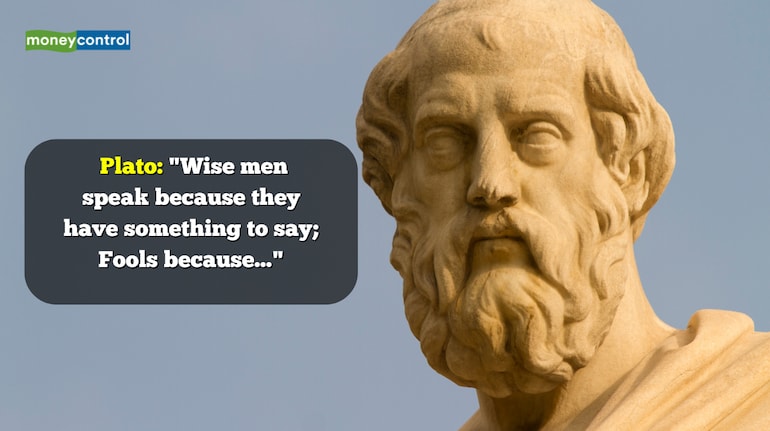

In an age of constant noise, where everyone has a platform and the pressure to speak is relentless, the ancient Greek philosopher Plato offers a timeless filter for our words. His observation cuts through the clutter with surgical precision:
"Wise men speak because they have something to say; Fools because they have to say something."
This distinction, drawn over two thousand years ago, has never been more relevant. It challenges us to examine not just what we say, but why we say it.
Source of Wise Speech
Plato's wise person begins not with the mouth but with the mind. They speak only when they have something of substance to contribute—an insight, a question that advances understanding, a perspective that illuminates rather than obscures. Their words are born of reflection, not impulse. This does not mean they speak rarely or reluctantly, but that their speech carries weight because it emerges from a place of genuine thought. The wise person respects language too much to waste it on empty noise.
Compulsion of the Fool
The fool, in Plato's formulation, is driven by a different force entirely: the need to be heard. Silence feels like absence, so they fill it. Opinion must be offered on every topic, regardless of knowledge. Conversation becomes performance, not exchange. The fool speaks not to communicate but to exist, believing that visibility equals value. Their words multiply while their meaning diminishes, until they are drowning in their own noise, unable to distinguish what matters from what merely fills space.
Psychology of Compulsive Speech
Why do intelligent people fall into this pattern? Insecurity plays a central role. The fear of being overlooked, of seeming uninformed, of losing status in a social hierarchy—these anxieties drive us to claim knowledge we don't possess and offer opinions we haven't formed. Modern technology amplifies this tendency, rewarding constant output with likes, shares, and the illusion of influence. Plato saw through this millennia ago, recognizing that the compulsion to speak is often a mask for the fear of being forgotten.
Power of Strategic Silence
If wisdom lies in speaking with purpose, then silence becomes a strategic tool, not a weakness. The wise person is comfortable with pauses, with listening, with the space between words where thought happens. They know that silence allows others to speak, that it creates room for genuine exchange, and that it lends greater power to the words they eventually choose to offer. In a world screaming for attention, the quiet voice often carries furthest.
A Filter for Modern Communication
Plato's distinction provides a practical filter for our daily interactions. Before speaking, we can ask: Do I have something to say, or do I just feel the need to say something? Before posting, before commenting, before interrupting, this question cuts through impulse and invites intention. It does not demand perfection or silence, but honesty. If you have something real to contribute, speak. If not, listen. Both are forms of participation.
Courage to Withhold
Sometimes the wisest choice is to withhold speech entirely. This requires its own form of courage—the courage to let others wonder what you think, to risk being underestimated, to trust that your value does not depend on constant verbal proof. The person who can sit quietly while others fill the air has a kind of power that the compulsive talker will never know.
Plato invites us to treat words as treasure rather than trash. When speech is rare and meaningful, it commands attention. When it is constant and empty, it becomes background noise, easily ignored. The choice between wisdom and folly is not always about what we know, but about how we choose to share it.
In the end, Plato's simple observation is a liberation. It frees us from the pressure to have an opinion on everything, to fill every silence, to prove our existence through constant output. It gives us permission to think first, to speak second, and to trust that when we have something genuine to say, the right moment and the right listeners will appear.
Discover the latest Business News, Sensex, and Nifty updates. Obtain Personal Finance insights, tax queries, and expert opinions on Moneycontrol or download the Moneycontrol App to stay updated!
Find the best of Al News in one place, specially curated for you every weekend.
Stay on top of the latest tech trends and biggest startup news.





