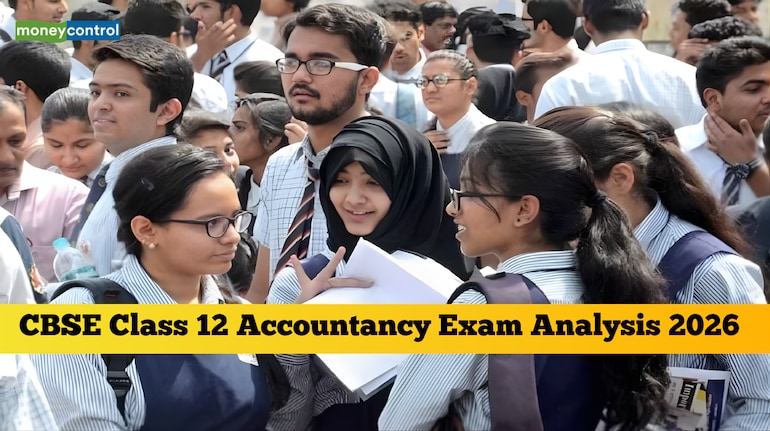

The Central Board of Secondary Education (CBSE) successfully conducted the Class 12 Accountancy board exam today, 24 February 2026. The examination, held from 10:30 AM to 1:30 PM, marks an important moment for commerce students across the country. As a core subject, Accountancy plays a significant role in determining overall board percentages and lays the foundation for competitive exams.
This year's paper, aligned with the updated 2025-2026 syllabus, tested not just theoretical knowledge but also analytical and application-based skills. Here is the complete analysis of the CBSE Class 12 Accountancy exam for 2026.
Exam Overview and Pattern
As per the CBSE date sheet, the Accountancy paper was conducted for 80 marks over a three-hour duration, with an additional 15 minutes provided for reading the question paper.
The question paper adhered strictly to the pattern outlined in the CBSE sample paper. It comprised a total of 34 questions, which were divided into two parts: Part A (Compulsory) and Part B (Optional) .
Marks Distribution
The breakdown of questions was as follows:
Section-Wise Breakdown
Part A: Accounting for Partnership Firms and Companies (60 Marks)
As expected, Part A carried the highest weightage. This section was reported to be balanced but lengthy. Questions focused heavily on the reconstitution of partnership firms, including admission, retirement, and death of partners, along with goodwill valuation. The company accounts section featured practical problems on the issue and forfeiture of shares and debentures, requiring precise journal entries and format adherence.
Part B: Financial Statement Analysis (20 Marks)
In Part B, students were given the option to choose between Financial Statement Analysis and Computerised Accounting . The Financial Statement Analysis section included questions on Ratio Analysis, Cash Flow Statements (Indirect Method), and Comparative Statements . Experts noted that the questions were concept-based, requiring students to interpret data rather than just present it.
Difficulty Level and Student Reactions
Initial reactions from students and teachers suggest that the paper was moderately difficult, with a strong emphasis on competency-based questions.
Balanced but Lengthy: Many students found the paper lengthy but manageable. The inclusion of case-study-oriented questions required careful reading and application of concepts.
Format Sensitivity: Consistent with expert predictions, the marking scheme rewarded step-wise markings and proper presentation. Students who maintained neat formats and showed clear working notes found it easier to attempt the paper confidently.
Mixed Reactions: While some students found the 1-mark MCQs straightforward, others felt the long-answer questions (6 marks) from the partnership unit were tricky and required in-depth knowledge.
Passing Criteria
To pass the exam, students must secure at least 33% marks overall, with a mandatory 26 marks out of 80 in the theory paper and 7 marks out of 20 in the internal assessment/project.
(It's a developing story)Discover the latest Business News, Sensex, and Nifty updates. Obtain Personal Finance insights, tax queries, and expert opinions on Moneycontrol or download the Moneycontrol App to stay updated!





Find the best of Al News in one place, specially curated for you every weekend.
Stay on top of the latest tech trends and biggest startup news.