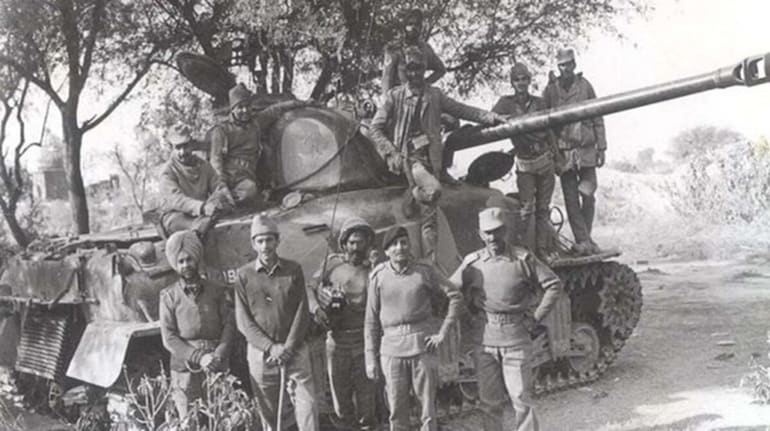
By the first week of September 1965, the villages around Khem Karan had emptied. Farmers had moved what they could. What remained were flooded fields, tall sugarcane and narrow canal banks cutting across the flat Punjab countryside. It looked like open ground on a map. On the ground, it was something else entirely.
This was where Pakistan expected its armour to break through.
The thrust towards Khem Karan was meant to be decisive. Pakistan’s 1 Armoured Division, equipped with American-supplied M47 and M48 Patton tanks, was considered the most powerful armoured force in South Asia at the time. The Patton was modern, fast, heavily armed and had performed well in NATO exercises. Indian forces opposing it were equipped mainly with Centurion tanks, supported by older Shermans that many officers privately acknowledged were nearing obsolescence.
On paper, the outcome looked predictable. It was not.
The advance that slowed
Pakistan’s armoured columns crossed the international border on September 8, moving quickly towards Khem Karan. The expectation was that Indian forward units would give way under pressure, allowing armour to exploit depth and speed. That assumption proved costly.
Indian infantry units did withdraw, but not in panic. They fell back slowly, buying time. Engineers worked quietly, breaching irrigation canals and allowing water to spread into low-lying areas. What appeared to be farmland began turning soft under heavy steel tracks.
Indian commanders in the sector resisted the instinct to counter with tanks immediately. Instead, they allowed the Pakistani armour to push forward, deeper into ground that restricted manoeuvre. Sugarcane fields rose high on either side of the narrow approaches. Visibility dropped. Movement slowed.
By the time Pakistani tank units realised the terrain was working against them, momentum had already begun to drain away.
Where armour stopped being mobile
When the counter-attacks came, they were not dramatic charges across open plains. Indian Centurions waited in hull-down positions, often concealed behind cane fields and embankments. Engagements were short and brutal.
The Centurion’s 105 mm gun, stabilised and accurate, proved decisive at the ranges involved. Pakistani Pattons, heavier and faster on firm ground, struggled in the flooded fields. Several bogged down. Others were forced into narrow corridors where they emerged one by one into Indian firing arcs.
Indian Army battle accounts describe instances where multiple Pattons were knocked out within minutes. Some were hit before their turrets could traverse fully. Others were struck while attempting to reverse out of soft ground.
The battlefield quickly filled with burning wrecks.
Indian troops began referring to the area as “Patton Nagar”. The name stuck.
Infantry, engineers and patience
Asal Uttar is often remembered as a tank battle, but armour alone did not decide it. Indian infantry units played a crucial role, holding forward positions just long enough to shape the battlefield. Anti-tank teams operating with recoilless rifles and close-support weapons added to the attrition.
Engineers ensured that once Pakistani tanks entered the flooded zone, their options narrowed rapidly. Retreat was as difficult as advance.
What stood out was restraint at higher command levels. Indian commanders avoided meeting Pakistan’s armour in open manoeuvre, where Patton speed and numbers might have mattered more. Instead, they forced the fight into conditions where preparation outweighed hardware.
On the Pakistani side, later assessments pointed to overconfidence in armour-led breakthroughs and insufficient reconnaissance. The assumption that Indian resistance would crumble under pressure proved wrong. Once the advance stalled, the armoured division found itself fighting without space, time or initiative.
The toll
Precise figures differ, but Indian records indicate that Pakistan lost over 90 tanks in the Khem Karan–Asal Uttar sector, a large number of them Pattons. Indian losses were significantly lower. More important than the numbers was the effect on Pakistan’s offensive capability. The armoured thrust in that sector was effectively finished.
The psychological impact travelled far beyond the battlefield. The Patton tank, until then seen as near-invincible in the region, lost its mystique. Indian armoured units, still rebuilding confidence after the trauma of 1962, gained something harder to quantify: belief.
A shift in Indian armour thinking
Asal Uttar did not produce a sweeping breakthrough or a deep exploitation. What it produced was something more enduring: a method.
Indian armoured doctrine absorbed the lessons quickly. Terrain was no longer a backdrop but a weapon. Armour would fight as part of a combined system with infantry and engineers, not as a standalone arm. Defensive battles could be turned offensive through patience and preparation.
Training institutions and war colleges returned repeatedly to the battle in the years that followed. It became a case study not because it was large, but because it was clean in its lessons.
Why the battle still matters
The 1965 war ended without major territorial changes. Strategically, it was a stalemate. Battles like Asal Uttar mattered because they offered clarity in an otherwise ambiguous conflict.
For Indian soldiers and officers, Asal Uttar demonstrated that modern warfare was not decided by equipment brochures or alliance politics. It was decided by ground, timing and judgement.
That is why the battle continues to dominate Indian armoured lore. Not because it was dramatic, but because it was disciplined. Not because it rewrote borders, but because it reset confidence.
Even today, preserved Patton tanks near Khem Karan stand as reminders. They are not trophies of conquest so much as markers of a moment when Indian armour stopped reacting and started dictating terms.
In the sugarcane fields of Punjab, Indian armour did not just win a battle. It learned how to fight.
Discover the latest Business News, Sensex, and Nifty updates. Obtain Personal Finance insights, tax queries, and expert opinions on Moneycontrol or download the Moneycontrol App to stay updated!
Find the best of Al News in one place, specially curated for you every weekend.
Stay on top of the latest tech trends and biggest startup news.