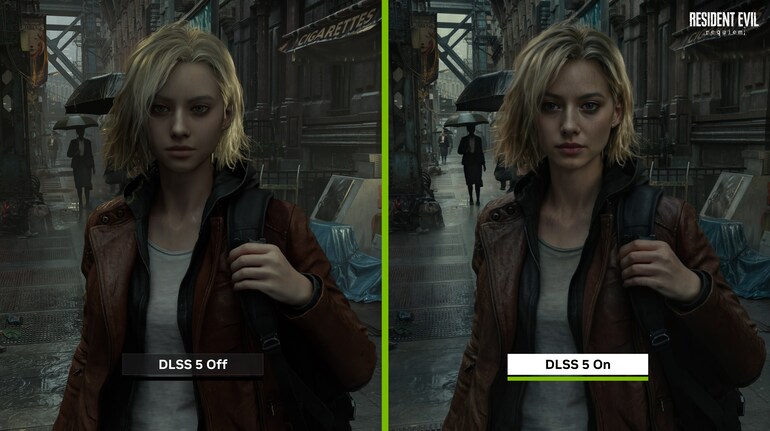

Nvidia announced Deep Learning Super Sampling 5 (DLSS 5) on March 16, 2026 during its GTC conference, introducing a new rendering technique designed to change how graphics are produced in PC games. Unlike earlier DLSS versions that focused on increasing frame rates or improving resolution, DLSS 5 introduces 3D-guided neural rendering, where artificial intelligence calculates lighting and material interactions in real time.
The technology runs on tensor cores inside GeForce RTX GPUs and is expected to launch in Fall 2026. Nvidia says the system will integrate with existing game engines through the Streamline framework and will support upcoming titles such as Starfield, Hogwarts Legacy and Resident Evil Requiem.
The announcement positions DLSS 5 as the next step in Nvidia’s long-running effort to integrate machine learning into real-time graphics rendering.
What is Nvidia DLSS 5
DLSS 5 changes how lighting and visual details are generated inside each frame of a video game.
Traditionally, game engines calculate lighting, shadows and reflections using techniques such as rasterization, ray tracing or path tracing. These calculations require large amounts of compute power and must be completed within milliseconds to maintain playable frame rates.
DLSS 5 shifts this workload to an AI model. Instead of fully calculating lighting in the engine, the game outputs scene geometry, color information and motion vectors. This data is sent to the GPU’s tensor cores, which run a neural rendering model trained on film-production datasets.
The AI analyzes the structure of the scene and identifies objects using semantic classification. Materials such as skin, hair, metal, water and fabric are detected by the system. The model then calculates how light interacts with these surfaces, generating reflections, shadows and subsurface scattering effects.
Because the AI performs these calculations using trained neural models rather than brute-force computation, the system can produce complex lighting effects while maintaining real-time performance. Nvidia says the system can output frames at resolutions up to 3840×2160.
Developers still retain creative control. Through the Streamline framework, they can adjust masking layers and intensity settings to determine where and how neural rendering is applied within the game.
How DLSS 5 is different from DLSS 4.5
DLSS 4.5 and DLSS 5 address different parts of the rendering pipeline.
DLSS 4.5 focuses primarily on performance and frame output. The update introduces Dynamic Multi Frame Generation, which can generate multiple AI frames between frames rendered by the game engine. In some cases, up to five AI-generated frames can be created for each engine-rendered frame.
The system monitors GPU render time and the display refresh rate to dynamically adjust the frame multiplier. If the GPU load increases, the multiplier automatically reduces to maintain smooth frame delivery and avoid visual artifacts.
DLSS 5 takes a different approach. Instead of increasing the number of frames, it focuses on changing the visual content within each frame. The neural model calculates lighting and material behaviour independently of the game engine’s traditional rendering calculations.
In simple terms, DLSS 4.5 improves how smoothly frames are delivered, while DLSS 5 changes how those frames are visually constructed.
Why DLSS 5 is a game-changer for gamers and developers
DLSS 5 represents a shift toward AI-driven graphics rendering.
In traditional pipelines, achieving realistic lighting requires heavy computation through ray tracing or path tracing. These techniques simulate how light moves through a scene, which can be expensive even for high-end GPUs.
Neural rendering uses trained AI models to predict how light interacts with surfaces instead of calculating every ray of light mathematically. This allows the GPU to render more complex lighting effects within the time limits required for real-time gameplay.
The technology can produce effects such as skin translucency, detailed reflections on metal or water surfaces and accurate light interactions with hair or fabric. These details bring gameplay visuals closer to the level of cinematic rendering typically seen in pre-rendered cutscenes.
DLSS 5 will also integrate with existing DLSS features such as super resolution and frame generation, allowing developers to combine neural rendering with performance-enhancing technologies.
Several developers and publishers have confirmed adoption of the technology, including Bethesda, Capcom, Ubisoft and Tencent. Games expected to support DLSS 5 include Starfield, Hogwarts Legacy, Resident Evil Requiem, Assassin’s Creed Shadows and Phantom Blade Zero.
With neural rendering handling lighting calculations, DLSS 5 marks a potential transition from traditional graphics pipelines toward AI-assisted real-time graphics in PC gaming.


Discover the latest Business News, Sensex, and Nifty updates. Obtain Personal Finance insights, tax queries, and expert opinions on Moneycontrol or download the Moneycontrol App to stay updated!
Find the best of Al News in one place, specially curated for you every weekend.
Stay on top of the latest tech trends and biggest startup news.