






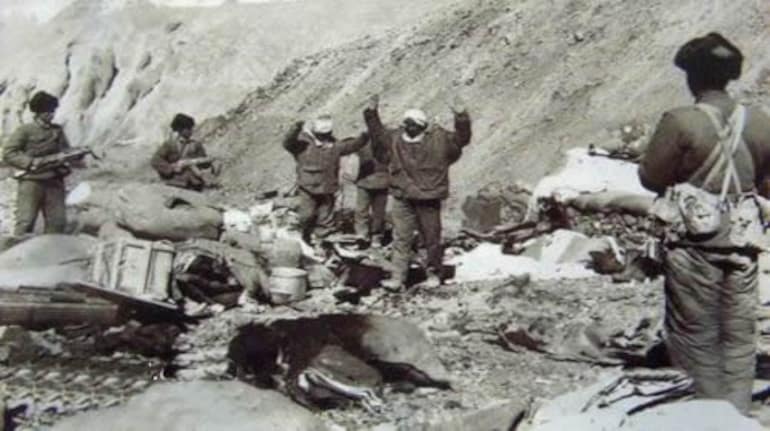

Every few years, the 1962 war with China returns to the same uncomfortable “what if.” What if India had used the Indian Air Force in an offensive role, not just to fly troops and supplies, but to hit Chinese positions, choke supply routes, and support the Army on the front?
The reason this debate persists is that the Indian Air Force was not sitting helplessly on the sidelines. It was very much in the fight, just in a constrained way. Transport aircraft and helicopters flew missions in difficult conditions, keeping men and material moving in the mountains, and air reconnaissance did happen. But the political leadership did not authorise offensive air operations, the kind that would involve fighter and bomber strikes against Chinese troops, logistics, and routes in and around the battle zone.
That choice was not one single decision made on one single day. It was a posture that hardened as the crisis escalated, and it reflected how India’s leadership understood escalation, air power, and the risks of inviting Chinese retaliation.
What the Indian Air Force actually did in 1962
A common line you still hear is “the Indian Air Force was not used.” That is not accurate if you mean the service did nothing. The more precise version is that the Indian Air Force was not used in an offensive combat role. It provided air maintenance, transport and helicopter support in the eastern theatre and elsewhere, and it was deeply involved in the logistics of the campaign, especially as the situation deteriorated.
This distinction matters because it shows the real issue was not capability alone. It was authorisation. The debate is about why New Delhi refused to cross the line from support to strikes.
The fear that changed everything: Retaliation on Indian cities
The most cited reason is also the simplest: the leadership feared that if India used fighters and bombers against Chinese forces, China would respond by bombing Indian cities and infrastructure.
This fear shows up repeatedly in accounts of the period and in later commentary, including the argument that India’s air defence posture was not strong enough to protect major population centres if the conflict widened. The logic went like this: India could hit Chinese troops near the front, but China could hit Indian cities. Even if China’s ability to do so from Tibet was limited, the worry inside New Delhi was that the risk was unacceptable.
Several analysts and former officials have argued later that this fear was exaggerated, and that Chinese air capacity in Tibet at the time was not positioned for large-scale sustained operations. But the key point is what decision-makers believed in 1962, not what we know with hindsight.
Air power was seen as “escalatory,” and that mindset dominated
Another big factor was conceptual. India’s political leadership treated offensive air power as escalatory by nature, something that would automatically widen the war.
You can see this logic echoed even in recent official reflections. Chief of Defence Staff General Anil Chauhan has publicly described the non-use of air power in 1962 as a missed opportunity, while also noting that at the time it was viewed as escalatory, which effectively took it off the table.
That “escalation” framing mattered because the 1962 conflict was not approached like a full conventional war. India’s leadership wanted to limit the conflict, contain it geographically, and avoid a wider confrontation. In that mental model, using fighter-bombers was not just another tool. It was seen as a step into a bigger, more dangerous war.
Conflicting advice and a bias toward caution
The decision was also shaped by the advice circulating within the strategic establishment. One thread, discussed in later military writing, is that Prime Minister Jawaharlal Nehru and Defence Minister VK Krishna Menon leaned toward conservative assessments, including advice associated with PMS Blackett, a British scientist and defence advisor, whose views were perceived as discouraging offensive air use.
At the same time, the historical record suggests there was no single unified military push that forced the political leadership’s hand in the opposite direction. The Army’s immediate problems in NEFA were collapse of positions, poor logistics, and a fast-moving Chinese offensive in brutal terrain. In such conditions, even people who believed air power could help were dealing with a system already under severe stress.
So what emerged was a default preference for restraint. When leaders are uncertain, they often choose the option that avoids a new risk, even if it also avoids a potential advantage.
Terrain, targets, and the “will air strikes even work?” argument
There was also a practical argument used at the time, and repeated later: would close air support be effective in the eastern theatre, given mountainous terrain, valleys, dense cover, and the difficulty of identifying targets?
Some accounts note that thick vegetation and terrain made close air support seem less straightforward, and this fed hesitation about how decisive offensive air operations would be.
To be clear, that does not mean air power would have been useless. Even limited interdiction strikes, pressure on supply lines, and psychological effects can alter battlefield tempo. But in 1962, a leadership already nervous about escalation was receptive to arguments that reduced the expected payoff.
The argument many Air Force veterans still make
Former Indian Air Force chiefs and senior officers have repeatedly said that keeping the service out of offensive operations was a major mistake, and that expanding its role beyond logistics could have changed the course of the war.
This view has been reported for years. It is often framed not as “air power would have won the war overnight,” but as “air power could have slowed the Chinese advance, bought time, and imposed costs,” which matters a lot in mountain warfare where tempo is everything.
That framing is important because it avoids the overconfident claim that air strikes alone would have reversed the ground situation. The more credible version is about disruption, delay, and giving ground forces breathing space.
So was it a mistake or a rational call?
With hindsight, many analysts lean toward “missed opportunity.” The Chinese Air Force did not play a decisive role in 1962, and India’s fear of major retaliatory bombing is often questioned in later assessments.
But it is also true that leaders in 1962 were operating with imperfect intelligence, high uncertainty, and deep anxiety about widening the conflict. They worried about air attacks on Indian cities, they saw air power as inherently escalatory, and they were managing a crisis in which the Army’s ground posture in NEFA was already fragile.
The final decision not to use offensive air power, then, looks less like one dramatic moment and more like the outcome of a broader mindset: caution, fear of escalation, and a tendency to assume the worst about the other side’s next move.
The real lesson 1962 leaves behind
The most useful way to look at this episode is not as a single mistake to mock decades later, but as a case study in how governments misread escalation.
Air power is a tool. It can escalate, but it can also deter escalation if used credibly. The hard part is judging what the adversary will actually do, not what you fear they might do.
In 1962, India’s leadership made a conservative bet: avoid offensive air operations and keep the war limited. The tragedy is that the war did not stay limited in the way India wanted. The ground situation collapsed in key places, and restraint did not buy the strategic outcome India needed.
That is why the question still stings. Not because air strikes are magic, but because choosing not to use them was one of the few major options India still controlled as the crisis spiralled.
Discover the latest Business News, Sensex, and Nifty updates. Obtain Personal Finance insights, tax queries, and expert opinions on Moneycontrol or download the Moneycontrol App to stay updated!
Find the best of Al News in one place, specially curated for you every weekend.
Stay on top of the latest tech trends and biggest startup news.





