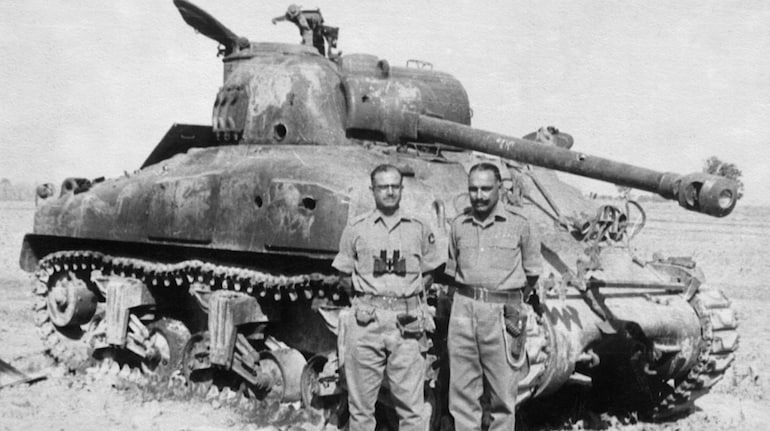
In the September 1965 war, the fighting around Sialkot turned into a grinding armoured
clash that is still talked about in the same breath as the biggest tank battles of the
twentieth century.
Chawinda is a small town in Pakistan’s Punjab, not far from Sialkot. In September
1965, it became the centre of gravity for a huge armoured contest because that’s
where Pakistan chose to concentrate its armour to stop India’s thrust in the Sialkot
sector.
What began as a fast-moving offensive built around Indian armour and
artillery slowly turned into a stubborn, messy, high-casualty contest of tanks, guns, air
strikes, and field defences, with neither side getting the clean breakthrough it wanted.
The “largest since Kursk” line gets attached to Chawinda in popular memory because
the scale of armoured forces in the 1965 war was genuinely large by subcontinental
standards, and the battles in the Sialkot sector involved repeated tank-on-tank
engagements over days.
But it’s also worth being careful: losses and numbers vary
widely by source and by national narrative. What is not in dispute is that this sector
saw sustained armoured fighting, and Chawinda became the point where India’s
advance ran into Pakistan’s most determined armour-heavy defence.
The bigger picture before the tanks rolled in
By early September 1965, the war had expanded across multiple fronts. In the Sialkot
sector, India committed I Corps, including its 1 Armoured Division, backed by infantry
divisions and heavy artillery. The idea was to push into Pakistani territory in a corps-
level offensive that wasn’t a raid or a limited jab, but a serious attempt to force
Pakistan to fight where India wanted it to fight. This was India’s biggest armoured
gamble since World War II, built around a large concentration of armour and artillery
in a relatively compressed battlefield.
Pakistan responded by committing its 6 Armoured Division, equipped with US-
supplied Patton tanks that carried a strong reputation at the time. This choice shaped
what followed: once both sides had committed major armoured formations in the
same area, disengagement became difficult, and any local reverse risked turning into
a larger breakthrough.
From Phillora to Chawinda: The road that mattered
A key reason Chawinda became so important is geography and road networks. The
Indian offensive progressed through a chain of engagements. The Battle of Phillora,
fought in the Sialkot sector, is described in India’s official commemorations as one of
the fiercest tank battles of the war, with Indian forces pressing hard enough to force
Pakistani units to retreat and regroup toward Chawinda.
The National War Memorial account places Phillora’s offensive beginning around 10
September 1965 and describes intense fighting over the next two days, with Pakistani
resistance stiff but eventually compelled to fall back towards Chawinda. It also
highlights how the fight was not just tank-versus-tank theatre. Artillery fire and air
attacks were part of the problem set, and terrain and visibility mattered.
Once you understand that Phillora was not an end point but a step in the advance,
Chawinda’s role becomes clearer. If Phillora was where the Indian thrust showed
momentum, Chawinda is where Pakistan attempted to make that momentum bleed
out.
The stand at Chawinda was not one clean battle, but a grind
People often talk about Chawinda as a single dramatic clash, but what makes it
historically significant is the sustained nature of fighting and the way it absorbed
armour, time and attention. By the time the confrontation consolidated around
Chawinda, Pakistan had chosen to mass armour and create a defensive belt strong
enough to halt the advance. That meant Indian armour faced not just enemy tanks,
but coordinated artillery, prepared positions, obstacles, and a battlespace where
movement was increasingly punished.
Phillora represented early momentum, Chawinda represented resistance. It describes
the battle around Chawinda as a grinding fight where neither side achieved a clean
breakthrough, and where the limitations of armoured warfare in that terrain became
obvious.
ThePrint’s reporting, drawing on accounts of Pakistan’s armour actions, also
underlines the same theme: delaying actions and tactical deception bought Pakistan
time to “beef up” for what became the Battle of Chawinda.
This matters because armoured warfare is not only about how many tanks you have.
It is about time, ground, and whether you can bring guns, infantry and air support
into a combined system faster than the other side can. Chawinda became a contest of
systems, not just steel.
The human story inside the armour
Even in a tank battle, infantry and artillery shape the outcome. One useful reminder
comes from an Indian Express Military Digest piece which notes that Indian units
fighting in the Chawinda and Jassoran area faced concentrated armour, artillery and
air strikes, and that positions could become untenable even when communications
held. It’s a very “close-to-the-ground” view of how brutal the fighting was beyond the
headline image of tanks.
Indian narratives of the Sialkot sector often highlight Lt Col A B Tarapore of Poona
Horse, who was later awarded the Param Vir Chakra. News accounts mention his
leadership during these armoured engagements and notes that Indian
commemorations emphasise his directing operations despite wounds.
On the Pakistani side, ThePrint’s account of Lt Col Nisar Ahmed Khan and 25 Cavalry
describes a classic battlefield problem: being outnumbered, needing to delay and
mislead the enemy about the strength you actually have, and buying time for a larger
defence to form.
Whether you read this as tactical brilliance, professional
improvisation, or simply the logic of delaying actions, it points to something
important about Chawinda: both sides were trying to manage risk as much as they
were trying to win ground.
Why it is compared to Kursk, and why that comparison needs care
The Kursk comparison is basically shorthand for “a lot of tanks fought in one place.”
In the 1965 war, large numbers of tanks were indeed committed across multiple
battles. Britannica describes Asal Uttar as one of the largest tank battles since Kursk,
and separately notes Chawinda as another major tank battle where Pakistani
armoured units halted an Indian advance.
So the careful way to say it is this: Chawinda is widely remembered as one of the
biggest armoured clashes in the 1965 war, and it is often placed among the large post-
World War II tank engagements in popular discussion, but precise “largest since”
rankings depend heavily on what you count, whose figures you use, and whether you
mean a single day’s action or a multi-day campaign.
What is safer and still meaningful is the strategic point. Chawinda forced a
concentration of Pakistan’s armour in defence and slowed India’s offensive before the
war ended in a ceasefire later in September.
What Chawinda achieved and what it did not
This was one of those battles where both sides claimed success and the larger war
ended without a decisive territorial outcome. The Sialkot offensive did not produce a
dramatic territorial gain that survived the post-war settlement, but it mattered
because it fixed Pakistan’s premier armoured division and imposed costs, while also
proving that Indian armour could fight Pakistan’s Patton-equipped formations head-on.
India’s official commemorations also describe the sequence as an advance that
culminated at Chawinda, where the advance was halted as the ceasefire took hold.
So the legacy is more about lessons than land. Chawinda reinforced a brutal truth
about armoured warfare: a breakthrough is not guaranteed just because you have
tanks. You need logistics, infantry integration, artillery dominance, control of routes,
and a tempo that the opponent cannot match. When the opponent can match it, the
battle becomes a grind.
The aftertaste of Chawinda
The war ended with international pressure and a ceasefire, and later the Tashkent
Declaration in January 1966 formalised the post-war reset. Britannica notes the
Tashkent Declaration and places it as the formal end point to the conflict’s settlement.
But the memory of Chawinda lingered because it felt like the moment when the war’s
promises collided with its limits.
For India, it was proof of an ambitious armoured
thrust and a costly near-miss of a decisive breakthrough. For Pakistan, it was a
defensive stand that stopped an advance and protected a critical area. For military
historians, it is a case study in what happens when both sides commit armour in
depth and neither side collapses quickly.
Discover the latest Business News, Sensex, and Nifty updates. Obtain Personal Finance insights, tax queries, and expert opinions on Moneycontrol or download the Moneycontrol App to stay updated!
Find the best of Al News in one place, specially curated for you every weekend.
Stay on top of the latest tech trends and biggest startup news.