
When the Kargil conflict is recalled, public memory gravitates to a handful of dramatic peaks. Yet some of the hardest and most consequential fighting of 1999 unfolded in the Batalik bowl and the Dras sector, where progress was measured not in dramatic night assaults but in weeks of attrition, artillery fire and incremental infantry gains.
Indian news reporting from the time, particularly in The Indian Express and The Hindu, described these sectors as the most unforgiving parts of the battlefield. Here, the intrusions were deeper, the terrain more open to observation, and the enemy’s positions better integrated with artillery across the Line of Control. Victory did not come through a single climactic assault but through the grinding coordination of guns and foot soldiers.
Why Batalik and Dras mattered
Geographically, Batalik and Dras sat astride approaches that threatened not just National Highway 1A but also lateral movement along the front. Pakistani positions in these sectors overlooked long stretches of road and valley floor, enabling sustained interdiction. Unlike some isolated peaks elsewhere, the intrusions here formed mutually supporting clusters.
Indian Army assessments cited in post-war reporting noted that unless these sectors were cleared, restoring the status quo along the Line of Control would remain incomplete. That strategic necessity shaped the way operations were conducted.
The artillery war that changed the balance
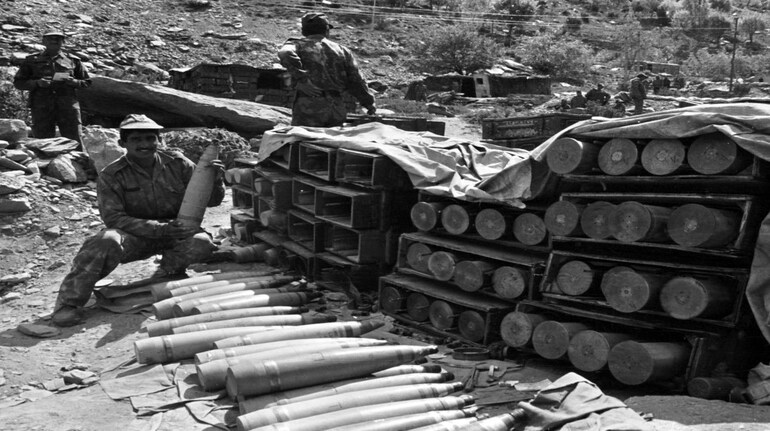
The defining feature of operations in Batalik and Dras was artillery. From the earliest days of the conflict, Indian field and medium artillery, supported later by Bofors FH-77B guns, began a systematic campaign against enemy sangars, supply routes and gun positions.
The Hindu’s contemporaneous coverage repeatedly highlighted the scale of this firepower. Unlike earlier mountain conflicts, Kargil saw artillery used not just in support of assaults but as a shaping weapon over weeks. Sustained barrages degraded enemy morale, cut off re-supply, and forced defenders to remain under cover for extended periods.
This was not indiscriminate fire. Artillery observers, often positioned in exposed forward locations, adjusted fire based on infantry feedback. Media reports from Dras described how platoon commanders relayed bunker locations and movement patterns, allowing gunners to refine their targets. Over time, this coordination began to tell.
Infantry persistence under fire
If artillery created conditions, infantry had to exploit them. In Batalik and Dras, that exploitation was slow and costly. Assaults often followed prolonged shelling, but terrain limited surprise. Many approaches were visible for kilometres, leaving troops exposed to small-arms and mortar fire.
Indian Express dispatches from June and July 1999 noted that gains were often counted in tens of metres. A ridge would be taken, consolidated, and then held under counter-fire before the next move could begin. Withdrawal was rarely an option, as vacated ground could be reoccupied by the enemy.
The persistence required of infantry units in these sectors was exceptional. Troops carried supplies up steep gradients repeatedly, often under observation. Casualty evacuation itself became a tactical challenge, with helicopters vulnerable to ground fire and stretcher carries taking hours.
Leadership at the company and platoon level
As in other parts of Kargil, junior leadership proved decisive. Company commanders had to balance pressure from above to advance with the physical limits of men operating above 15,000 feet. Platoon commanders and junior commissioned officers frequently made calls to pause, reorganise or probe alternate routes when frontal movement stalled.
News interviews published after the war in The Hindu and Frontline captured this reality. Officers spoke of abandoning rigid timelines and focusing instead on sustainability: holding ground securely, maintaining supply lines, and waiting for artillery effects to accumulate before pushing again.
This approach contrasted with more dramatic single-night assaults elsewhere, but it was suited to the terrain. In Batalik and Dras, persistence mattered more than speed.
Counter-fire and escalation risks
One of the complexities of artillery dominance in these sectors was escalation control. Pakistani guns across the Line of Control responded vigorously, leading to some of the heaviest artillery exchanges seen in decades. Villages in Dras came under fire, prompting civilian evacuations that were widely reported in the Indian press.
Despite this, Indian commanders chose not to ease pressure. As The Indian Express reported, the logic was clear: any slackening of fire would allow enemy positions to recover. The artillery duel thus became both a military and political signal, underscoring India’s resolve while staying within the bounds of a limited conflict.
Breaking the defensive system
Over time, the cumulative effect of artillery and infantry pressure began to fracture the defensive system in Batalik and Dras. Supply routes became hazardous. Defensive sangars collapsed or were abandoned. Intercepts and later media briefings suggested growing strain among intruding forces.
Infantry advances that had once stalled began to make steadier progress. Positions fell not because of a single tactical breakthrough but because defenders could no longer hold under constant fire and dwindling supplies.
By late July, as Indian troops consolidated gains across the sector, it was evident that the balance had shifted decisively. Clearing Batalik and Dras removed the last major threats to the highway and helped seal the broader operational outcome of the war.
An unglamorous but decisive fight
In retrospect, Batalik and Dras exemplify a less glamorous but more representative form of mountain warfare. There were no dramatic summit photos or single iconic assaults. Instead, there was coordination, endurance and acceptance of slow progress.
Indian news media have increasingly emphasised this aspect in anniversary coverage. Articles in The Indian Express and The Hindu marking 10 and 20 years of Kargil have pointed out that without the attritional success in these sectors, victories elsewhere would have been incomplete.
Lessons that endure
The experience of Batalik and Dras reinforced several enduring lessons. Artillery, when used intelligently and persistently, can dominate even the harshest terrain. Infantry, properly supported, can hold and advance despite extreme conditions. And wars in the mountains are often won not by speed but by the ability to sustain pressure longer than the opponent.
These lessons remain relevant as India continues to deploy and train forces in high-altitude environments. Kargil’s quieter battles remind us that military success is often built on patience, coordination and the willingness to endure.
Discover the latest Business News, Sensex, and Nifty updates. Obtain Personal Finance insights, tax queries, and expert opinions on Moneycontrol or download the Moneycontrol App to stay updated!
Find the best of Al News in one place, specially curated for you every weekend.
Stay on top of the latest tech trends and biggest startup news.