






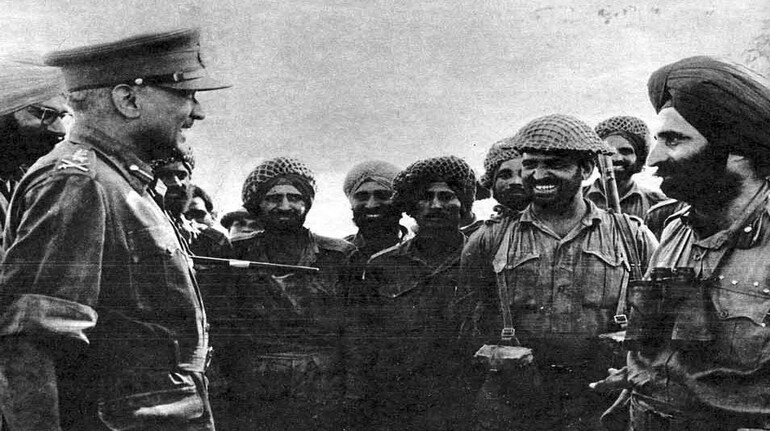
The Ichhogil Canal, formally the Bambawali–Ravi–Bedian (BRB) Canal, was the most formidable man-made obstacle on the Lahore front in September 1965. Conceived by Pakistani planners as a defensive barrier against an Indian armoured thrust, it combined a wide water channel with raised banks, concrete bunkers, and interlocking machine-gun fire. Indian Army official histories describe it not as a simple canal crossing problem, but as a prepared defensive system meant to bleed attacking infantry before armour could even come into play.
When Indian forces crossed the International Border on the morning of 6 September 1965, the immediate objective of 7 Infantry Division was to break through this canal belt by seizing key villages and bridges on the approaches to Lahore. Among these, Barki emerged as the focal point. Located just east of the canal, the village had been converted into a fortified locality, with houses loopholed for fire, lanes mined, and positions sited to dominate likely infantry approaches, a pattern recorded in the Indian Army’s official account of the Western Theatre in 1965.
The fighting that unfolded here explains why the phrase “the charge at Ichhogil” entered regimental lore. The terrain forced infantry assaults at close quarters. The canal and its subsidiary drains funnelled troops into narrow axes, leaving little room for manoeuvre. Darkness, smoke, and dust reduced visibility, making junior leadership and individual initiative decisive. In such conditions, attacks often collapsed into short, violent rushes against bunkers and machine-gun nests, the kind of action that soldiers themselves remember simply as “charging”.
Barki and the road to the canal
Indian accounts agree that the capture of Barki was essential to any further movement towards the canal. The village blocked access to bridges and siphons that could allow armour to cross or, failing that, be denied to the enemy. According to the official history of the 1965 war, repeated attempts were required to clear Barki because Pakistani defenders used fortified houses and trenches to fight from point to point, inflicting heavy casualties on the attackers.
The assault that finally broke the defence came at night, supported by concentrated artillery fire. Infantry moved in small groups, clearing buildings one by one. Regimental histories of the Sikh Regiment note that Sikh troops were among those tasked with leading these assaults, suffering significant losses but steadily collapsing resistance. One widely cited episode from this fighting involves a junior leader silencing a machine-gun post at grenade range despite being wounded, an action later recognised with a gallantry award, illustrating the kind of individual bravery that defined the battle in memory.
Once Barki was secured, attention shifted fully to the canal line itself. The Indian Army’s operational narrative records attempts to approach and neutralise canal crossings under fire, often against defenders occupying the higher western bank. In several instances, bridges were destroyed during the fighting, either deliberately or in the chaos of combat, denying both sides immediate use and turning the canal into a static killing zone.
The nature of the “charge”
What did a “charge” mean at Ichhogil in 1965? It did not resemble a massed daylight assault of an earlier era. Instead, it consisted of short, desperate rushes across exposed ground, often no more than a few dozen metres, to close with a firing point that was holding up the advance. Infantry training manuals of the period emphasised closing quickly once detected, because hesitation under machine-gun fire almost guaranteed casualties.
Veterans’ accounts published in regimental journals describe these moments vividly: the sudden order to rush, the feeling of running into a wall of fire, the explosion of grenades at bunker mouths, and the silence that followed when a position was knocked out. Such descriptions recur across units and sectors on the Lahore front, which is why the Ichhogil Canal came to symbolise infantry sacrifice far beyond any single battalion’s war diary entry.
8 Sikh and regimental memory
Within this broader context, the association of 8 Sikh with the Ichhogil Canal reflects how regiments remember campaigns. While commonly available operational summaries tend to name specific battalions for specific battle honours, regimental memory often works at the level of sectors and experiences rather than precise objectives. Sikh Regiment histories list Burki and the Ichhogil sector among the regiment’s proudest chapters of the 1965 war, even though different battalions may have fought at different points along that line.
Military historians have noted that on static fronts like Ichhogil, units rotated through forward localities, patrols, and limited assaults once the initial objectives were taken. Such actions rarely make it into popular histories but account for a large share of casualties. It is in this grinding, repetitive combat that legends are born. A platoon’s costly rush to silence a bunker, even if tactically minor, becomes emblematic of the entire battle in regimental storytelling.
The absence of a single, universally documented “8 Sikh charge” in open-source operational histories does not diminish this memory. Instead, it highlights the gap between formal military history and lived soldier experience. As Srinath Raghavan observes in his study of the 1965 war, many of the fiercest infantry engagements were local, fragmented, and poorly recorded beyond unit level, yet they shaped morale and identity within regiments for decades.
Casualties and cost
What is beyond dispute is the human cost. Indian Army casualty figures for the Lahore sector show that infantry units bore the brunt of losses in September 1965. The canal defences ensured that even limited advances were paid for in blood. Regimental rolls from the Sikh Regiment list officers, junior leaders, and jawans killed or wounded in the Barki-Ichhogil fighting, reinforcing the sense that this was a baptism of fire for a generation of soldiers.
The Pakistani side commemorates the same ground with equal intensity. Major Raja Aziz Bhatti, killed defending the Barki sector, is honoured as a national hero in Pakistan, and Defence Day observances there underline how critical and costly the fighting was. The existence of parallel memories on both sides points to the scale and ferocity of the battle rather than to any single tactical episode.
Why the legend endures
The Ichhogil Canal occupies a unique place in the Indian Army’s collective memory because it represents the limits of infantry courage against prepared defences. The advance towards
Lahore ultimately stalled along this line, and strategic decisions elsewhere shaped the war’s outcome. Yet at the level of the soldier, Ichhogil was a place where orders were simple and brutal: move forward, silence the gun, hold the ground.
That is why “the charge at Ichhogil” survives as a phrase within regiments like 8 Sikh. It encapsulates a style of fighting rather than a single manoeuvre. It speaks to the belief that, when faced with an obstacle designed to stop you, the infantry’s answer is to close in regardless of cost.
In that sense, the legend is less about precise attribution and more about what the canal demanded of those who fought there. As the Indian Army’s official history of the 1965 war concludes in its chapter on the Lahore front, Ichhogil was where courage met concrete, and neither side found an easy way through.
Discover the latest Business News, Sensex, and Nifty updates. Obtain Personal Finance insights, tax queries, and expert opinions on Moneycontrol or download the Moneycontrol App to stay updated!
Find the best of Al News in one place, specially curated for you every weekend.
Stay on top of the latest tech trends and biggest startup news.




