








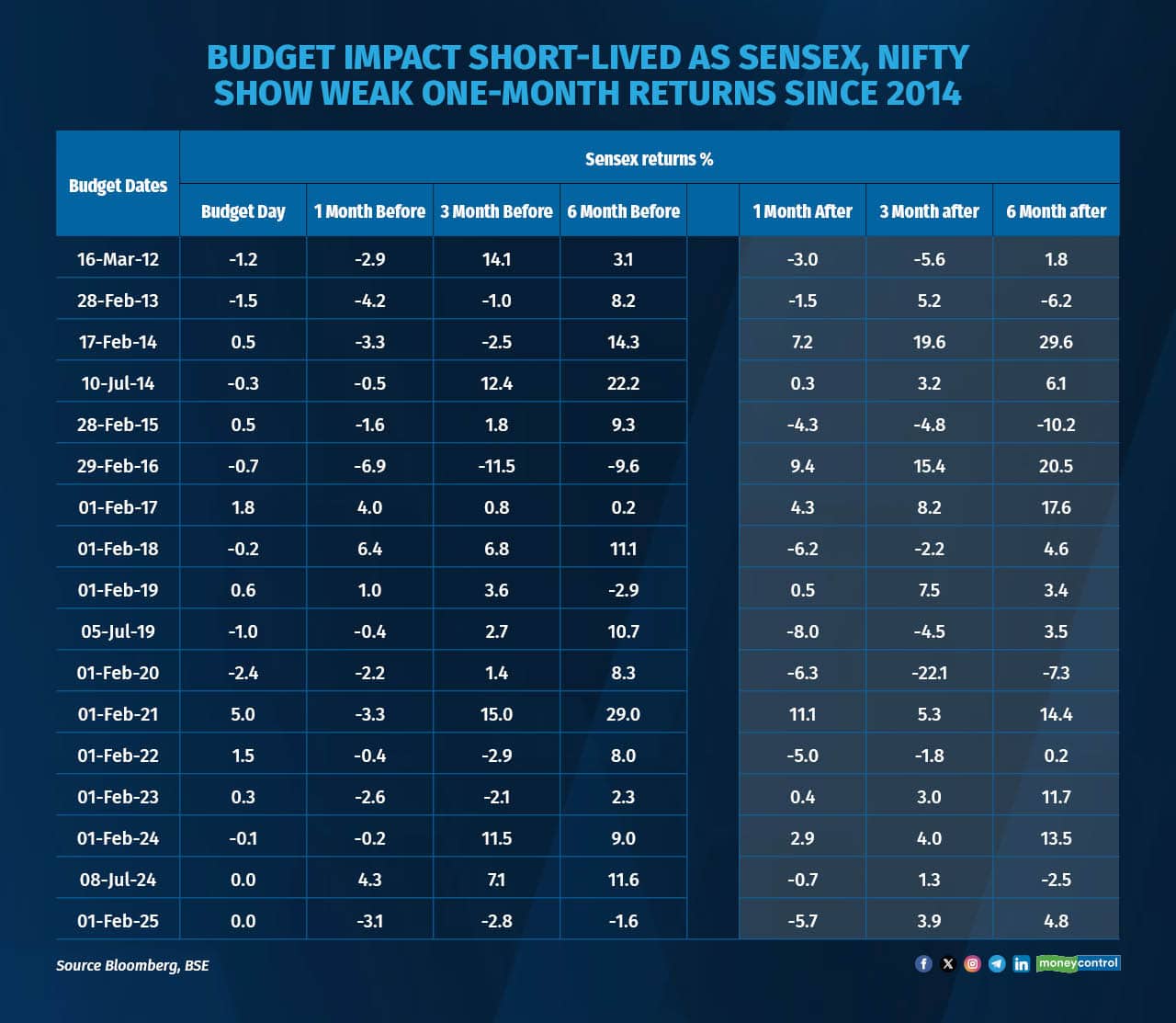
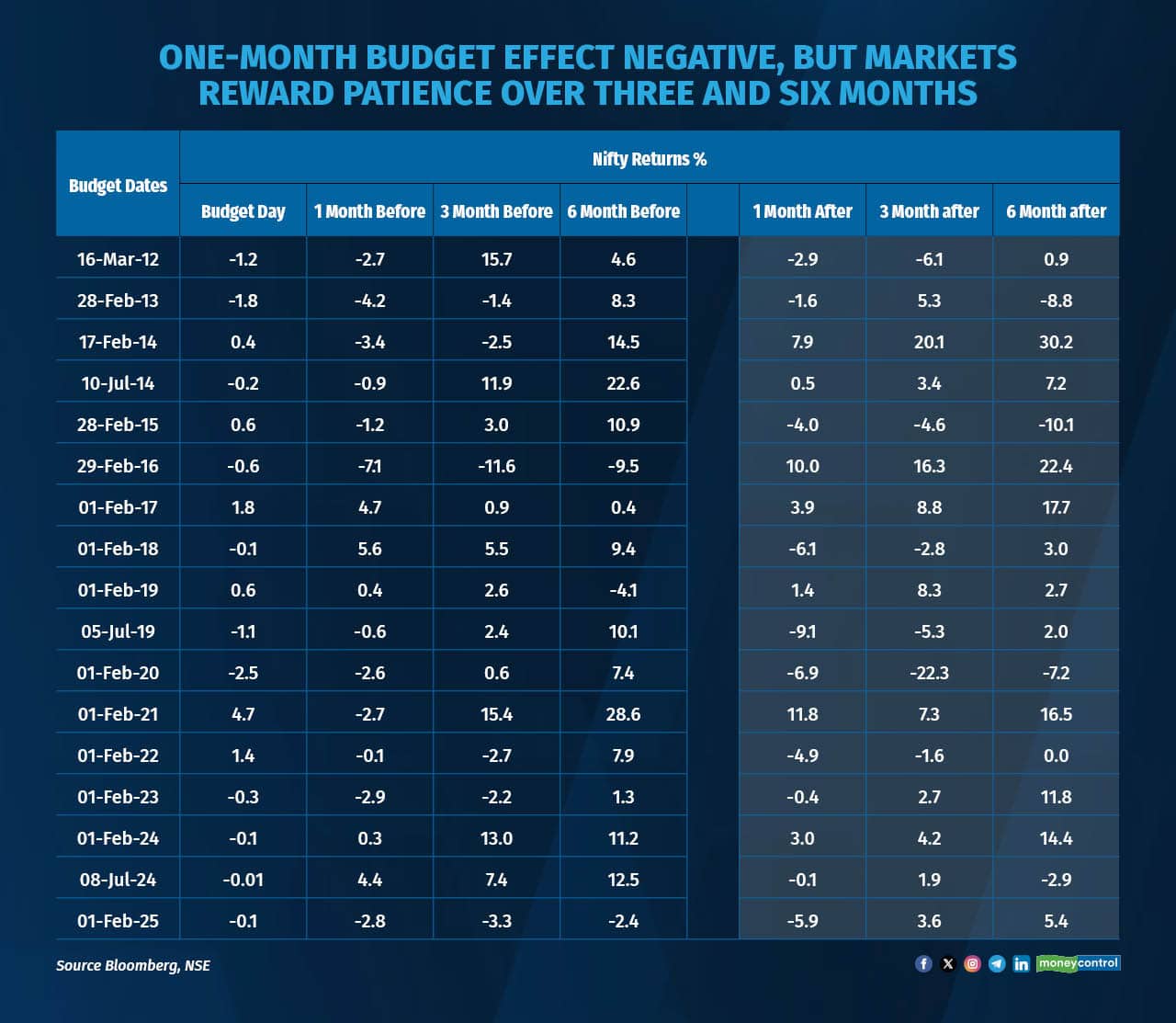
The government is set to announce the Union Budget on 1 February, and historical data suggests that domestic equity markets have largely struggled in the immediate period surrounding the event. Market performance in the one-month window before and after the Budget has generally remained weak, even as returns over longer periods of three and six months have been significantly stronger.
Since the Modi government took charge in 2014, a total of 14 Union Budgets including interim have been presented. During this period, India’s benchmark indices — the Sensex and the Nifty — delivered negative returns on 10 occasions in the one month preceding the Budget. In the one month following the Budget, negative returns were recorded in seven instances. On an average basis, returns in the one month before the Budget have declined by around 0.4 percent, while average returns in the one month after the Budget have fallen by about 0.5 percent.
In contrast, market performance improves notably when the time horizon is extended. Both the three-month and six-month periods before and after the Budget have consistently delivered positive returns. Since 2014, markets have posted gains 10 times in the three months preceding the Budget and 11 times in the six months before it. Similarly, returns have been positive on nine occasions in the three months following the Budget and 11 times in the six months after the announcement. Average returns before and after three months stand at 3.1 percent and 1.2 percent respectively, while six-month average returns are around 8 percent before the Budget and 6 percent after it.
Kranthi Baithini, Director – Equity Strategy at WealthMills Securities, said the Union Budget continues to be a major event for the stock market, although its overall significance has evolved in recent years. With several proactive policy measures and the introduction of the Goods and Services Tax, many indirect tax-related decisions have shifted to the GST Council. As a result, the Union Budget’s scope has increasingly narrowed to direct taxes such as income tax, along with select policy decisions.
Despite this change, Baithini said the Budget still carries importance, particularly with respect to fiscal deficit numbers, government borrowing plans, infrastructure spending, railways and capital expenditure targets. At the same time, he noted that equity markets are now influenced by a wider range of factors, including market cycles and global geopolitical developments. In recent years, while the Budget has remained an important event, it has not always been the primary driver of market direction.
Experts said market reactions on Budget day are often knee-jerk in nature, with indices frequently swinging between gains and losses during the session as investors assess the proposals and their potential impact on the economy and corporate profitability. The movements in the month preceding the Budget are typically driven by a combination of global developments, fund flows — both foreign and domestic — and company-specific factors.
The build-up of expectations generally begins about a week before the Budget, influenced by media discussions, representations from industry bodies and signals from policymakers. These moves tend to intensify when a newly elected government is presenting its first Budget, as expectations rise sharply.
According to independent research analyst Deepak Jasani, market movements in the month following the Budget are often inversely proportional to those seen in the preceding month, unless the Budget outcome is significantly better or worse than anticipated. Investor reactions are usually concentrated in the week after the Budget, when market participants analyse both the announcements and subsequent clarifications or amendments proposed by the finance minister. He added that market performance over six- and twelve-month periods before and after the Budget remains largely independent of Budget expectations, as markets continue to respond to global trends, liquidity flows and microeconomic developments.
Few experts noted that the Budget still holds importance, particularly for fiscal deficit targets, government borrowing plans, infrastructure outlays, railways and capital expenditure priorities. However, analysts also highlighted that equity markets are increasingly shaped by broader forces, including global economic cycles and geopolitical developments, reducing the Budget’s role as a sole market driver.
Pre-Budget and post-Budget rallies remain a recurring feature, but these moves are often sharp and short-lived. Markets frequently witness a rally ahead of the Budget, followed by profit booking once announcements are made, contributing to the weak one-month performance reflected in historical data. Analysts said markets typically look for strong reform-oriented measures, and in several recent Budgets such expectations have not always been met, they added.
Looking ahead to Budget 2026, market expectations are centred on measures to promote cash market participation and the potential easing of long-term and short-term capital gains taxes introduced in Budget 2025. The previous Budget brought several changes viewed negatively by the equity market, including a uniform long-term capital gains tax rate of 12.5 percent across asset classes and the removal of indexation benefits for most assets.
While the annual exemption limit for gains on listed equity shares and mutual funds was raised to Rs 1.25 lakh, the short-term capital gains tax on listed equities and equity-oriented mutual funds was increased to 20 percent from 15 percent. In addition, the securities transaction tax on futures and options was raised, with higher rates applied to both segments.
Indian equity markets have witnessed heightened volatility since the beginning of 2026 and throughout 2025, amid continued foreign investor outflows, stretched valuations, subdued earnings growth, geopolitical uncertainties and concerns over steep tariffs on Indian exports.
Market participants expect the upcoming Budget to emphasise fiscal discipline, with the fiscal deficit likely to be targeted at around 4.3 percent of GDP, lower than 4.4 percent in FY26. Given this focus, analysts do not expect populist measures or large tax giveaways. The Budget is expected to be framed around a nominal GDP growth assumption of about 10.1 percent, providing room to balance fiscal discipline with growth support. At the same time, analysts see scope for increased capital expenditure in non-traditional or sunrise sectors, particularly defence and allied industries, as India increasingly aligns its fiscal framework with the debt-to-GDP ratio as a primary policy objective.
Discover the latest Business News, Sensex, and Nifty updates. Obtain Personal Finance insights, tax queries, and expert opinions on Moneycontrol or download the Moneycontrol App to stay updated!
Find the best of Al News in one place, specially curated for you every weekend.
Stay on top of the latest tech trends and biggest startup news.





