






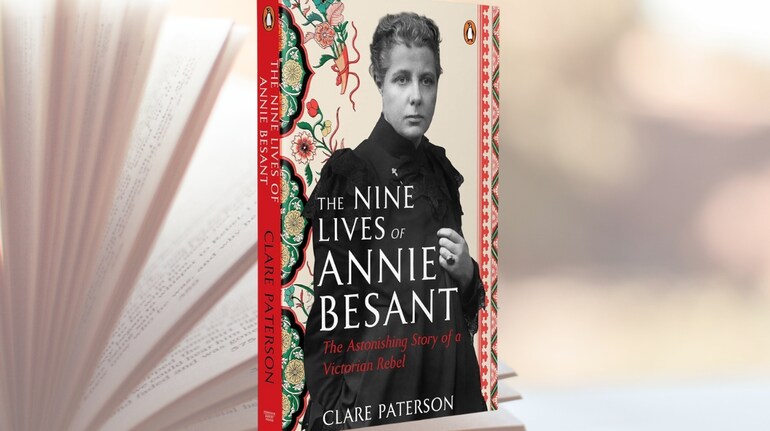
Excerpted with permission from the publisher The Nine Lives of Annie Besant: The Astonishing Story of a Victorian Rebel, Clare Paterson, published by Penguin eBury Press.
******
Once Annie had secured her position as president of the society and was living in India, she made her home the international headquarters in Adyar on the outskirts of Madras.
Famed for its ancient giant banyans nearly 4,000sq ft, the estate remains a riot of green leaves spangled with bright colours from flaming fruit and flowers. Annie acquired more land here and extended the beautiful riverside estate, which Madame Blavatsky and Olcott had founded in the 1880s. Among the dense trees, Annie set about constructing temples for Hindus, Christians, Zoroastrians and others as a physical reminder that Theosophy was compatible with all faiths. At its fullest, Adyar accommodated about fifty Europeans and a hundred Indians.
Adyar became a place of pilgrimage for students of Theosophy like Emily Lutyens. Another visitor was suffragette Clara Codd, who was a Theosophical lecturer as well as the society's librarian. Thanks to a generous sponsor, she arrived in Adyar around 1911 for a two-year stay, which she described as 'the pilgrimage of my life."" After enduring the tricky journey by ship, during which as a vegetarian she survived on lots of carrots smothered in Worcestershire sauce, she felt huge relief. 'I said to myself: "I am here! I am really here!" [...] An immense and steady peace pervaded it. Even strangers visiting us would always remark on that, and I felt I was in a mystic "powerhouse" from which currents reached unseen to every quarter of the globe." Clara Codd attended debates in the large, elegant meeting hall, decorated with symbols of all religions, which sat at the heart of the complex. Externally, it was embellished with large elephants' heads. Inside today, under the whirl- ing ceiling fans, are busts of Olcott and Annie and a life-sized double statue of Colonel Olcott standing proudly behind a seated Madame Blavatsky. Clara sought permission each day to spend half an hour of solitude in the shrine room, which contained two large paintings of the Masters. No servant was allowed to enter and it was cleaned by devoted members. Just as visitors do now, Clara ate vegetarian food, and stayed in simple lodgings on the estate. She relished feeling close to nature and rejoiced in the lizards, the chameleons, the red and white waterlilies, and the abundance of squirrels.
Clara recalled that at 5 p.m. each day Anne would set off through the trees and a little crocodile would form behind her. Everyone would hope to be called forward for a word. Outside the estate there was speculation about loose morals, and one visitor quizzed Clara about the subject. Clara assured her that lovemaking unknown. 'All Madras considered that were an “anode of love". We were supposed to live promiscuously whereas the simple truth was as I had stated it’.
Annie's rooms were upstairs in the central block, overlooking the wide river with its buffalos, egrets and cormorants. The space has remained untouched, and behind the heavy door, which is kept locked even today, is a cool suite of rooms with very plain decoration. There is a single bed for nighttime, as well as a daybed attached to a low desk, and it is here that Annie sat cross-legged and wrote by hand, rarely using the services of a secretary. Looking down on her were portraits of her colleagues, and in pride of place a portrait of Madame Blavatsky. Alongside the rooms on two sides was a wide covered terrace. Here Annie could walk in the shade and absorb all the sounds of the river below, while being protected from the punishingly high temperatures. This was her private space. Clara, Emily, the other well-to-do British ladies, and the many Indian members wishing to learn, would have met in the public spaces to hear talks by Leadbeater and by Annie. 'Her magnetism pervaded the whole place,' remarked Clara.
From 1908 Annie had signalled in her writing and her lectures that a new Christ was coming. There would be a new messiah, a world teacher. This was part of Theosophy's understanding of evolutionary theory and the development of the human race towards enlightenment. As human nature improved, Lord Maitreya, in Theosophical terms the leader of the esoteric spiritual hierarchy, would appear in the 'vehicle' of a messiah. Leadbeater thought he had found that 'vehicle' in the person of Hubert van Hook, a 7-year-old American boy, the son of a Theosophical supporter who would soon be arriving at Adyar. But plans are always subject to change.
Leadbeater lived in the international headquarters. Each afternoon he left his residence, not far from the great banyan tree, and followed the path through the coconut plantation and down to the river's edge. Here on the beach, he and his followers would swim. One day in April 1909 Leadbeater found his eyes to a frail Indian teenager on the beach. The 14-year-old was 'undernourished, scrawny and dirty; his ribs showed through his skin and he had a persistent cough. His teeth were crooked. His biographer Roland Vernon writes:
Oblivious of his companions in the sea, Leadbeater had eyes only for the boy […] The child appeared to be surrounded by an etheric substance of gorgeous luminescence.
Krishnamurti was the boy. He and his brother Nityananda, who was by far the brighter and sparkier of the two, were living with their siblings on the edge of the Adyar estate. Their mother had died five years before and their father, Jiddu Narayaniah, was a Theosophist and retired civil servant, now working in the society office with a paltry income and squalid home. Within weeks, Leadbeater had plucked both boys from their school, home and father's supervision, and begun to groom Krishnamurti for his new role, replacing the now rejected American choice for the messiah. If Krishna (as he was known) were to be the 'vehicle', he would have special responsibilities, including abandoning caste limitations and maintaining life-long celibacy. He would also need to discover and develop his spiritual capacity. Leadbeater, with his ability to trace past lives, was soon able to document the boy's last thirty incarnations, which proved how well qualified he was for the task. Leadbeater also supervised the two brothers' educations, with contributions from several other keen, learned Theosophists, but he managed the spiritual training himself.
In Adyar the two boys' daily routine was organised strictly, starting at 5 a.m. with ablutions, prayers in the shrine room, lengthy bike rides, baths and then classes, and later lectures from Leadbeater well into the evening.
After five months of training, Krishnamurti had made significant spiritual progress and was ready for his initiation. On her travels again, Annie was only present 'astrally,' so Krishna tried to recall for her what had happened. He described a marathon 36 hour induction in Annie’s bedroom during which he had left his body and visited the Masters in Tibet. 'It was beautiful,' he wrote. They spoke kindly to him. We all prostrated ourselves, and the Master drew me onto his knee, and asked me whether I would forget myself entirely and never have a selfish thought; and I said I only wanted to be like Him someday.' The teenager's letter immediately passed on from secret initiation rites to his cycling statistic. ‘I have ridden 234 miles now and I enjoy my rides very much. I send you very much love many times each day. Your loving son, Krishna.'
Annie was still away on her American tour and sailed back to Madras six months after the discovery. She arrived by train on 27 November 1909 and with keen anticipation, met the new saviour for the first time at the station. He was now well fed and spruced up, 'a slim and gracious Indian boy in spotless silken Indian clothes'." She left again after only a few weeks but started a correspondence with the boy that lasted for decades. 'Dear boy,' she wrote, 'I will indeed be your mother. I love you as my son. This was not love at first sight because Annie knew they had met before. ‘I know you will always love me, my Krishna, for we have loved each other through so many lives, & now are fellow disciples, following our Masters.'
In March 1910, the boys' father Narayaniah signed an agreement that relinquished guardianship of his sons to Annie until they were 25. ‘Being fully convinced that until they grow up and become fit to enter upon life they cannot be in better supervision than yours,' he wrote. ‘It is my wish that you alone should be the guardian of their persons during their minority. His expectation was that the brothers would be educated in England and prepared for studying at Oxford University, a previously undreamed-of advancement for his sons.
Lady Emily Lutyens, the 37-year-old daughter of a previous Viceroy of India and wife of the man who was destined soon to build the new parliament buildings for the British in Delhi, was a very religious woman who was curious about Theosophy. In the summer of 1910, Annie was back in the London giving a talk at the Fabian Society. The event was restricted to members, so Emily joined specifically to hear her lecture, and she had quite a shock when she first saw the speaker. ‘She was dressed in flowing white robes of a most feminine character while her fine massive head with its short white curls looked entirely masculine. She was sixty-three but showed not the slightest had the most amazing vitality of anyone I have ever met.’ Annie was still in her prime and came across as assertive without being loud. Men might have called her a battleaxe but women like Emily Lutyens relished seeing a strong woman in a position of power. Annie soon had significant plans and Emily Lutyens was keen to help, and as a new follower became a key partner in the next project.
Emily Lutyens read in The Theosophist that the body, which the new messiah would inhabit had already been born and she wanted to know who it might be. Then she saw a photo of Krishnamurti. ‘As soon as I looked at his face,' she recalled, 'I knew in a flash the answer to my question and that he, and no other, was the coming Teacher." And so began a life-long devotion from Lady Emily towards the teenager endowed with a spiritual mission. Krishnamurti wrote regularly to her too, and from his point of view, she was his second mother. He was always respectful and deeply loving to Annie. He was more intimate and confiding with Emily, in a strong and unusual relationship. It was confessional from the teenager and loving in a borderline romantic, but platonic, way from Lady Emily.
By the end of his first Theosophical year, the boy with the divine credentials 'wrote' a book, At the Feet of the Master, although he was semi-literate. It sold like hot cakes and still sells today. Excitement about the new world leader spread throughout the lodges. By 1911 there were 16,000 Theosophy members worldwide and a new, international sub-organisation was formed for those who believed in the coming world teacher and wanted to prepare the world for his coming. It was called the Order of the Star in the East.
Lady Emily became the British representative of the order, but her husband Edwin Lutyens was dubious about it, especially as his wife seemed obsessed with the boy. In a letter to her, the architect refrained from criticism but worried about her engaging with the spiritual realm. He did believe in a force, but was not convinced it had anything to do with the 'soul' rather than an element like electricity. This force, he thought, although stimulating, could paralyse the brain (like whisky he said), and while he found the subject thrilling, he was against messing with it. 'I should rather a child of mine went on foot,'he told Emily, 'than dabble with magic and The occult was best left alone until it was understood. His wife, although sometimes plagued by doubts, fervently disagreed.
In April 1911, Annie, still wearing her white sari-like dresses, together with headmaster George Arundale, accompanied the boys to Britain. En route, the boys had their ears sewn up to conceal their piercings. They were given European clothes Norfolk jackets, single-breasted made of tweed, with box pleats and belts, as well as shiny leather shoes, which were an unpleasant novelty. The photograph of the arrival at Charing Cross looks like that of a Hollywood film star. Emily Lutyens recalled the occasion standing amid enthusiastic crowds on the platform. ‘I had eyes for none but Krishna’ she wrote, 'an odd figure with long black hair falling out to his shoulders, and enormous dark eyes which had a vacant look in them.’ As she left the station, she found one of the members of the society in an almost fainting condition. 'She was somewhat psychic and had been overwhelmed by the glory of Krishna's aura." Theosophy was very fashionable in London society, but out and about, Krishna was also subjected to less sympathetic responses, such as 'get yer 'air cut'.
The boys stayed with Annie's devoted friends, Theosophists Esther and Ursula Bright, and were looked after by an array of aristocratic, benevolent patrons including donors Countess de la Warr and the very wealthy American heiress Lady Dodge. The latter provided a car, as well as settling a life-long annuity of £500 per annum for Krishna. She also gifted lashings of money to Annie over the years, including for building work and other Theosophical enterprises. Trips to the zoo, the theatre, Madame Tussaud's, St Paul's Cathedral and cricket at Lords followed. They watched the coronation with Lady Emily from seats in Whitehall. They were also expected to have lots of exercise and ten hours' sleep. Enormous hope was invested in Krishna's academic future. Nitya was a decent student, and learned mathematics, Shakespeare and algebra. Whatever Krishna's spiritual prospects, he was disappointingly non-academic.
As ever, Annie's agenda was full. Her public presence peaked in June when 40,000 women marched through London to fight for women's suffrage.“ One newspaper called it ‘the greatest procession known to the history of the world'." It culminated at the Albert Hall where Emmeline Pankhurst opened proceedings. Annie, dressed in Masonic Regalia made the closing speech in which she urged the audience to think about what they would do with the vote, for by that history would judge them.
In December 1911, Annie returned with the boys to Benares, where an extraordinary event occurred. Krishna was handing out certificates of membership at an Order of the Star ceremony. Suddenly, someone approaching the new messiah collapsed or perhaps prostrated themselves depending on which account you read, followed by hundreds of others rushing to lie at the boy’s feet, in mass hysteria. The moment was infused with divinity. Amid the weeping, Leadbeater and Annie claimed that, as they approached him, they were each rewarded with an astral vision. The whole atmosphere altered, they recalled, and the air was thrown into powerful pulsing vibrations of a most extraordinary force. A shimmering blue appeared around Krishnamurti's head from which shot out blue rays. The following day, Annie said, "Those of you who were here yesterday, can no longer have any doubt whose vehicle the Lord will use.'
Soon after this event, now two years into the guardianship arrangement, Jiddu Narayaniah became anxious about the deification of his son. He was worried he would be made a laughing stock a among ortho- dox Hindus for 'selling' his boys to Annie. He also had concerns about Leadbeater and made it clear to Annie that he did not want her charges to go anywhere near him. Annie tried to reassure him they had all been together in previous lives. Unimpressed, Narayaniah insisted he wanted to take the boys back. When she refused, he told her that he had seen Leadbeater do something 'evil', but he was unhappy to say more to her. He reiterated that he wanted the boys to have nothing to do with Leadbeater, but he did agree to them going to England with Annie. On 3 February 1912, she took the boys not to London, but to Taormina in Sicily. Narayaniah could not have been happy to learn that the travellers were staying there for three months with Leadbeater for intensive spiritual training, before they went onto London. That autumn, Narayaniah filed a suit at the local court in Chingleput to demand the cancellation of the agreement. This led to a guardianship tug of war and one of the most startling and talked-about legal cases in India."
**********
Clare Paterson, The Nine Lives of Annie Besant: The Astonishing Story of a Victorian Rebel, Penguin eBury Press, 2025. Pb. Pp. 256
On Thursday, 5 April 1877, thirty-year-old Annie Besant stood trial in London for daring to sell a small book on birth control―an act that shocked Victorian society and made her a household name. This was only the beginning of a lifetime spent defying authority.
Besant began as a devout Christian wife, only to renounce her faith and embrace atheism. She became a fiery socialist voice in the strikes and protests of the 1880s, then turned to Theosophy in search of spiritual truths. But it was in India that she found her greatest cause. Moving beyond religion and reform, she became a leader in the Indian movement for self-rule, edited nationalist newspapers, campaigned for self-rule and was even interned by the British government for her influence. To many Indians she was a heroine; to the colonial State, a dangerous agitator.
Annie Besant’s life was extraordinary and full of contradictions: from politics to mysticism, from the London suburbs to the heart of India’s freedom struggle, from Christian piety to Theosophical priestesshood. The Nine Lives of Annie Besant tells the complete story of a woman who broke all the rules.
Clare Paterson is an award-winning television executive with extensive experience of commissioning diverse programming, including The Great British Bake Off and Exodus: Our Journey to Europe, as well as films about the death of Lord Mountbatten, the refugee crisis, grooming, dyslexia, canal journeys and the Great Wall of China. Mr Horniman’s Walrus, her book about three generations of a Victorian family, was published in September 2022.
Discover the latest Business News, Sensex, and Nifty updates. Obtain Personal Finance insights, tax queries, and expert opinions on Moneycontrol or download the Moneycontrol App to stay updated!
Find the best of Al News in one place, specially curated for you every weekend.
Stay on top of the latest tech trends and biggest startup news.




