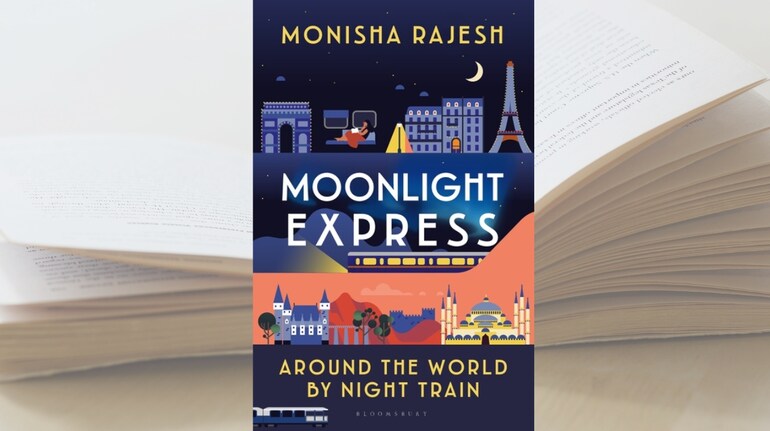
Excerpted with permission from the publisher Moonlight Express: Around the World By Night Train, Monisha Rajesh, published by Bloomsbury Publishing.
******
Sandals slapped the ground as passengers leaped off, the train still sailing up the platform at Jodhpur Junction. Delighted, I peered from the barred windows, watching the same people now ambling along.As trains drew into stations the routine was always the same and I relished watching the familiar scene unfold. Passengers piled into the vestibule and crowded into the open doorway. Each one would lightly touch the wrist of the stranger in front or place a single finger in their lower back. These gestures were designed to goad with gentleness, but designed to goad all the same. At the first squeal of brakes, those in the doorway would jump off as though a fire burned under their feet, only to stand about on the platform sipping tea. Ever happy to go with the flow, I had no reservations about following local customs, but hurling myself from a moving train was not on my bucket list and I now searched under the seat for my trainers as the train jerked to a halt.
In 2010 I lost my heart to Indian Railways and being back on
these clanking, dusty rails felt like a homecoming. With nothing but a withering rail pass, an outdated map and hopeless naivety, I’d spent four months travelling 25,000 miles – the circumference of the earth – reaching the four points of the country’s geographical diamond. When I’d arrived in India, the trains were simply a means to an end, a cheap and cheerful way for me to get around the country with ease. But in between hang-ing from doorways, squatting on carriage steps and snoozing in vestibules on stacked-up bags of laundry, I’d realised that the railways were a microcosm of Indian society. Being on board the trains brought me face to face with everyone from diplomats to dabbawalas, and by the end of my adventure around India in eighty trains, I realised that the trains were the hero of my story: the lifeblood that kept the country’s heart beating. There was nowhere like it on earth.
Of course, India was where I’d met Marc, on board a train. Now he was gathering his bags behind me, thrilled to be back in the homeland. Boarding at Jaipur that morning, we’d arrived at Jodhpur in Rajasthan. It was a couple of months after our journey into Norway’s midnight sun, and we were on assignment for a magazine in honour of the 170th anniversary of Indian Railways. We’d finished a week-long trip from Bombay down the Konkan coast to Goa, travelling there on my favourite train in the world, the Mandovi Express, and we were now in Jodhpur to take another day train up to Jaisalmer then transfer to Delhi on the Shalimar Express, a sleeper service. Indian Railways had come a long way since I’d last travelled here, introducing bullet trains and electrifying almost all of its 42,000 miles of track. But I was sceptical about how much the new services catered to the average Indian traveller, most of whom couldn’t afford the cost of high-speed rail. Instead of testing out what I suspected were vanity projects, I was curious to see the state of the clanking old sleepers.
I’d passed through Rajasthan on several occasions but had never spent more than a day in this princely state. Owing to niggly train timetables, I’d found barely enough time on my last visit to whip around Jodhpur’s spice market, stocking up on cloth pouches of pepper and Himalayan salt that sparkled like chunks of rose quartz. I’d then hung around the rooftop of a heritage hotel, eating laal maas, smoking cinnamon beedis and – with the arrogance of youth – failing to see anything within the blue-walled city. The time had come to rectify that.
………..
For the first time in years, I had booked a first-class compart-ment. Trains in the north were notoriously dirty and unhygienic when compared with those in the south, despite train maintenance following standard practice across the country. It boiled down to passengers and their habits, and on my first adventure around India, I’d observed first-hand how the state of carriages deteriorated the further I travelled north. Yet I couldn’t help but find a weird charm in it all. It was 10.30 p.m. and the Shalimar Express was the only train at the station. Jamie had a visible spring in his step, so excited was he about the prospect of travelling in a swanky compartment. At first glance of the interiors, I sensed the excitement would be short-lived.
‘Is this the right carriage?’ he asked as we clumped through, checking the numbers of each berth.
‘Think so,’ I said, taking in the ripped covers, grubby windows and torn curtains. ‘Marc and I are in a twin one and you’re next to us.’
Worse than I’d expected, the train looked as though it had been repurposed from a scrapyard. Hospital lighting did little to lift a rapid onset of depression.
‘Could have at least sprayed the table,’ Jamie said, pushing a finger through the greasy layer. ‘I was expecting something a bit different. Anyway, this might help,’ he said, pulling out an edible cookie from Dr Bhang and taking a large bite. The trains had reached a sorry state of affairs if they were only tolerable while stoned.
Assuming we were sleeping in the main first-class carriage, we discovered that our tickets were actually booked for one of three compartments with doors that locked. A family of three had settled into ours, their child asleep under her mother’s sari. Two suitcases blocked the door and my heart sank. I was loath to make them move, but we had no choice. The ticket inspector arrived and scanned his clipboard, moving them to the four-person compartment next door – which included Jamie, whose berth had been assigned with them.
‘Erm, okay,’ said Jamie, climbing onto his berth still wearing his trilby and shoes, his legs sticking out at the end, like Pete Doherty lying in state. Helping the couple to shift their suitcases, I saw Jamie pull out a paper bag and take another bite of his cookie. At least the child was still deeply asleep, and I waved to Jamie as a family member arrived from a different compartment, sat down at the end of the lower berth and started talking at the mother so loudly I wanted to cry for everyone concerned. For a second or two the woman watched me standing in the corridor. She picked her left nostril with her right hand and then reached across and yanked the door shut in my face.
‘Well, that’s that then,’ said Marc. ‘Hope Jamie has a good night with aunty in there. Want to go for a wander? The compartment’s a bit claustrophobic.’
The train was starting to move, so I went to the door to look out. The fort was shimmering like a palace, golden in the dark-ness. I watched it shrinking, listening to the drum of the wheels before picking my way back into the corridor. Passengers were unrolling bedding, laying out glasses and tablets and plugging in phones. Some were already asleep. Halfway up the carriage a young man sat propped up against his pillow making notes. He was listening to music and gestured for us to sit down.
‘It’s been good,’ Marc said to me, reflecting on our time in India.‘Got a lot packed into a short space of time.’
For a few moments we sat back listening to the wheels thumping as we jerked sideways and barrelled into the desert. In two weeks we’d travelled more than 2,000 miles by rail and I wanted to carry on, to go back to Bombay and Goa, to continue down to Kerala… but home beckoned. A bearded blond man wearing a maroon hoodie and cargo pants stopped by the compartment and we both sat up.
‘Sorry, man, are we in your seat?’ Marc asked, leaning to get up. ‘No.’ He raised both palms to tell us to stay put. ‘I just wanted to see how the other half lives,’ he laughed. ‘Which carriage are you in?’ I asked.
‘Like 2A or something?’ he said, looking into the neighbour-ing compartment.
‘Not much differently then. We’ve got a doorway, that’s about it.’
Marc offered him a seat and the usual exchange of traveller stories kicked off. Daniel was at the tail end of a three-month journey around the north of India which had largely centred on the Himalaya. He was on gardening leave before starting a new job in Pittsburgh and was now recounting how he’d tagged along into the Thar desert with a gang of students from Gurgaon.
‘Did you go into the desert?’ he asked me. ‘For the sunset, yes.’
‘Oh, so we actually stayed overnight. With like a fire and those beds.’
‘Charpoys.’
‘Yes! Charpoys,’ Daniel pointed at me. ‘I mean you’re Indian, right, so you know how it is, these guys wouldn’t let me pay for the ride and they bought all the beer and the food, and honestly, I’ve spent like, literally no money this whole trip. It’s like every-where you go, people just want to know everything about you,’ he said, scratching something out of his beard and examining the underneath of his nail.
‘Did you want to know about them?’ I asked.
He flashed me a vague look then carried on chatting to Marc for the next few minutes.
‘Anyway, I better get back in case someone tries to steal my shit,’ he said. ‘Maybe catch you guys on the other side?’
Watching Daniel walk back the way he came, I sincerely hoped we didn’t. I’d grown weary of wealthy white Westerners traipsing around the Global South, exploiting the kindness of strangers to boost their dinner-party chat. A few years earlier I’d met some-one whose entire schtick was travelling without luggage. Nothing more than a toothbrush and credit card to hand, he navigated his way around the world by blagging and borrowing, allowing people to put him up and pay for his meals, while he turned up as a ‘chief guest’ at their weddings and sometimes funerals.
‘That’s so dark, man,’ said Marc.
‘I’d haunt him if he came to my funeral.’
‘I bet he had way more money than everyone else as well.’ He thought for a moment. ‘It also sounds like quite an unsophisticated ploy to get laid.’
The young man whose berth we were sitting on had taken out his earphones and was now listening to our conversation. Karthik was a postgraduate student from St Stephen’s College in Delhi, a prestigious university. He’d been in Jaisalmer celebrating a friend’s birthday but had left early to sit an exam.
‘What you reckon?’ Marc asked him.
‘I bloody hate these people,’ said Karthik.
‘Oh wow, mate, tell us what you really think,’ said Marc, clap-ping his hands, bent over laughing.
Karthik adjusted his T-shirt and sat up. ‘A lot of young people in India, not just young people, but people in India still have this way of worshipping the white man,’ he said softly.‘ Racism is still a huge problem here. Huge,’ he said, fanning out his hand for emphasis. ‘And people still feel that the lighter your skin or the closer you place yourself to white people, the more likely you are of success.’
Marc was listening to Karthik with a look of resignation etched across his face.‘ That’s really grim.’
We chatted for a while about Karthik’s plans to stay in Delhi after he graduated. In the past, young people couldn’t wait to flee abroad but, according to Karthik, there was so much opportunity that there was no longer the same impetus to escape.
I looked around. The bodies were still, humped under thick grey blankets. Midnight had come and gone and I too was desperate to sleep. I promised Karthik we’d find him in the morning and he tipped his head to one side, wedging in his earphones and turning back to his books.
Two hours into the journey it was too dark to see anything but the lights of passing trains. I tried to get comfortable but the berth was hard, the air-conditioning set too high. Turning onto my back I wondered how Jamie was faring, wishing I’d asked for a cookie. I had thought this was what I’d wanted. It was why I’d come back, to be bounced around on a rickety old train, reminiscing about my first adventure around India. But as the train lurched along at speed, I could feel my stress levels rising at every bump. I’d ridden more than a hundred of India’s trains, juddering across some of the highest bridges in the country, winding up precarious mountainous tracks and inching through jungles known for severe landslides and floods. Invariably I did so just days before the bridges collapsed, the tracks came apart and burst rivers swept away the lines. Safety had improved on India’s railways but when an accident did occur, the death tolls were staggering, and I was now being flung around like a rag doll, convinced the train would derail. Anxiety was my new travelling companion, and a part of my brain was always focused on my children. Before their arrival I owed nothing to anyone. No one depended on me, no one needed me, hell, no one missed me when I was away. I thought of all the male travel writers who disappeared for months at a time, leaving young children behind with their partners, and I wondered how they did it. I knew the girls were safe and well, but I still missed them deeply.
…….
A chaiwallah boarded at the town of Borawar and I woke to the melancholy drone of his call. Sipping the milky tea, I looked around wondering where Marc had gone. From the vestibule I watched a couple of children waiting under an awning, their school ties reaching down to their waists. It was just before 8 a.m. and the morning light made everything feel safe again, my anxiety long forgotten. The train was now running along the body of Shakambari Jheel, India’s largest inland salt lake, which fluctuated between shades of purple and orange depending on the concentration of the brine. In winter it saw thousands of migratory flamingoes flock to its wetlands, but for now it was green and still. An elderly man came through to wash his hands and neck, and we struck up a conversation. Jayanth worked for the Ministry of Defence and since the early 1990s he’d been travelling by train around the north of India for work. He made a clicking sound with his teeth as he slicked back his hair with water.
‘These northern trains, they haven’t really got better in terms of conditions. People have learned bad behaviour but it’s now more clean on board. Old, yes, but cleanliness is there and improvement in service is there. Fifteen years back I went to Dibrugarh in Assam and the train was 102 hours late. Now it is maximum ten hours in winter due to fog. Modi has made our India proud,’ he added.
From what I could tell, Indian Railways’ priority was to invest in brand new trains which created an illusion of progress. Money was being poured into semi-high-speed rail and Vistadome specials, which included glass roofs and rotatable chairs to enhance views of the scenery. Glamorous Vande Bharat Express trains were being introduced with the intention of replacing the daytime Shatabdis and plans were afoot to put on long-distance versions of the Vande Bharat trains, but with sleeper cars that would include better-quality berths, floor lights, designated luggage racks, staff cabins and even a space for pets. But I still felt that the pressing needs of the average Indian traveller were being ignored. Few could even dream of riding on those unaffordable new trains. Overcrowding on board was still a huge, sometimes fatal problem and what the government really needed to do was invest in more low-cost sleeper-class coaches for the working classes who made up the majority of ridership.
Jayanth sniffed and looked out at the villages sailing by. ‘Modi is a good PM. He is my PM. If my PM tell me you jump for me, I will jump,’ he held up his fist. ‘I have blind faith in my PM.’
This was emotive rhetoric and I asked Jayanth why he felt so strongly.
‘There is no corruption any more. He does maximum things for poor people. He gives food for poor people. He has given free gas, free houses, free medical care for the poor. If you have single girl child, you can get education.’
‘Is there anyone who doesn’t like him?’ I asked.
‘Muslims. Other political parties.’ He held up his hand. ‘All the fingers cannot be equal.’
‘Why don’t Muslims like him?’
‘They are always fighting someone. If they don’t fight Hindus then they are fighting among themselves.’
Jayanth went on to ask if I was married and I explained that my kids were at home with their dad.
‘My wife was a school teacher but I asked her to be at home with the children,’ he said. ‘When they’re small it is not good to work or they will go here and there.’
‘I work and my children are just fine with their dad,’ I replied, filled with indignance.
Jayanth smiled demurely in response. He leaned his head to one side in an infuriating gesture, at which point I decided to take leave and head back to the compartment.
Marc had reappeared and was dealing out the Kama Sutra-themed playing cards we’d bought while buzzing in Jaisalmer. I sat in a corner watching him teach Jamie how to play Shithead and pulled out my diary, which was covered in sand from the desert. Dusting off the cover, I turned to my original bucket list of trains, most of which had satisfying scores through the middle. While fingering the stuffing coming out of my berth, I thought back to the comfy compartments on the Dacia, the dining car on the Dog˘u Express and the double bed on the Caledonian Sleeper. European sleepers were sleek, comfortable and, in comparison to Indian trains, quiet. As I listened to a hawker crowing up the aisles selling samosa, I realised that for all the positives of Europe’s night trains, I still found an unrivalled charm on Indian Railways. I looked at the trains remaining on my list. In a few weeks I’d be riding the Silver Meteor in the US, then the Santa Claus Express with the girls at Christmas. The name of the final train still looked at me, taunting me. Giving it no more thought, I shut the diary and turned to enjoy the view.
An abundance of recent rain had replenished a thirsty land-scape, and the meadows were flourishing. Buffalo wallowed in deep lakes and perfect lines of saplings stretched out like fields of cocktail umbrellas. Solitary farmhouses popped up, solitary shepherds keeping watch, their bright orange pagaris like tiny flames in the fields. Haystacks were tied into bundles, and I noticed new tracks being laid, girders piled high. On the approach to Jaipur a fight broke out at an intermediate station, and everyone rushed to the windows to watch the tamasha. No one threw punches here, but tight slaps were dealt out in the style of Hindi movie villains. I observed with admiration as someone in the middle of the brawl managed to maintain a phone conversation while limbs flew all around him. Just a few metres away from the ruckus a child was imprisoned inside an orange sari fashioned into a hammock. His mother continued to thread flowers in spite of the noise, and he was trying his best to escape.
At Jaipur we hopped out for coffee, Jamie nailing three in succession as an officious type drifted over and began to narrate his thoughts unprompted. Everyone had an opinion in India, especially when it came to how other people ought to live their lives, and it didn’t take long for the man to bemoan the onslaught of smartphones among young people.
‘They are causing havoc in rural India,’ he grumbled, gesturing at passengers scrolling as they waited for the train to sound its horn.
‘In what way?’ I asked, enjoying the warmth of the sun. ‘They have the world on the phone. Anything and everything
is there. They join groups, debating this and that, very different from how they have been brought up.’
‘Surely that’s a good thing?’ I said.
‘No. Rural children grow up in a traditional society here. Now they are exposed to Western ways of life where live-in relationships are normal, there is pornography. They are ques-tioning religion, social structures. You can’t rebel against it.’
Jamie flushed. ‘It is a difficult balance though isn’t it,’ he said. ‘I mean it is good to question things per se, and find your own sense of mind and question authority.’
‘No one is asking you not to question, but don’t oppose it for the sake of obsession,’ said the man, sniffing deeply then pull-ing out an enormous handkerchief. ‘You can’t have everything, feminist rights, all of that, you have to understand the deeper reasoning behind many of the structures.They see certain things happening at home and then they find arguments against it on YouTube and they start opposing what happens at home with-out stopping to think why it happens.’
The train let out a long and sonorous horn and we clambered back up the steps for the final few hours.
Back on board, the three of us sat in a row like a still from The Darjeeling Limited, but minus the garlands and bandages. In less than twenty-four hours we’d established that the woman’s place was still in the home, colonialism was alive and well, and that the rural poor had no right to question structures of oppression. Throw in the fight on the platform and we’d had a mighty fruitful journey. Nothing at all out of the ordinary for a regular old Indian sleeper. Little did I know that we were some of the last riders on the Shalimar Express, which would be permanently cancelled the following year.
At around four o’clock the train passed between high-rise apartments and woods, and under a tree I spotted my favourite sight: a group of elderly men cross-legged on a blanket, dealing out cards.Two others were leaning over the game, hands behind their backs. The brakes began to creak and the Shalimar Express slowed into Delhi Cantonment station. The three of us disem-barked, pulling bags along a floral path as the train rumbled to life and continued on its way.
**********
Monisha Rajesh, Moonlight Express: Around the World By Night Train, Bloomsbury Publishing, 2025. Pb. Pp. 336
From the author of the smash-hit Around the World in 80 Trains comes a new globetrotting journey - this time celebrating the peculiar magic and mayhem of the night train.''Nobody writes trains like Monisha Rajesh'' Irvine Welsh''A moonlit express train to travel writing heaven. This is Monisha Rajesh''s wittiest and most irresistible adventure yet'' William DalrympleThe wonder of the night train: headlamps ablaze, passengers boarding after sunset and leaving before sunrise, slipping in and out of compartments unseen. For Monisha Rajesh, the singular thrill of sleeper trains inspired a new journey around the world – one filled with moonlit landscapes, cosy compartments and quirky companions.From Austria’s Nightjet to the Caledonian Sleeper and the Santa Claus Express, Rajesh invites us on an adventure aboard the world’s most wondrous night trains. Along the way, she samples reindeer stew in Scandinavia, retraces the original route of the Orient Express, sips on pisco sours aboard the Andean Explorer, and watches the sun rise over the Potomac River on the Silver Meteor to New York.A decade ago night trains were giving way to budget airlines and high-speed rail. But as people search for slower and more environmentally friendly ways to travel, night trains are in the midst of a renaissance. By turns romantic and hilarious, Moonlight Express brings us along for the ride – and drops us back at the platform before sunrise.
Monisha Rajesh is a British journalist whose writing has appeared in Time magazine, the New York Times, and Vanity Fair. Her first book, Around India in 80 Trains, was named one of the Independent's best books on India. Her second book, Around the World in 80 Trains, won the National Geographic Traveller Book of the Year and was shortlisted for the Stanford Dolman Travel Book of the Year. In 2024 she was named in Condé Nast Traveller's Women Who Travel Power List. She lives in London.
Discover the latest Business News, Sensex, and Nifty updates. Obtain Personal Finance insights, tax queries, and expert opinions on Moneycontrol or download the Moneycontrol App to stay updated!
Find the best of Al News in one place, specially curated for you every weekend.
Stay on top of the latest tech trends and biggest startup news.