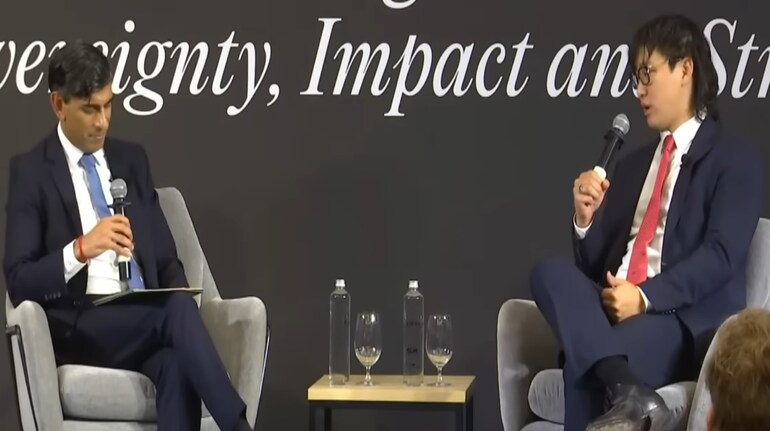

2026 marks an inflection point in artificial intelligence (AI) in many ways as we enter the era of recursive self-improvement, Meta's chief AI officer Alexandr Wang said on Thursday.
"We are at the beginning of a true acceleration in technology," Wang said during a fireside chat with former United Kingdom Prime Minister Rishi Sunak, held on the sidelines of the India AI Impact Summit in New Delhi.
Wang noted that from 2018 through 2024, the industry was in the era of pre-training, riding a large 'predictable' exponential curve towards improving the performance of the models. "It had clear characteristics where the more resources you put in, the more results you would get out," he explained.
While the end of 2024 kickstarted the next major wave with reinforcement learning, where models began to learn to reason. But, Wang noted that even this phase had limitations.
By the end of 2025, however, the industry entered an entirely new paradigm with recursive self-improvement. This shift is now becoming visible in frontier model development, wherein the models themselves have become instrumental in accelerating the process of producing the next generation of AI, Wang said.
Also read: 2026 will be the year AI 'dramatically' changes the way Meta works, says Mark Zuckerberg
"From the outside what you see is an acceleration of overall development velocity, the speed at which the new models are being released" Wang said "Internally what we see is dramatic speedups. The productivity of an individual researcher has grown dramatically and we don't expect it to stop."
In fact, Meta's AI chief expects it to keep accelerating, where the output of an individual researcher or an engineer will continue growing exponentially as the technology improves.
Coincident with this shift is the arrival of agents in earnest. "This is something that has been discussed with a lot of fanfare since 2023," Wang noted. "For a long time, it was one of those buzzwords that never quite lived up to the expectations."
However, from late 2025, Wang said that agents have actually started working. Models can now take independent actions and automate entire workflows, becoming "dramatically more productive" entities unto themselves rather than simple assistants.
While this era began with coding agents, it is now "percolating" through personal agents.
"Over the course of 2026, we will see large scale agent deployments in many areas of the economy and across the world with the GDP of AI set to grow exponentially," he said.
India a 'positive case study'
Wang also praised India as a "positive case study" largely due to the country's expanding talent pool.
"I was at a dinner with a number of Indian founders and venture capitalists last night, and the statistic was that there are more consumer AI startups in India than in the United States," he pointed out.
During the chat, Wang also reiterated Meta's vision to deliver "personal superintelligence" to consumers.
"How does each person have an agent that helps them accomplish the things that they're extremely excited about? How can they help them explore their passions, build a business, make a discovery, invent a thing, achieve the most maximal version of their own lives," he said.


Discover the latest Business News, Sensex, and Nifty updates. Obtain Personal Finance insights, tax queries, and expert opinions on Moneycontrol or download the Moneycontrol App to stay updated!
Find the best of Al News in one place, specially curated for you every weekend.
Stay on top of the latest tech trends and biggest startup news.