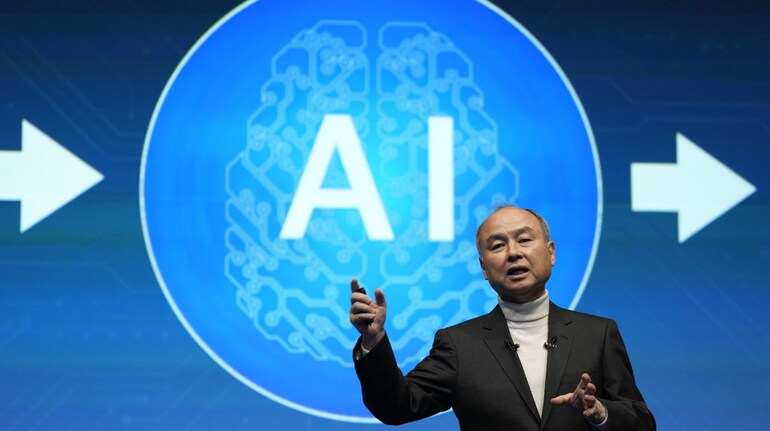
Growing unease over frothy artificial intelligence valuations is weighing on shares of SoftBank Group Corp., which traders increasingly view as a proxy for privately held OpenAI.
The Japanese tech investor sits at the forefront of a global AI selloff amid worries about new pressure on OpenAI following Alphabet Inc.’s Gemini 3.0 debut. SoftBank shares have plunged around 40% since late October, erasing over ¥16 trillion ($102 billion) in market value, as its founder Masayoshi Son prepares to double down on OpenAI and the infrastructure that supports it.
SoftBank has ridden the global AI investment boom faster than any other Japanese company. Its exposure to OpenAI — and a $14.6 billion gain on that stake — helped it post a surprise ¥2.5 trillion net income in the fiscal second quarter, putting it on track for one of its highest annual profits.
SoftBank stock rose as much as 8% on Wednesday after the company said it completed its $6.5 billion purchase of US chip designer Ampere Computing LLC. SoftBank still faces a $22.5 billion December payment to OpenAI — part of the $32 billion it has committed to the ChatGPT developer — and must finance its proposed $5.4 billion acquisition of ABB Ltd.’s robotics unit.
But that same exposure to the industry, and the billions it’s committing, also leaves SoftBank vulnerable to any signs that OpenAI could lose its lead.
Fears continue to swirl around the lofty valuations attached to AI-related companies. Earlier this month, when asked whether the sector was caught in an AI bubble, Chief Financial Officer Yoshimitsu Goto — who, alongside Son, has lived through multiple boom-and-bust cycles — said he couldn’t say. “That’s something you only know for sure in hindsight,” he said.
Son aims to make SoftBank a major player in an AI ecosystem he believes OpenAI will lead. He has sold SoftBank’s stakes in Nvidia Corp. and Oracle Corp. to raise firepower and is buying into AI chip designers, convinced future devices will need energy-efficient AI. SoftBank now owns nearly 90% of Arm Holdings Plc, whose architecture underpins much of modern tech from phones to servers. Ampere Computing, a server-processor maker, is one of Arm’s customers.
SoftBank’s push into chipmaking may raise questions at a time when the world’s biggest tech companies are also designing their own AI chips, said Amir Anvarzadeh, Japan equity strategist at Asymmetric Advisors.
“Beyond its blind faith in going all in with its investments in OpenAI, what the market has totally ignored is the growing penetration of RISC-V in core designs of AI chips, which even Nvidia is adopting,” he said, referring to the open-sourced architecture that rivals Arm’s.
RISC-V is gaining ground in China, where fears are growing about reliance on Western technologies that may be barred in the future. “That’s the next chip that may fall,” Anvarzadeh said.
A wave of stock rotation could hit other Japanese AI names after reports that Meta Platforms Inc. plans to use Google’s Gemini AI chip fueled concerns about Nvidia’s business. Some analysts say Google’s move could be negative for Japanese components maker Ibiden Co., a major supplier of substrates used to make Nvidia chips. Ibiden shares fell about 4% this week.
Meanwhile, Toppan Holdings Inc. is up about 11% this week, partly on the view that the company will benefit from its large share of business with Broadcom Corp., which designs AI chips with Google. Japanese chip-equipment makers such as Advantest Corp. may also gain, according to Maito Yamamoto, chief analyst at Nissay Asset Management.
“The phase of indiscriminate buying of AI-related stocks has ended, and selection will become more stringent going forward,” said Kazunori Tatebe, chief strategist at Daiwa Asset Management.


Discover the latest Business News, Sensex, and Nifty updates. Obtain Personal Finance insights, tax queries, and expert opinions on Moneycontrol or download the Moneycontrol App to stay updated!
Find the best of Al News in one place, specially curated for you every weekend.
Stay on top of the latest tech trends and biggest startup news.