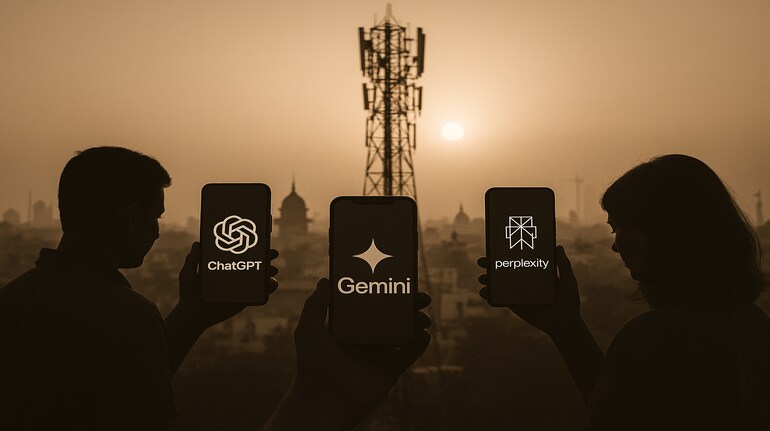
When Bharti Airtel announced in July this year that all 360 million of its mobile and broadband customers could claim a free one-year subscription to Perplexity Pro, worth around Rs 20,000, it seemed like a generous tech freebie. Weeks later, Reliance Jio followed with an 18-month free pass to Google's Gemini Pro (now with Gemini 3 as well). OpenAI joined the party in November, offering Indian users a free year of ChatGPT Go.
But former NITI Aayog CEO Amitabh Kant sees something else: "Neo-colonisation in very stealth mode."
Speaking at a recent event, Kant warned that global AI companies are gaining easy access to Indian data through telecom operators and universities. "All these models are getting better and better with your data. Indian data, and many other developing countries' data," he said. "All these models are getting better and then they will be selling their AI products back to you using your data, selling it back to you at very high prices."
The freemium gold rush
Between Airtel's 360 million eligible users, Jio's Gemini offer and OpenAI's India-wide ChatGPT Go promotion, hundreds of millions of Indians suddenly have access to AI tools that typically cost between $5 and $20 monthly.
"This is a classic freemium strategy," Tarun Pathak, Research Director at Counterpoint Research told Moneycontrol. "The plan is to get Indians hooked on to the generative AI before asking them to pay for it."
India's young, digitally savvy population of around 700 million smartphone users represents the world's second-largest internet market after China. "Even if 5 percent converts into a paid one, that's still a number that runs into 10 to 20 million," Pathak said. "That translates into roughly $160 million kind of revenue opportunities every month," he added.
But there's more at stake than subscription revenue. "The more unique and first-hand data they get, the better their models and generative AI systems will become," Pathak said.
"Understanding a market like India, which is culturally diverse and a lot of things that can actually make this data even richer is the multilingual data," he added.
Jacob Joseph, VP of Data Science at CleverTap, told Moneycontrol, "These systems are interested in the interaction layer, collecting prompts and understanding usage patterns, language behaviour, error corrections, what people ask for, how they upload, and how the model performs across contexts. That's the raw material that helps refine future versions of the model." As he put it, the old internet rule still applies: “If you’re not paying for the product, you’re probably the product.”
Also read: The AI circular economy just got an upgrade: Inside the Microsoft, Nvidia, Anthropic deal
The consent conundrum
India's Digital Personal Data Protection (DPDP) Act was passed in 2023, with rules released on November 14, 2025. Implementation will be staggered, with several provisions not taking effect immediately. This timing gap has created a "grey zone" where enforcement is largely self-regulatory.
When a customer clicks "Claim Now" to activate the free access AI through the telco’s app, are they providing informed consent for their data to be used in AI training?
Alvin Antony, Chief Compliance Officer at GovernAI, argues they are not. "Section 6(1) of the law requires that consent must be free, specific, informed, unconditional, and unambiguous," he told Moneycontrol. "If a telecom provider links AI platform access to the recharge bundle, the consent may become conditional as well as not specific."
The bundling nature, Antony said, violates the DPDP Act's spirit. "When doing the recharge, a consumer might be only thinking of the essential telephone services and hence any data processing by AI due to a bundled package might take it far from being specific consent for data processing," he says.
There's also confusion around data erasure rights. "A consumer, who has recharged, may get confused whom to approach, if they decide to erase the personal data under Section 12 (3) of the Act," Antony said. "Certainty may be lost due to bundling."
To be sure, these models do offer users the option to opt out of having their chats used to train future versions of the model.
Moneycontrol has reached out to both Airtel and Jio for comments; this story will be updated when they respond.
Who's liable when data flows abroad?
If user data flows from Airtel to Perplexity or from Jio to Google Gemini, the question of legal liability becomes complex.
"The liability will depend on the identification of who can be considered as the Data Fiduciary in this transaction as per law," Antony said. Under the DPDP Act, a data fiduciary determines the purpose and means of processing personal data.
"Given such a scenario, the Indian service provider may have liability if the distinction between the nature and provision of services is not provided," Antony added.
Speaking to Moneycontrol, Mahesh Uppal, founder of ComFirst Consulting, took a different view. "If it is your personal information, for example, if it is my movement data or my family data or my health data, etc. Then that is something that they are obligated to ensure is not shared," he said, referring to telcos. "In this case, it's obviously the telcos" who would bear liability if telecom-specific personal data were misused.
But Uppal distinguishes between data that the telco controls and data users share directly with AI platforms.
Uppal doesn't believe that signing up for Perplexity through Airtel grants the telco automatic permission to share subscriber data. "I do not see that signing up for Perplexity or any other AI app through the telco implies that the telco has any consent from you for your personal data to be shared," he told Moneycontrol. "Because the telco's obligation to protect your personal data is quite serious."
Also read: Gemini 3 launch gives Google an edge in the fiercely competitive AI race
A fragmented regulatory landscape
Between the Ministry of Electronics and Information Technology (MeitY), the Telecom Regulatory Authority of India (TRAI), and the Data Protection Board (DPB), the regulatory landscape for AI-telco partnerships is fragmented.
Antony of GovernAI points to a 2018 Supreme Court decision establishing that TRAI has primary jurisdiction over telecom sector-specific issues. "TRAI is the primary enforcer for AI-telecom bundled services," he said. "DPB is the adjudicatory body for the data protection aspect under the DPDP Act. Its jurisdiction is secondary and complementary to TRAI's, focusing on data-specific harms."
Uppal agrees that TRAI would handle telco license compliance issues. But when it comes to internet content, including AI services, "that is MeitY, or in some cases, the DPDP mandate," he said.
Constitutional questions
The Supreme Court's landmark 2017 K.S. Puttaswamy v. Union of India judgment established informational privacy as a fundamental right. Could that create a constitutional obligation for stricter regulation of "free AI" bundles?
Antony believes it could. "The Supreme Court's landmark 2017 Justice K.S. Puttaswamy v. Union of India, in a way, established informational self-determination as a core component," he said. The judgment requires that "information is not used without the consent of users and that it is used for the purpose and to the extent it was disclosed."
"Offering such services on a take it or leave it format keeps away the independent nature of providing consent as well as is kind of putting pressure on the consumer," Antony said. “Such practices could violate Section 4 and Section 2(1)(e) of the Dark Pattern Guidelines 2023, which prohibit tricking consumers into actions they wouldn't independently take. Given the lack of option of not providing an opt-out system, consumer has to accept to obtaining such a service," he noted. "This may be considered an unfair trade practice," he added.
Industry perspective
Not everyone sees these partnerships as exploitative. Ganesh Gopalan, co-founder and CEO of AI startup Gnani.ai, offers a more optimistic take.
"Indian consumers are indeed contributing valuable data that helps global AI models become more accurate, inclusive, and reflective of diverse perspectives, and this can be seen as a positive opportunity rather than exploitation," Gopalan told Moneycontrol. "By engaging with these technologies, Indian users are helping shape AI systems to better understand local languages, behaviours, and cultural nuances, which in turn benefits the entire ecosystem," he added.
As for competition with domestic startups, Gopalan is confident. "Local companies possess a distinct advantage in building regionally relevant, culturally nuanced, and multilingual AI models tailored to India's diverse linguistic and social landscape, areas where global systems often fall short."
Joseph of CleverTap agrees. "A rising AI tide also expands the total market; more familiarity, more use-cases, more demand for local solutions," he said. "Indian startups can compete where global models tend to struggle: vernacular nuance, cultural context, domain-specific depth, affordability, and enterprise-grade customisation."
What happens after the free period?
Joseph predicts a fragmented future. "At the end of the free period, pricing will decide whether the funnel stays broad or narrows into a digital divide," he said. "My guess is we'll see more India-specific tiers, UPI-linked micro-subscriptions, ad-supported free tiers, and lightweight regional plans. This won't be a copy-paste of US pricing: India is too important, and too different."
Both Airtel and Jio have been explicit that their free subscriptions will not auto-renew; users must upgrade to paid plans or revert to free versions.
Data sovereignty question
Kant's warning about "neo-colonisation" touches on broader questions of data sovereignty. His concern is that India is providing raw material (user data) at zero cost, which foreign companies will refine into AI products and sell back at premium prices.
"What is happening is you are using data at zero cost and exporting at billions and billions for the billions of the world," Kant said. "And we must understand that this is Neo-colonisation in very stealth mode."
For global AI companies, including Perplexity, Google and OpenAI, India has already become a strategically important market. Perplexity co-founder Aravind Srinivas told Moneycontrol in April that India ranks among the company's top 10 countries by revenue.
The path forward
As India's DPDP Act moves toward full implementation, clearer boundaries may emerge. But for now, hundreds of millions of Indians are engaging with premium AI tools without a clear understanding of how their interactions are being used.
"The key is consent. Users should know, clearly and upfront, what is and isn't used for training," Joseph said. "AI companies must treat disclosure not as a legal checkbox, but as a transparent and clear onboarding step."
What is certain is that India has become a critical battleground for global AI companies, not just as a market, but as a source of diverse, multilingual, culturally rich training data. Whether this represents an opportunity for democratisation or a new form of digital exploitation may ultimately depend on how rigorously India enforces its data protection framework.


Discover the latest Business News, Sensex, and Nifty updates. Obtain Personal Finance insights, tax queries, and expert opinions on Moneycontrol or download the Moneycontrol App to stay updated!
Find the best of Al News in one place, specially curated for you every weekend.
Stay on top of the latest tech trends and biggest startup news.