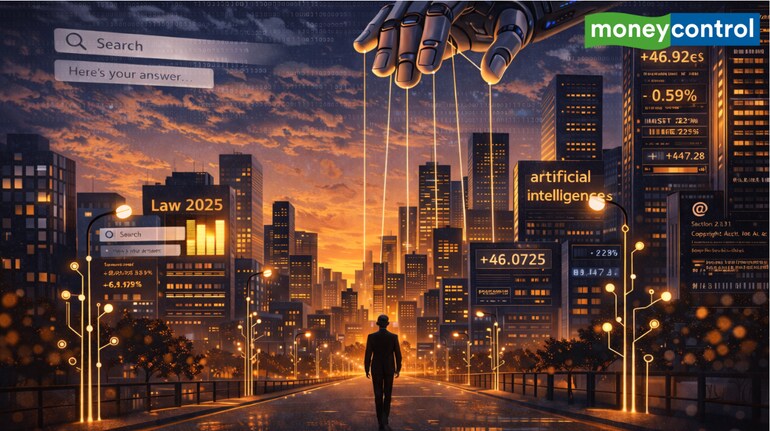
In early 2025, AI still had the vibe of a clever add-on: a chatbot in the corner, a 'summarise' button, a new feature in a familiar app.
By December, it looks less like a feature and more like a force of nature, quietly rearranging who gets traffic, who gets paid, what gets regulated, and which countries get to set the terms.
This is the big pivot of 2025: the world stopped trying AI and started building around it. And when a technology shifts from novelty to infrastructure, the mood changes fast. People stop cheering. They start asking: Who controls it? Who pays for it? Who gets harmed by it? Who is liable when it goes wrong?
The plot twist: intelligence wasn’t the main story; power was
Yes, the models got better. But the year’s most consequential developments weren’t just technical. They were about distribution, compute, law, and trust, the four places where modern power lives.
1) The model leap: GPT-5 and Claude 4 pushed AI from 'talk' to 'do'
The marquee products of 2025 weren’t just trying to sound human. They were trying to behave usefully.
OpenAI launched GPT-5 in August and positioned it as its most capable model yet, leaning hard into the idea of 'built-in thinking,' a framing that signals where the industry is headed: systems that can reason through multi-step tasks and use tools, not just autocomplete sentences.
Anthropic’s Claude 4 (May) made the same directional bet: stronger reasoning, stronger coding, and the idea that the model can act like an assistant that executes work rather than merely describing it.
What changed for users wasn’t just quality. It was an expectation. 2025 was the year people began to treat AI less like a chat partner and more like a junior operator inside software, sometimes brilliant, sometimes confidently wrong, always consequential.
2) Search changed shape: Google turned answers into a product, and publishers noticed
Search used to be a referral machine: you asked, and it sent you to the web.
In 2025, the big platforms pushed search toward something else: a destination. Google expanded generative features like AI Overviews and rolled out an experimental AI Mode, an explicit attempt to make the answer itself the experience.
An economic rewire!
When AI summarises the web, the traffic doesn’t automatically follow the sources. That’s why 2025 saw a sharper public backlash from publishers and a growing regulatory interest in how AI search products use (and profit from) others’ content.
The internet’s old bargain, 'publish, get indexed, earn clicks,' started to look shaky in broad daylight.
3) The underplayed shock: China’s open-model surge went global
One of the year’s most important shifts came from what didn’t require permission.
Across 2025, China’s AI ecosystem gained attention not just for capability, but for open models, systems that developers can download, fine-tune, and deploy without waiting for access or paying per prompt. A year-end analysis in Time explicitly flagged China’s rise in open-source AI as a defining development of 2025.
Open weights matter because they travel. They spread fast across borders, languages, and devices. They also create a strategic headache for anyone trying to 'control' AI through gatekeeping. Once the tools are widely available, the true chokepoints become chips, data centres, and energy.
4) Compute became geopolitics: chips, export controls, and the physical reality of AI
By 2025, AI stopped being 'just software' in the way a hurricane stops being 'just weather.' It became physical: racks, megawatts, semiconductor supply chains, export restrictions, and national-security briefings.
A late-year Reuters report captured the mood perfectly: Nvidia telling Chinese clients it aimed to start shipping H200 chips to China before the Lunar New Year in mid-February 2026, an example of how deeply AI hardware now sits inside geopolitics.
This is where the AI story becomes less Silicon Valley and more statecraft. It was leverage.
5) Regulation stopped being a threat and became a calendar
For years, AI regulation lived in the same category as 'someday.' In 2025, 'some day' arrived, with dates.
The EU AI Act moved from landmark legislation to ticking deadlines, including early 2025 applicability for certain provisions and 2025 obligations beginning to bite for general-purpose AI.
In the US, the action was less unified and more messy: a clash between federal ambitions and state-level lawmaking. States began targeting specific product categories, like 'AI companions,' with requirements around disclosures and safeguards, including around self-harm risk.
That’s the regulatory shape of the next phase: governments won’t regulate 'AI' like it’s one thing. They’ll regulate use cases, one risk category at a time.
6) Copyright became a balance-sheet problem, not an ethics panel
The most uncomfortable question in AI, what you’re allowed to train on, kept moving from theory to precedent.
Reuters reported a key US ruling in June: a judge said Anthropic’s use of books to train AI was legal under fair use, while also stating that pirating books could not be justified. That’s not the end of the war, but it’s a map of the terrain: the provenance of training data matters, and “AI did it” won’t be a magic legal shield.
By year-end, the legal and financial pressure around training data continued to intensify, with fresh lawsuits and high-stakes settlement talk reported by Reuters and others. Training stopped being an abstract debate and became a measurable risk.
7) India’s AI year: build sovereign capacity, then fight the deepfake wave
India’s 2025 AI story ran on two tracks: capacity and control.
On capacity, the government pushed the IndiaAI Mission, approved with an outlay of over Rs 10,300 crore, to expand compute access and support a domestic ecosystem. It also highlighted BharatGen, described by the government as a homegrown, multimodal model supporting Indian languages.
On control, deepfakes forced urgency. Reuters reported in October that India proposed stricter draft IT rules that would require clearer labelling of AI-generated content, amid rising concern about misuse.
This is what AI looks like at national scale: build fast, regulate faster, and try to keep trust from collapsing in the gap.
What actually changed in 2025
Not the existence of AI. The default.
By the end of 2025:
AI didn’t just get smarter in 2025. It got entangled with law, politics, energy, and public trust. That’s what happens when a technology becomes infrastructure.
The year’s final lesson is blunt: AI isn’t 'the next app.' It’s the next layer. And once a layer forms, everyone fights over who gets to own it.



Discover the latest Business News, Sensex, and Nifty updates. Obtain Personal Finance insights, tax queries, and expert opinions on Moneycontrol or download the Moneycontrol App to stay updated!
Find the best of Al News in one place, specially curated for you every weekend.
Stay on top of the latest tech trends and biggest startup news.