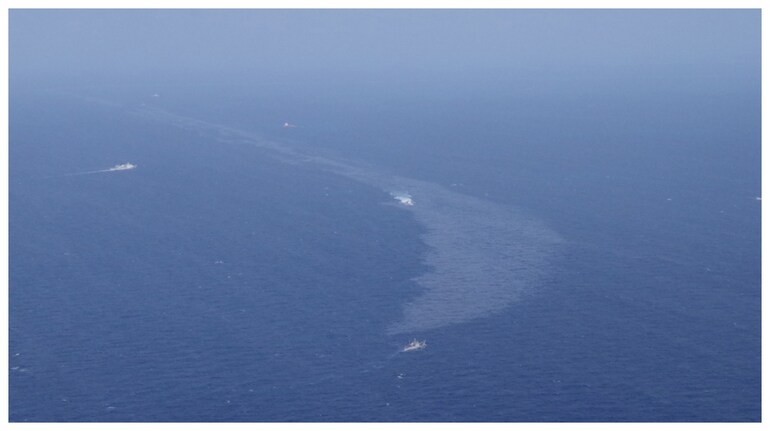
China has quietly demonstrated a new level of maritime coordination by mobilising thousands of fishing boats into dense, carefully arranged formations in the East China Sea, according to ship-tracking data analysed by The New York Times and maritime intelligence firms. The manoeuvres, which unfolded over late December and early January, went largely unnoticed at the time but are now being closely studied by regional security experts, the New York Times reported.
In one operation last week, roughly 1,400 Chinese fishing vessels abruptly abandoned normal fishing patterns or left their home ports and converged in the East China Sea. By January 11, they had assembled into a large rectangular formation stretching more than 200 miles. The concentration was so tight that some commercial ships appeared to divert their routes or weave cautiously through gaps in the mass of vessels.
A similar, even larger gathering took place on Christmas Day, when about 2,000 fishing boats formed two long, parallel lines, each nearly 290 miles in length. The repetition of these large-scale formations in the same waters within weeks has reinforced assessments that the activity was planned and directed, rather than spontaneous.
Beyond fishing activity
Analysts say the vessels were not behaving like fishing boats. Instead of looping or zigzagging as they trawl, the ships held steady positions for extended periods. The formations remained largely intact for more than a day, suggesting a level of discipline and communication unusual for civilian fleets.
“This is not something you see by accident,” said analysts who track maritime traffic in the region. Several described the scale and precision of the formations as unprecedented in publicly observed data.
The activity is widely seen as linked to China’s maritime militia, a force made up of civilian fishing boats that can be mobilised to support military and political objectives at sea. These vessels have previously been used to swarm disputed reefs, shadow foreign ships and reinforce China’s territorial claims while maintaining a veneer of civilian activity.
Strategic implications
Security experts say such formations could play a significant role in a crisis, particularly involving Taiwan or Japan. While fishing boats are too small to enforce a traditional naval blockade, large numbers of them could obstruct shipping lanes, complicate naval manoeuvres and strain surveillance systems.
Former military officers and analysts note that swarms of small vessels could overwhelm radar or drone sensors, act as decoys, or force opposing ships to slow down and reroute. In crowded sea lanes near major ports and trade routes, even temporary disruption could have economic and strategic consequences.
The East China Sea, where the formations appeared, is a vital maritime corridor linking Chinese ports such as Shanghai to global markets. It is also close to Japan’s Okinawa islands and Taiwan, making it a sensitive zone in any regional confrontation.
A signal, not an announcement
Beijing has made no public comment on the fishing boat operations. Analysts who examined the data said there was no evidence the ship signals were falsified, strengthening the conclusion that the movements were real and deliberate.
Researchers at US and regional think tanks independently confirmed the gatherings and said they were almost certainly state-directed. Some suggested the exercises were meant to test how quickly and effectively civilian fleets could be mobilised at scale in a future contingency, such as a maritime “quarantine” or pressure campaign short of open conflict.
The timing is also notable. The January manoeuvres followed Chinese military drills around Taiwan and came amid heightened tensions with Japan. While officials in Tokyo declined to comment, citing operational sensitivity, experts say the message was likely intended to be seen, even if it was not formally announced.
An evolving maritime tool
China has long used fishing fleets as part of its strategy in contested waters, but the recent operations suggest growing sophistication in command, control and coordination. Analysts say this could make maritime militia forces a more effective complement to China’s navy in future crises.
For neighbouring countries and their allies, the episode is a reminder that the balance of power at sea is no longer shaped only by warships and submarines. Civilian vessels, organised at scale and guided by state objectives, are becoming an increasingly central part of the maritime security picture in East Asia.
Discover the latest Business News, Sensex, and Nifty updates. Obtain Personal Finance insights, tax queries, and expert opinions on Moneycontrol or download the Moneycontrol App to stay updated!
Find the best of Al News in one place, specially curated for you every weekend.
Stay on top of the latest tech trends and biggest startup news.