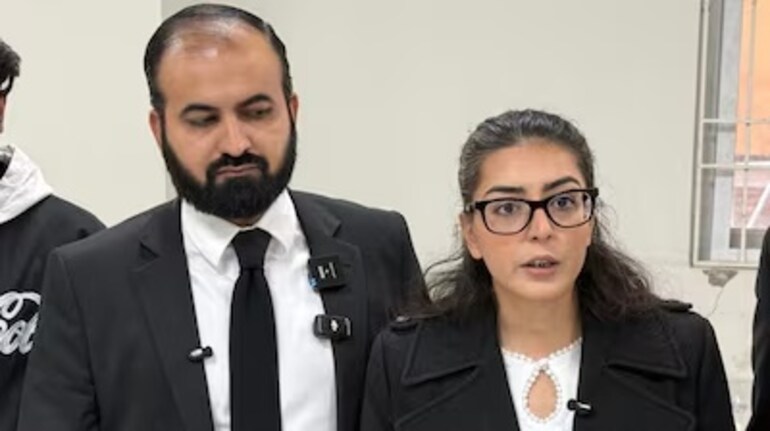

A Pakistani court has sentenced prominent human rights lawyer Imaan Mazari and her husband to a combined 17 years in prison over what authorities described as “anti-state” social media posts, a case that has renewed scrutiny of shrinking space for dissent and civil liberties in the country.
Mazari, a vocal critic of Pakistan’s powerful military establishment, was convicted on Saturday along with her husband, lawyer Hadi Ali Chattha, according to a court order seen by Reuters.
An Islamabad court found the couple guilty on three counts, handing down sentences of five years, 10 years and two years, to run concurrently.
Court documents said Mazari had “disseminated highly offensive” content online. Both Mazari and Chattha have denied the charges, maintaining that the cases stem from their criticism of enforced disappearances and alleged human rights abuses, accusations Pakistan’s military has repeatedly denied.
Speaking after her conviction, Mazari described her imprisonment as part of a wider pattern of repression. “We're not the first people who will be unlawfully incarcerated in this country,” she told AFP. Earlier in court, she struck a defiant note, saying, “Truth seems overwhelmingly difficult in this country,” and added that she was prepared to face the consequences of her work. “We will not back down,” she said.
Who is Imaan Mazari
At 32, Mazari is one of Pakistan’s most recognisable human rights lawyers, according to AFP. A University of Edinburgh graduate, her legal work has focused on enforced disappearances, minority rights, press freedom and the defence of individuals charged under Pakistan’s blasphemy laws.
She has represented ethnic Baloch activists, journalists facing defamation cases and Afghan nationals targeted during security crackdowns. Her work has frequently put her at odds with the security establishment, particularly over allegations of disappearances in Balochistan.
Mazari has publicly criticised the military’s role in politics and what she describes as the erosion of constitutional rights through rushed legislation and tighter state control. Her growing profile has been accompanied by a rising number of cases against her, including charges of “cyber terrorism” and “hate speech”.
Family background and pressure
Mazari is the daughter of former federal human rights minister Shireen Mazari. Her mother told AFP that while the family had faced threats linked to her daughter’s activism, she remained proud of Mazari’s work defending the “dispossessed and marginalised”.
Journalist Asad Ali Toor, whom Mazari has represented in several cases, said her legal career directly confronts state power. “Despite coming from a very well-off family, she has made her life considerably more difficult through the choices she has made about her activism,” he told AFP.
Mazari has also faced sustained online harassment, including sexist abuse and doctored images, in a country where women’s participation in public life remains limited. In 2025, she received the Young Inspiration Award from the World Expression Forum for her work, AFP reported.
That same year, the UN special rapporteur for human rights defenders said the cases against her appeared to reflect an arbitrary use of the legal system to harass and intimidate her.
In January 2026, Pakistan’s military publicly singled her out. During a press conference, military spokesperson Lieutenant General Ahmed Sharif Chaudhry cited one of her social media posts while warning about “hidden elements”. “They operate under the guise of democracy and human rights to promote terrorism,” he said.
*with agency inputs
Discover the latest Business News, Sensex, and Nifty updates. Obtain Personal Finance insights, tax queries, and expert opinions on Moneycontrol or download the Moneycontrol App to stay updated!
Find the best of Al News in one place, specially curated for you every weekend.
Stay on top of the latest tech trends and biggest startup news.