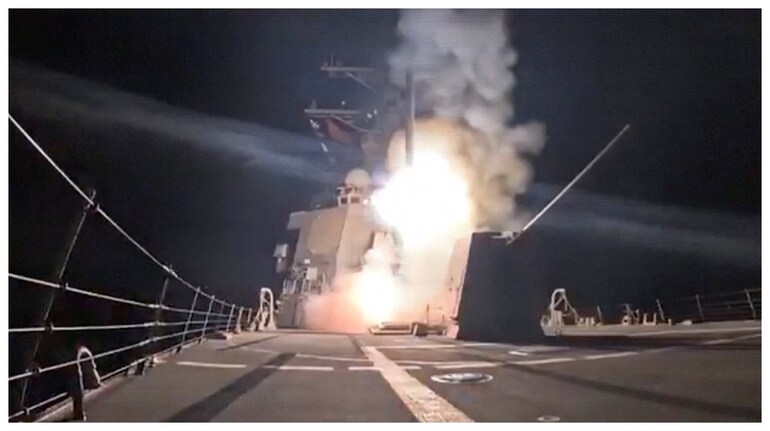
The United States carried out strikes in northwestern Nigeria against Islamic State fighters, according to President Trump, who announced the action on social media. He offered few operational details, describing it only as a “powerful and deadly strike” against ISIS militants in the region. In the same post, he accused the group of “targeting and viciously killing, primarily, innocent Christians.”
The US Defense Department said the strikes were done in coordination with the Nigerian government. Beyond that, there was little public detail about targets, damage, or the timeline of the operation, the New York Times reported.
The threat that came before the strike
This action did not come out of nowhere. Trump had been warning for months that he might use force in Nigeria if the government did not stop what he and his allies described as the killing of Christians by Islamist militants.
On November 1, he issued one of his most explicit threats yet. He said that if Nigeria continued to “allow the killing of Christians,” the United States would immediately stop all aid and assistance. He then went a step further, saying the US might go into Nigeria “guns-a-blazing.”
In the same post, he wrote that he was instructing what he called the “Department of War” to prepare for possible action, adding: “If we attack, it will be fast, vicious, and sweet.” US Defence Secretary Pete Hegseth responded publicly with: “Yes sir,” and wrote that the Pentagon was preparing for action.
What the administration has claimed—and what’s unclear
Trump did not specify which attacks he was referring to when he made the case that Christians were being targeted in Nigeria. The account also did not cite evidence for that claim, which has been repeated by several of his political allies.
In the days leading up to his comments, some allies amplified the same idea. Senator Ted Cruz, for example, accused Nigeria of “facilitating the mass murder” of Christians.
At the same time, the text around the strikes makes clear there is disagreement over how Nigeria’s violence should be described. A US commission report cited in the same material describes extremist violence as affecting “large numbers of Christians and Muslims” across several states, not only one community.
Nigeria’s response
Nigeria has denied the accusations that it is permitting religious killings or that it is broadly intolerant.
President Bola Ahmed Tinubu said the country remained committed to protecting religious freedom. He described Nigeria as a democracy with constitutional guarantees of religious liberty and said the portrayal of Nigeria as religiously intolerant did not reflect what he called the country’s “national reality.” He also pointed to government efforts to safeguard freedom of religion and belief.
What violence in Nigeria looks like on the ground
Nigeria is not a small or uniform place: it has around 220 million people and large Christian and Muslim populations.
Parts of the country have long faced attacks from extremist groups, including Boko Haram, based in the northeast, which has targeted both Christians and Muslims it considers insufficiently faithful. A splinter group, the Islamic State West Africa Province, has carried out similar attacks.
But Nigeria’s violence is not only about jihadist groups. Deadly clashes have also occurred repeatedly in central Nigeria between herders and farmers, where competition over scarce resources fuels tensions that overlap with religion and ethnicity. The herders are typically ethnic Fulani and Muslim, while farmers are often Christian. Some conflicts also involve armed men seizing land.
In the northwest—the region referenced in the strike announcement—kidnapping for ransom is a significant industry, adding another layer of insecurity that is not always ideological.
Why this matters now
The strike is notable not only because the US used force, but because of the way it was framed: Trump linked American military action to the claim that Christians are being killed in large numbers and that Nigeria’s government is failing to stop it. Nigeria disputes that framing.
The question going forward is whether this was a one-off action carried out with Nigerian cooperation, or the beginning of a more confrontational US approach—especially given Trump’s public suggestion that aid could be cut and further intervention could follow.
What is clear from the material is that Nigeria’s violence is complicated, widespread, and driven by multiple actors and conflicts. Strikes may hit militants, but they don’t simplify the underlying reality on the ground.
Discover the latest Business News, Sensex, and Nifty updates. Obtain Personal Finance insights, tax queries, and expert opinions on Moneycontrol or download the Moneycontrol App to stay updated!
Find the best of Al News in one place, specially curated for you every weekend.
Stay on top of the latest tech trends and biggest startup news.