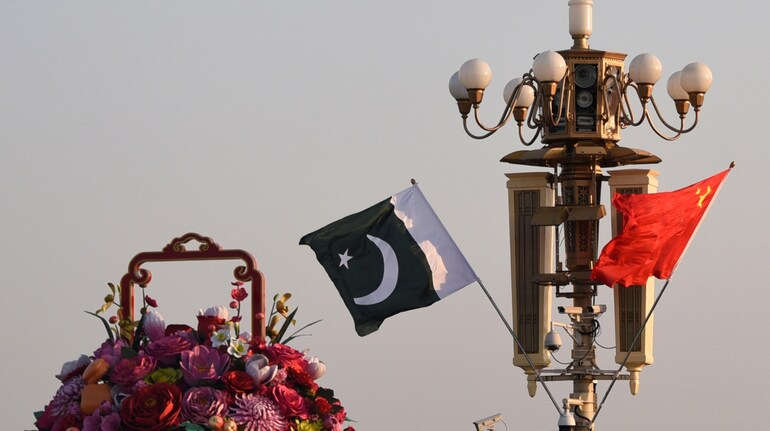

A new assessment by the US Department of Defense has delivered a blunt warning to India about China’s evolving two-track strategy that combines tactical calm on the border with sustained military pressure through Pakistan. The Pentagon’s findings underline that Beijing’s outward signals of de-escalation along the Line of Actual Control should not be mistaken for a softening of its long-term strategic intent toward India.
The warning appears in the US Department of Defense 2025 Annual Report to Congress on Military and Security Developments Involving the People’s Republic of China. The 100-page document offers a sweeping assessment of China’s national strategy, the rapid modernisation of the People’s Liberation Army, and Beijing’s expanding military footprint across regions critical to Indian security.
The report examines China’s growing capabilities across land, air, naval, space, cyber and nuclear domains and flags their implications for regional stability and the rules-based international order. For India, the most consequential takeaway is the Pentagon’s conclusion that Beijing is deliberately pursuing de-escalation on one front while intensifying pressure on another.
Calming the LAC, containing India
According to the Pentagon, India and China reached an understanding in October 2024 to disengage from the remaining standoff points along the Line of Actual Control. While this reduced immediate friction after years of tension, the US assessment makes clear that the move was tactical rather than conciliatory.
The report says Beijing’s key objective in calming the LAC was to stabilise ties with New Delhi and prevent India from moving closer into a deeper strategic alignment with Washington. US analysts see this as part of a broader Chinese effort to manage India as a secondary but growing challenge while Beijing remains focused on the United States and Taiwan.
At the same time, the Pentagon highlights a persistent trust deficit between India and China, rooted in past border clashes and Beijing’s wider regional behaviour. This deficit, the report notes, sharply limits the prospects of any genuine reset.
A particular concern flagged by the US is China’s stance on Arunachal Pradesh. The report underlines that Beijing continues to describe the Indian state as a “core interest.” By placing Arunachal Pradesh in the same category as Taiwan and the South China Sea, China is directly challenging Indian sovereignty, despite ongoing diplomatic engagement.
Pakistan as Beijing’s pressure tool
Even as China projects calm along the LAC, the Pentagon points to an aggressive and sustained expansion of military cooperation between Beijing and Pakistan. The report confirms that China has delivered 36 J-10C fighter jets to Pakistan since 2020, significantly enhancing the Pakistan Air Force’s frontline strike capability.
It also notes that China and Pakistan continue to jointly produce JF-17 fighter aircraft, while Islamabad remains one of the largest recipients of Chinese armed drones, naval vessels and other advanced platforms. The assessment describes Pakistan as a critical pillar of China’s regional military strategy, particularly in applying pressure on India without direct Chinese involvement.
The Pentagon further highlights that China and Pakistan conducted joint counterterrorism drills in December 2024, reinforcing the depth of their defence relationship. More worryingly for India, the report identifies Pakistan as a potential site for future Chinese military facilities, a development that would extend the PLA’s reach dangerously close to India’s western flank.
Preparing for mountain conflict
On the operational front, the Pentagon notes that China has not slowed its military preparations despite disengagement talks. The PLA’s Western Theatre Command, which is responsible for contingencies involving India, carried out intensive high-altitude and low-oxygen exercises throughout 2024.
These drills, the report says, point to sustained preparation for mountain warfare, underscoring that Beijing continues to plan for conflict scenarios even as it publicly supports de-escalation.
A clear warning for New Delhi
Taken together, the Pentagon’s assessment paints a stark picture. China is pursuing tactical calm along the LAC to buy time and shape perceptions, while simultaneously challenging India’s sovereignty, expanding military capabilities near its borders, and arming Pakistan at scale.
For New Delhi, the message from Washington is unambiguous. Beijing’s engagement should be viewed with caution; Pakistan remains central to China’s pressure strategy, and any easing of tensions on the border does not signal a reduction in the long-term strategic challenge posed by China and its closest regional partner.
Discover the latest Business News, Sensex, and Nifty updates. Obtain Personal Finance insights, tax queries, and expert opinions on Moneycontrol or download the Moneycontrol App to stay updated!
Find the best of Al News in one place, specially curated for you every weekend.
Stay on top of the latest tech trends and biggest startup news.