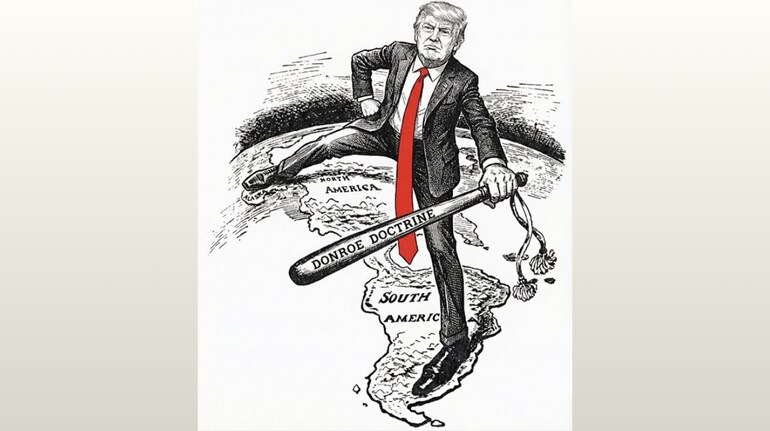
When US President Donald Trump casually coined the term “Donroe Doctrine” at Mar-a-Lago, it sounded like classic Trump wordplay. But behind the quip lies a serious revival of a 200-year-old foreign policy idea that once defined America’s role in the Western Hemisphere and is now being repurposed for a new era of geopolitical rivalry.
Trump invoked the term while justifying Washington’s dramatic operation against Venezuelan President Nicolás Maduro, framing it as a modern update of the Monroe Doctrine, first articulated in 1823 by America’s fifth president, James Monroe.
According to Trump, Venezuela under Maduro had allowed “foreign adversaries” and “menacing offensive weapons” into the region, violating what he described as the core principles of American foreign policy dating back more than two centuries.
Who was James Monroe, and what was the Monroe Doctrine
James Monroe, the fifth President of the United States, unveiled what later came to be known as the Monroe Doctrine during his annual message to Congress on December 2, 1823. At the time, much of Latin America was emerging from colonial rule, and European powers were weighing fresh interventions.
Monroe’s message was blunt. The Western Hemisphere was no longer open to European colonisation, and any attempt by European powers to interfere in the Americas would be viewed as a hostile act against the United States. In return, the US promised not to meddle in existing European colonies or internal European affairs.
The doctrine effectively divided the world into spheres of influence, positioning the Americas as a US sphere. Though framed as a defensive policy, it laid the foundation for Washington’s long-term dominance in the region.
How the Monroe Doctrine evolved into an intervention tool
Over time, the Monroe Doctrine shifted from a warning against European colonialism to a justification for US intervention across Latin America.
In 1904, President Theodore Roosevelt introduced the Roosevelt Corollary, arguing that the US had the right to exercise “international police power” in Latin American countries to prevent European interference, particularly over debt and instability. This expansion followed the Venezuelan debt crisis of 1902–03 and opened the door to repeated US military interventions in the Dominican Republic, Nicaragua and Haiti.
During the Cold War, the doctrine’s logic blended with America’s global anti-communist agenda. It was cited, directly or indirectly, during the Cuban Missile Crisis, US efforts to overthrow Fidel Castro, and Washington’s role in coups in Guatemala in 1954 and Chile in 1973. The goal, as scholars have noted, was strategic denial. First Europeans, then the Soviet Union, were to be kept out of the hemisphere, reported Time.
By 2013, however, then Secretary of State John Kerry declared that “the era of the Monroe Doctrine is over”, signalling a shift toward partnership-based diplomacy in the Americas. That declaration did not last long.
Trump, China and the return of hemispheric dominance
Trump’s second term has marked a decisive break from that thinking. While he campaigned on “America First”, his presidency has increasingly embraced muscular interventionism, especially in the Western Hemisphere.
The Trump administration has repeatedly warned that China has expanded its influence across Latin America through infrastructure projects, ports, energy investments and strategic assets. Blocking “non-Hemispheric competitors” from gaining a foothold in the region has now become official policy language.
That concern has shaped Trump’s actions, from aggressive moves against Venezuela to renewed rhetoric about Greenland and the Panama Canal. In official strategy documents, the administration has explicitly linked these actions to a revived Monroe Doctrine framework, now branded as a Trump Corollary. The message is clear: American power in the hemisphere is non-negotiable.
Monroe to ‘Donroe’
Trump has gone a step further by personalising the doctrine. “The Monroe Doctrine is a big deal, but we’ve superseded it by a lot. They now call it the Donroe Doctrine,” he said, asserting that “American dominance in the Western Hemisphere will never be questioned again.”
The administration argues that these actions protect US security and economic interests, from countering drug cartels to accessing Venezuela’s oil reserves and securing strategic trade routes. Critics, including Trump’s former adviser John Bolton, argue there is no coherent doctrine at all, only ad hoc decision-making driven by immediate interests.
A message written into steel
Perhaps the most symbolic moment of this revival has unfolded not in speeches, but at sea. The US Coast Guard cutter that chased the Russian tanker Marinera across the Atlantic was none other than USCGC Munro (WMSL-755), pronounced Monroe.
It is hard to call that a coincidence. A ship bearing Monroe’s name enforcing American power against a foreign adversary is the Monroe Doctrine in action, almost two centuries later. Trump, as ever, knows how to send a message.
In rebranding a foundational idea as the “Donroe Doctrine”, Trump has signalled that old doctrines never really die.
Discover the latest Business News, Sensex, and Nifty updates. Obtain Personal Finance insights, tax queries, and expert opinions on Moneycontrol or download the Moneycontrol App to stay updated!
Find the best of Al News in one place, specially curated for you every weekend.
Stay on top of the latest tech trends and biggest startup news.