



The Trump administration is weighing an executive order that could reshape the landscape of college sports by increasing federal scrutiny of “name, image, and likeness” (NIL) payments to athletes, according to White House officials familiar with the discussions, the Wall Street Journal reported.
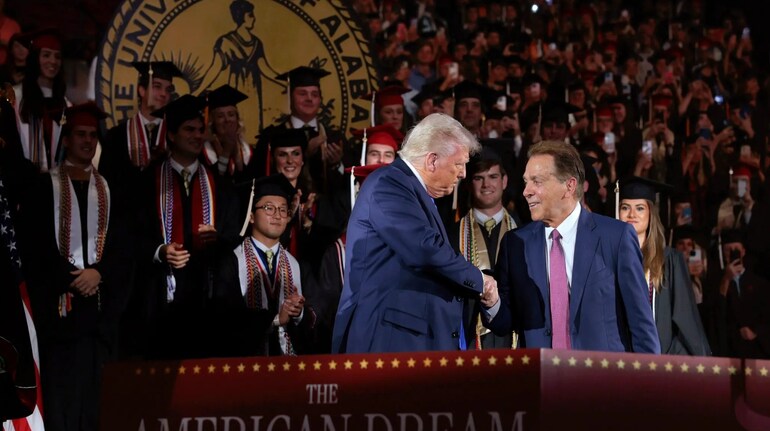
The move follows a Thursday night meeting between President Trump and former University of Alabama football coach Nick Saban in Tuscaloosa, where Trump delivered the school’s commencement address. During their private conversation, Saban reportedly expressed concerns that NIL deals were spiralling out of control, undermining competitive balance in college athletics.
Trump, who agreed with Saban’s assessment, told aides to begin exploring what an executive order might look like, the officials said. While specifics are still being discussed, the aim would be to “reform” rather than eliminate the ability of college athletes to earn compensation.
Saban’s warning: A broken model
Saban, who retired in 2023 after winning seven national titles, has long voiced concerns about the effects of NIL. In January, he said in a radio interview that the current system is “unsustainable,” pointing to disparities in how much different universities can spend on recruiting and retaining talent.
Although he did not advocate banning NIL outright, Saban reportedly told Trump that a lack of regulation has created an arms race among top-tier programs, with some schools able to offer far more lucrative opportunities to student-athletes than others.
In the current system, top athletes in football and basketball can earn millions annually through endorsement deals, booster-backed collectives, and social media campaigns. Opendorse, a platform that tracks NIL activity, estimated that $1.67 billion changed hands during the 2024–25 academic year alone, with nearly 4,300 Division I football players transferring schools during the same period.
An unregulated marketplace
The NCAA, under pressure from courts and state legislatures, relaxed its NIL restrictions in 2021. It also loosened its transfer rules, allowing athletes to switch schools more freely in search of higher payouts—much like coaches have long done.
But critics say the current model lacks the safeguards common in professional sports, such as salary caps or standard contracts. Coaches have complained that the absence of these guardrails leads to constant roster churn and undermines team cohesion.
“It’s a free-for-all,” one Power Five coach told The Wall Street Journal. “And unlike the NFL, we don’t have a commissioner or a union—we have chaos.”
A federal response on the horizon?
The NCAA declined to comment on the potential executive order but acknowledged that the organization is facing mounting pressure. “There are some threats to college sports that federal legislation can effectively address,” said NCAA spokesman Tim Buckley, who added that the NCAA is advocating for bipartisan support to bring structure to NIL.
Several bills have been introduced in Congress over the past three years to regulate athlete compensation, but none have made it to the president’s desk. Trump’s executive order could signal a shift toward unilateral federal intervention—especially if legislative gridlock continues.
Saban’s influence on the sport adds weight to the conversation. Since retiring, he has become a prominent commentator on ESPN’s College GameDay, offering a broader perspective on college athletics. In a recent interview, he noted that as a coach, he used to view the sport “through a straw,” but now sees the larger forces reshaping the game.
Trump’s return to the NIL spotlight
This isn’t the first time Trump has weighed in on college athletics. He attended multiple Alabama football games during his first term, including Saban’s 2018 championship victory. His political relationship with college football’s passionate fan base remains strong, and a move to “fix” NIL could resonate with voters in key Southern battleground states.
Still, critics warn that any executive action must tread carefully. “You can’t unwind NIL,” said one university official. “But you might be able to build a fairer system. That’s the challenge—and the risk.”
With the 2024-25 college football season approaching and legal pressure mounting on the NCAA to allow direct pay to athletes, Trump’s next move could significantly shape the future of amateur sports.
Discover the latest Business News, Sensex, and Nifty updates. Obtain Personal Finance insights, tax queries, and expert opinions on Moneycontrol or download the Moneycontrol App to stay updated!
Find the best of Al News in one place, specially curated for you every weekend.
Stay on top of the latest tech trends and biggest startup news.