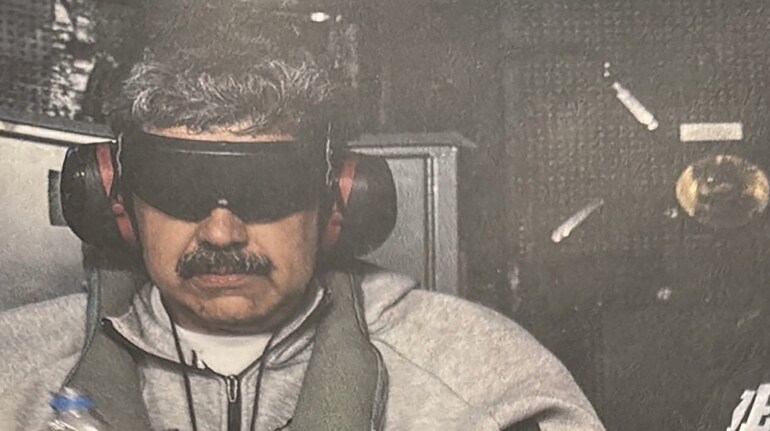

The US military operation that led to the capture of Venezuelan President Nicolás Maduro has triggered one of the most complex legal debates in recent decades, cutting across international law, US constitutional authority, and long-standing norms governing sovereignty and the use of force. The questions intensified further after President Donald Trump publicly stated that the United States would “run” Venezuela for an unspecified period following Maduro’s removal.
The Trump administration has not released a formal legal justification for either the capture itself or the broader claim of administrative control. However, statements by senior officials, past U.S. precedents, and internal executive branch legal theories offer clues into how Washington may be framing the action.
At the heart of the controversy lie two separate but intertwined issues: whether the seizure of a sitting foreign leader on foreign soil was lawful, and whether the U.S. president has any legal authority to govern another country following such an operation.
Framing the operation as law enforcement
US officials have described the Maduro operation as support for a criminal arrest rather than a traditional military intervention. Maduro had been indicted in New York on drug trafficking and weapons charges, similar to the 1989 indictment of Panama’s de facto leader Manuel Noriega. In that earlier case, the Pentagon characterised the invasion of Panama as assistance to law enforcement authorities.
That parallel has re-emerged in the current administration’s messaging. The Pentagon said the military provided support to the Justice Department, and Attorney General Pam Bondi stated that the defendants “will soon face the full wrath of American justice on American soil in American courts.”
However, legal scholars have pointed out that arresting an individual abroad is fundamentally different from using force to seize control of airspace, disable air defences, and conduct helicopter assaults inside another sovereign state. As one expert put it, “You cannot say this was a law enforcement operation and then turn around and say now we need to run the country. It just doesn’t make any sense.”
The prohibition under international law
International law, particularly the United Nations Charter, sets a high bar for the lawful use of force. Article 2(4) prohibits states from using force against the territorial integrity or political independence of another state unless specific exceptions apply, such as self-defence or authorisation by the UN Security Council.
In this case, neither exception clearly exists. Drug trafficking and organised crime, while serious, do not constitute an armed attack under international law. Nor was there Security Council approval. As a result, several experts have said the operation appears to breach the Charter.
The precedent of Panama looms large. In 1989, the U.N. General Assembly voted overwhelmingly to condemn the US invasion, calling it “a flagrant violation of international law and the independence, sovereignty and territorial integrity of states.” While the United States vetoed a Security Council resolution at the time, the broader international reaction was clear.
Whether such condemnation carries legal consequences is another matter, but the normative prohibition itself remains firmly embedded in international law.
Does international law bind the US president?
The US Constitution incorporates ratified treaties into domestic law and instructs presidents to faithfully execute the law. Yet executive branch lawyers have long argued that the president’s inherent constitutional powers may sometimes override international legal constraints.
During the Panama intervention, the Justice Department’s Office of Legal Counsel asserted that President George HW Bush had constitutional authority to deploy federal agents abroad to apprehend a fugitive, even if doing so violated international law. That opinion was signed by William P Barr, who later became attorney general.
Critics have argued that this reasoning collapses two distinct questions: whether courts can enforce treaties, and whether presidents are obligated to obey them regardless of enforceability. As one former State Department lawyer explained, ratified treaties like the UN Charter were understood to bind presidents even “whether or not courts can enforce it.”
There is no definitive Supreme Court ruling resolving this tension, leaving the legal status of such actions unsettled.
Air strikes and the claim of self-protection
Beyond the seizure itself, US forces reportedly destroyed Venezuelan air defence systems and exchanged fire with hostile forces during the operation. Videos later showed explosions in Caracas.
Senator Mike Lee initially questioned the constitutional basis for the action, citing the absence of a declaration of war or authorisation for the use of military force. After speaking with Secretary of State Marco Rubio, he said the military action was meant to protect those executing the arrest warrant and “likely falls within the president’s inherent authority under Article II of the Constitution to protect U.S. personnel from an actual or imminent attack.”
This justification draws on the doctrine of inherent protective power, which allows the president to use force to defend federal agents carrying out federal law. A related doctrine permits deployed units to respond in self-defence if they come under fire.
Whether disabling a country’s air defences in advance fits within these doctrines remains a point of debate.
Can the US legally ‘run’ Venezuela?
President Trump’s assertion that the United States would “run the country” raised even more profound legal concerns. He suggested that direct control might not be necessary if Maduro’s vice president, Delcy Rodríguez, complied with U.S. demands. “If the vice president does what we want, we won’t have to do that,” he said.
Legal scholars have expressed deep skepticism. Rebecca Ingber, a former senior State Department lawyer, said, “This sounds like an illegal occupation under international law, and there is no authority for the president to do it under domestic law.”
Under international law, occupation occurs when a foreign power exercises effective control over territory without sovereign consent. Such control triggers extensive legal obligations and is generally unlawful absent armed conflict or Security Council approval.
Domestically, the US Constitution gives Congress authority over funding and declarations of war. Even limited overseas military actions have often been justified as temporary or defensive. Long-term governance of another state would likely require congressional approval, appropriations, and a legal framework that does not currently exist.
The Panama example again offers contrast. After Noriega’s arrest, the United States supported Guillermo Endara, who was sworn in as president and governed Panama himself. Washington did not claim to directly administer the country.
Head of state immunity and recognition
Another major legal issue concerns Maduro’s potential immunity from prosecution. International law traditionally shields sitting heads of state from arrest in foreign courts. The U.S. Supreme Court has recognised this principle, noting that “the person of the sovereign” is exempt from detention.
Whether Maduro qualifies depends largely on recognition. The United States has not recognised him as Venezuela’s legitimate president since 2019, citing fraudulent elections. Secretary Rubio has repeatedly argued that Maduro is not a lawful leader but “the head of a drug trafficking organization masquerading as a government.”
Courts have previously deferred to the executive branch on recognition questions. A 2015 Supreme Court ruling affirmed that presidents have exclusive authority to recognise foreign governments. Based on that precedent, one legal scholar predicted that courts would likely accept Trump’s denial of recognition for purposes of immunity.
The Noriega case again provides a partial parallel. U.S. courts rejected Noriega’s immunity claim, noting that Washington did not recognise him and that Panama’s own constitution defined its head of state as an elected president, which Noriega was not.
Maduro’s situation is more complex. He previously won elections, was recognised by the U.S. for years, and was formally declared the winner in subsequent votes, even though those elections were widely disputed.
Jurisdiction despite contested capture
Even if the operation violated international law, US courts are unlikely to dismiss the case on that basis alone. A long line of judicial decisions has held that courts retain jurisdiction over defendants regardless of how they were brought before the court.
As one principle established over more than a century makes clear, a defendant’s physical presence is what matters, not the legality of the arrest abroad.
This means that challenges based on the manner of Maduro’s capture may have little practical effect on the prosecution itself.
A legal grey zone with few consequences
Experts broadly agree that the operation occupies a legal grey area, and possibly crosses established legal boundaries. Yet they also note the lack of effective enforcement mechanisms in international law.
“It’s hard to see how any legal body could impose practical consequences on the administration,” one constitutional law professor observed.
The capture of Maduro and the claim of temporary US control over Venezuela thus sit at the intersection of power and law, where legal norms are strained, precedents are contested, and accountability remains uncertain.
With inputs from The New York Times and ReutersDiscover the latest Business News, Sensex, and Nifty updates. Obtain Personal Finance insights, tax queries, and expert opinions on Moneycontrol or download the Moneycontrol App to stay updated!
Find the best of Al News in one place, specially curated for you every weekend.
Stay on top of the latest tech trends and biggest startup news.