






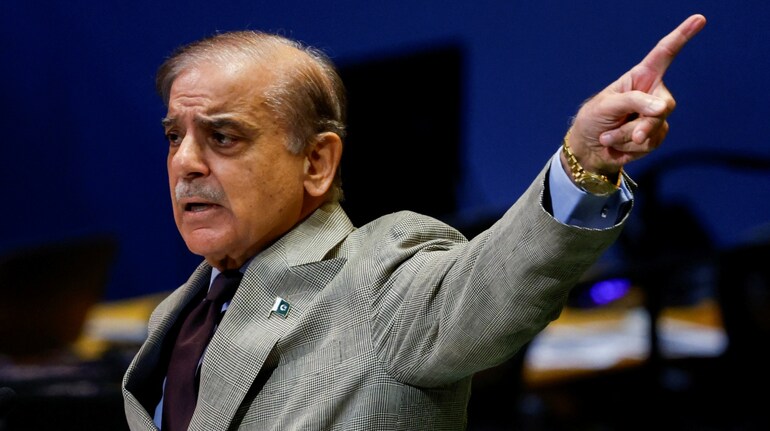

Pakistan Prime Minister Shehbaz Sharif chose the global stage at the World Economic Forum in Davos to deliver what sounded like a call for unity. But for many observers, his remarks instead underlined a deeper and more troubling reality about who truly runs Pakistan’s economy and policy machinery.
Speaking in Davos, Sharif stressed the need for “teamwork” between Pakistan’s political and military leadership to deal with the country’s worsening economic challenges. He said tackling these issues required “a sense of understanding between key stakeholders,” language that drew immediate scrutiny.
Geopolitical analyst Michael Kugelman interpreted the remarks as more than just rhetoric. Writing on X, Kugelman said Sharif’s comments appeared to be an effort to justify the military’s deep and expanding role in economic policymaking, a role that has increasingly overshadowed civilian authority.
"PM Sharif, speaking at Davos, talks of “teamwork” between the political & military leadership. He says to tackle big economic challenges, needs to be “a sense of understanding between key stakeholders.” This may be an effort to justify the military’s deep role in economic policy," Kugelman wrote on X.
PM Sharif, speaking at Davos, talks of “teamwork” between the political & military leadership. He says to tackle big economic challenges, needs to be “a sense of understanding between key stakeholders.” This may be an effort to justify the military’s deep role in economic policy.— Michael Kugelman (@MichaelKugelman) January 21, 2026
Military dominance dressed up as cooperation
Sharif’s framing of civil-military “teamwork” comes at a time when Pakistan’s armed forces, under Chief of Defence Staff Asim Munir, are openly embedded in decisions ranging from foreign policy to IMF negotiations. Previous reporting by Moneycontrol has shown that key economic calls, including bailout talks and fiscal commitments, are cleared by the military leadership, with the civilian government often acting as a rubber stamp.
This concentration of power has weakened democratic accountability and blurred the line between elected authority and uniformed control. What is being presented as coordination increasingly looks like domination.
Arms-for-cash gambit falling flat
The military’s growing influence over economic strategy has also produced questionable ideas. One such approach is Pakistan’s attempt to plug financial gaps by pitching arms sales as a substitute for cash or debt repayments. Islamabad has aggressively marketed its JF-17 fighter jets and other military hardware as “combat tested,” hoping exports would bring in much-needed foreign currency.
That strategy has so far failed. Despite loud claims and diplomatic outreach, Pakistan has not secured a single confirmed export order for its flagship fighter jets. Analysts see this as another example of how militarised decision-making is not delivering real economic relief.
A pattern, not an exception
Munir’s public messaging about destiny, faith and Pakistan’s long-term mission has also raised concerns about ideology shaping state policy. Combined with Sharif’s Davos remarks, it reinforces the perception that Pakistan’s civilian leadership is increasingly normalising military supremacy rather than challenging it.
Sharif's Davos speech was less about reform and more about managing perceptions. As Pakistan’s economy continues to struggle, calls for “understanding” between civilians and generals sound more like an admission that real power lies firmly in uniformed hands, with few results to show for it.
Discover the latest Business News, Sensex, and Nifty updates. Obtain Personal Finance insights, tax queries, and expert opinions on Moneycontrol or download the Moneycontrol App to stay updated!
Find the best of Al News in one place, specially curated for you every weekend.
Stay on top of the latest tech trends and biggest startup news.





