






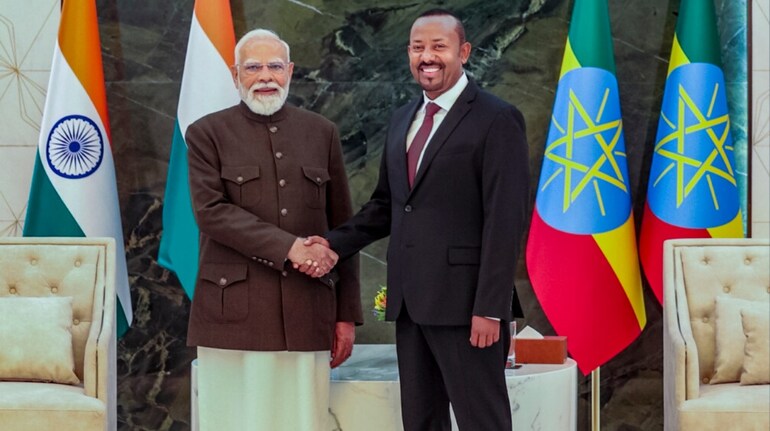
Prime Minister Narendra Modi’s two-day State visit to Ethiopia comes at a carefully chosen moment in India’s foreign policy calendar. It signals New Delhi’s intent to deepen engagement with Africa, reinforce its leadership role in the Global South, and prepare the ground for assuming the chairmanship of Brics on January 1, 2026.
The visit, undertaken at the invitation of Ethiopian Prime Minister Abiy Ahmed Ali, is PM Modi’s first official visit to Ethiopia and his third visit to Africa this year. It follows his stop in Jordan and precedes his visit to Oman, forming the middle leg of a broader West Asia Africa outreach. Indian officials have described the Ethiopia leg as strategically significant, particularly in the context of Brics expansion and Africa’s growing role in global decision-making.
Why Ethiopia matters for India
India and Ethiopia share a relationship that goes back decades, well before the establishment of modern diplomatic ties. Trade, education and people-to-people links have long anchored the partnership. However, Modi’s visit is notable for a more immediate reason. No Indian prime minister has visited Ethiopia in the last 15 years.
India’s Ambassador to Ethiopia, Anil Kumar Rai, underlined the importance of the visit and the agenda it carries.
“Both countries are members of BRICS. And we are very important partners when it comes to cooperating on international issues, such as UN reforms and regional issues, and also there are agendas that we discuss at the regional level, particularly at the level of BRICS. India is going to be the chair of BRICS in 2026, with Ethiopia being an important member. So, all those issues will come up during the discussions,” Rai told ANI.
The Ministry of External Affairs has framed the visit as a reaffirmation of shared priorities.
“As partners in the Global South, the visit will be a reiteration of the shared commitment of the two nations to advance close ties of friendship and bilateral cooperation,” the MEA said.
BRICS at the centre of the visit
Ethiopia’s entry into BRICS has added new strategic weight to the relationship. The grouping, founded by Brazil, Russia, India and China in 2006 and later joined by South Africa, has expanded steadily in recent years.
Ethiopia became a full member in January 2024 after receiving an invitation during South Africa’s BRICS chairmanship in August 2023. Egypt, Iran and the United Arab Emirates also joined at the same time, marking a significant expansion.
Indian officials have indicated that New Delhi played a key role in supporting Ethiopia’s inclusion, consistent with India’s push to strengthen African representation in major multilateral platforms. With India set to chair BRICS in 2026, Modi’s visit is expected to focus on coordination among members, the future direction of the grouping, and shared positions on issues such as UN reforms.
Africa outreach and Global South leadership
PM Modi’s Ethiopia visit is part of a broader Africa engagement. Earlier this year, he travelled to Ghana and Namibia, and he also visited South Africa last month. Modi and Abiy Ahmed last met on the sidelines of the BRICS summit in Johannesburg in 2023, where they discussed expanding cooperation across trade, defence, technology and development.
Abiy Ahmed has also backed India’s leadership of the Global South. He participated in the third Voice of the Global South dialogue chaired by Modi in 2024 and attended the inaugural Leaders’ Session at the Second Voice of the Global South Summit a year earlier.
Strong economic and development ties
India is Ethiopia’s second largest trading partner. According to India’s Department of Commerce, bilateral trade stood at 571.52 million dollars in the 2023 to 24 financial year. Indian exports accounted for 489.59 million dollars, while imports from Ethiopia were valued at 81.93 million dollars.
Indian companies have also made deep investments in Ethiopia. Around 650 Indian firms have licensed investments exceeding 5 billion dollars, with about 3 billion dollars already realised. These investments span agriculture, textiles, manufacturing, engineering, water management and consultancy services.
India is also one of Ethiopia’s largest sources of concessional finance in Africa. More than 1 billion dollars in lines of credit have been extended for projects in rural electrification, railways and the sugar industry.
Sectors likely to feature in talks
“All these sectors education, health, defence, agriculture, and digital technology are on our agenda for discussion, and in addition, investments from India in Ethiopia, the mining sector, digital public infrastructure, and cybersecurity are the areas,” Rai said.
“This visit is going to discuss the entire gamut of the relationship between both countries. During the visit, both leaders will also review regional and international issues,” he added.
Agriculture is expected to be a key focus.
“Agriculture is a very important area because 80 per cent of Ethiopians depend on agriculture for their livelihood. We are going to discuss wide-ranging areas, and I doubt that there is anything which has been left out,” Rai said.
Renewable energy cooperation through the International Solar Alliance is also likely to feature prominently. India plans to roll out ISA-backed projects in Ethiopia, including solar rooftops, off grid solutions, and solar-powered pumps.
“Through the International Solar Alliance, a large number of projects are proposed to be launched in Ethiopia and this ranges from solar rooftops to regional connectivity through solar energy, off-grid connectivity, and solar pumps so that the lives of those people who are not part of the national grid can be provided access to energy and access to energy is also one of the very important elements and a very important anti-poverty measure,” Rai said.
People-to-people links
People-to-people ties remain a strong pillar of India-Ethiopia relations. Indians have lived in Ethiopia since the late 19th century, with teachers playing a major role during the imperial era. Today, the Indian diaspora numbers around 2,500, with many working in education and industry.
The community is preparing a cultural welcome for Modi. “A large number of activities, including recitation of songs and poems, are planned. On the evening of the 16th, the Indian diaspora will present a memorable welcome for the Prime Minister,” Rai said.
As India prepares to lead BRICS, Modi’s Ethiopia visit underlines a clear message. Africa will be central to India’s vision for the Global South, and Ethiopia will be a key partner in shaping that future.
Discover the latest Business News, Sensex, and Nifty updates. Obtain Personal Finance insights, tax queries, and expert opinions on Moneycontrol or download the Moneycontrol App to stay updated!
Find the best of Al News in one place, specially curated for you every weekend.
Stay on top of the latest tech trends and biggest startup news.




