
The killing of Sharif Osman Hadi, a student leader and organiser of last year’s July uprising in Bangladesh, was allegedly used to fuel street protests and stoke agitation against India, rather than being driven by ideological rivalry, CNN-News18 has learnt from top intelligence sources.
Sources told CNN-News18 that Hadi, the convener of Inqilab Mancha, had by late 2025 become politically isolated and unpredictable. He was not aligned with any single political party and had criticised the Awami League, questioned the leadership of the Bangladesh Nationalist Party, and refused backing from Jamaat. This, intelligence inputs suggest, made him disruptive for multiple political players ahead of the 2026 general elections.
According to sources, Hadi’s death created space for large-scale street mobilisation, intimidation of the media and the justification of emergency-style governance. Several political parties had reportedly begun viewing him as a liability months before the attack.
Investigators identified the main shooter as Faisal Karim Masud, a former Chhatra League leader, with Alamgir Sheikh riding the motorcycle used in the attack. Sources said Faisal was part of an internal network operating within Hadi’s own ecosystem, pointing to political infiltration rather than an ideological feud. No weapon recovery has been publicly disclosed so far.
The Dhaka Metropolitan Police has said the investigation is nearing completion but has also admitted that the alleged mastermind remains at large.
Bangladesh Police later claimed the suspects fled to India via Meghalaya and sought their extradition. However, intelligence sources told CNN-News18 that there was no CCTV footage, border sensor data or telecom evidence to support claims that the suspects crossed into India.
The India-linked narrative surfaced only after protests and riots had already erupted, raising questions about its timing. Sources suggested that the India angle may have been introduced to divert attention and shield possible Jamaat-linked associates.
On Sunday, the Dhaka Metropolitan Police said the suspects crossed into India through the Haluaghat border area and travelled to Tura in Meghalaya. India’s Border Security Force rejected the claim, calling it false and misleading.
The BSF said there was no illegal cross-border movement in the Meghalaya sector and no arrests or interceptions had taken place. Inspector General OP Upadhyay, head of the BSF in Meghalaya, said there was no evidence to support the Bangladeshi claims and added that Meghalaya Police had also denied any such arrests. He pointed to contradictions in statements from Bangladeshi officials and questioned their credibility.
Hadi was shot in the head in Dhaka on December 12 and later died while undergoing treatment in Singapore. He was preparing to contest the Jatiya Sangsad elections as an independent candidate from the Dhaka-8 constituency. His group, Inqilab Mancha, rose to prominence during the July uprising that eventually led to the removal of Sheikh Hasina from power.
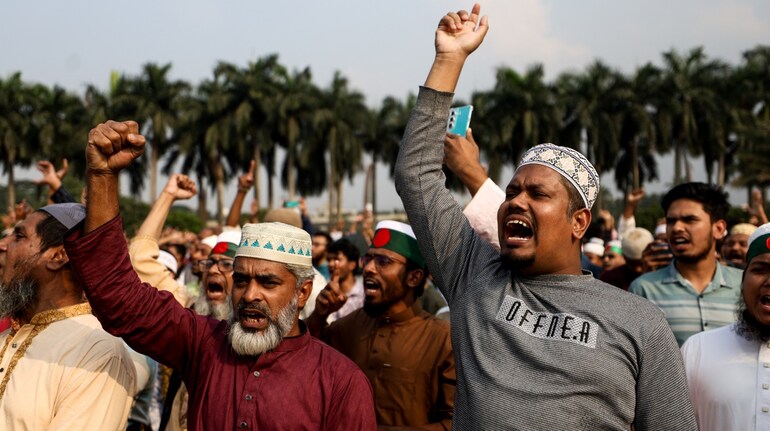
Following his death, violent protests broke out across Bangladesh. Media houses, cultural centres and political offices were attacked. In Mymensingh, a Hindu man, Dipu Chandra Das, was lynched and burnt to death over alleged blasphemy, with the mob recording the killing on their phones. Protesters also attempted to march towards the Indian High Commission in Dhaka, while the Indian Assistant High Commission in Chittagong was later pelted with stones.
Intelligence sources said the sequence of events points to a deliberate effort to exploit Hadi’s killing to inflame unrest and push an anti-India narrative, even as key questions around the conspiracy behind the assassination remain unanswered.
Discover the latest Business News, Sensex, and Nifty updates. Obtain Personal Finance insights, tax queries, and expert opinions on Moneycontrol or download the Moneycontrol App to stay updated!
Find the best of Al News in one place, specially curated for you every weekend.
Stay on top of the latest tech trends and biggest startup news.