







Iran’s nationwide anti-government protests have begun to spill beyond the country’s borders, pulling Washington and Tehran into their most dangerous standoff in years. What began as demonstrations against Supreme Leader Ayatollah Ali Khamenei has now evolved into open threats between the United States and Iran, raising the spectre of direct military confrontation.
Tensions surged on January 12 when the White House said US President Donald Trump was considering air strikes on Tehran to halt what it described as the killing of protesters “on the streets”. Trump later warned that the US would “rescue” demonstrators if the Iranian regime continued its violent crackdown.
Iran has responded with defiant rhetoric, prompting a renewed focus on its military strength and whether it can credibly deter or retaliate against US action.
Iran warns US of retaliation
Iranian President Masoud Pezeshkian first signalled Tehran’s stance in December, after Trump suggested the US could strike Iran if it attempted to rebuild its nuclear programme.
“Answer of Islamic Republic of Iran to any cruel aggression will be harsh and discouraging,” Pezeshkian wrote on social media.
The warnings escalated further last Sunday when parliament speaker Mohammad Bagher Qalibaf declared that Israel and “all American military centres, bases and ships in the region will be our legitimate targets” if Iran is attacked.
“We do not consider ourselves limited to reacting after the action and will act based on any objective signs of a threat,” Qalibaf said.
Iran’s attorney general added that protesters would be treated as “enemies of God”, an offence punishable by death, while Supreme Leader Ayatollah Ali Khamenei dismissed demonstrators as “a bunch of vandals” trying to “please” Trump. Iran has since announced three days of mourning for what it called “martyrs killed in Iranian national battle against the US and Israel”.
Manpower and proxy forces
According to the International Institute for Strategic Studies, Iran fields one of the largest armed forces in West Asia, with around 580,000 active-duty personnel and roughly 200,000 trained reserves split between the regular army and the Islamic Revolutionary Guard Corps.
Global Firepower ranks Iran 16th among 145 military powers worldwide.
SIPRI data shows Iran continues to prioritise defence spending despite sanctions, maintaining one of the region’s largest standing forces and expanding domestic weapons production to offset import restrictions.
Beyond formal forces, Iran controls the Basij militia, a paramilitary organisation used extensively to suppress protests. Analysts estimate Basij volunteers may number in the millions.
Iran also commands the Quds Force, which oversees proxy militias across the region, including Hezbollah in Lebanon, the Houthis in Yemen, armed groups in Syria and Iraq, and Hamas and Palestinian Islamic Jihad in Gaza.
Afshon Ostovar, associate professor of national security affairs at the Naval Postgraduate School, explained Iran’s deterrence strategy succinctly.
“There is a reason Iran has not been struck. It’s not that Iran’s adversaries fear Iran. It’s that they realise any war against Iran is a very serious war,” he said.
Missiles, drones and naval disruption
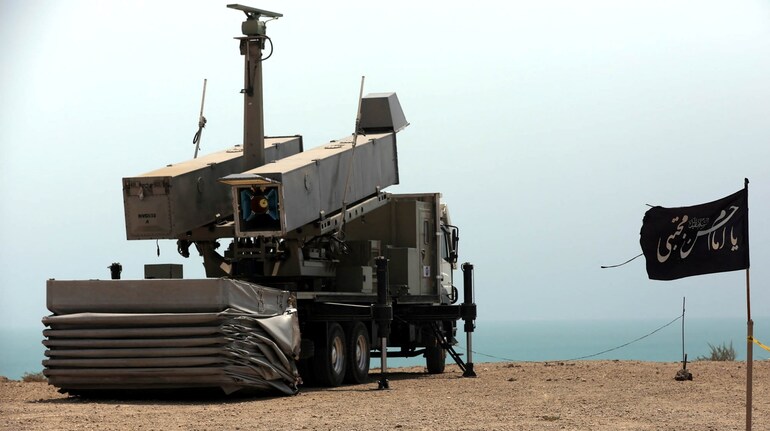
Iran’s real strength lies not in conventional air power but in missiles, drones and asymmetric warfare. SIPRI and CSIS assessments note that Iran possesses one of the largest missile and drone arsenals in West Asia.
Its inventory includes ballistic missiles with ranges of up to 2,000 kilometres, cruise missiles and anti-ship weapons capable of striking US bases and Israel. Systems such as the Sejil and Kheibar missiles give Tehran regional reach.
Iran has also developed and exported combat drones, including the Shahed series now used by Russia in Ukraine. These drones have also appeared in conflicts in Sudan and the Middle East.
Navally, Iran operates fleets of fast-attack boats and small submarines designed to disrupt shipping in the Persian Gulf and the Strait of Hormuz, a chokepoint critical to global energy supplies.
Limits of Iranian power
Despite its capabilities, defence experts stress that Iran remains far weaker than the US and Israel in terms of air power, intelligence and precision strike capacity. Many Iranian fighter jets date back to the Shah-era period, and sections of its armoured fleet are outdated.
Iran does not currently possess a nuclear weapon, but Western analysts say it has the knowledge and infrastructure to build one quickly if it chooses. SIPRI estimates suggest Iran could produce sufficient fissile material in weeks or months, though weaponisation would likely take longer.
In June, the US struck Iranian nuclear facilities at Natanz and Fordow, underscoring Washington’s willingness to act militarily if it perceives an imminent threat.
For now, the crisis remains fluid. Whether Trump follows through on military threats and how Iran chooses to respond could determine whether this confrontation remains rhetorical or spirals into open conflict.
Discover the latest Business News, Sensex, and Nifty updates. Obtain Personal Finance insights, tax queries, and expert opinions on Moneycontrol or download the Moneycontrol App to stay updated!
Find the best of Al News in one place, specially curated for you every weekend.
Stay on top of the latest tech trends and biggest startup news.





