






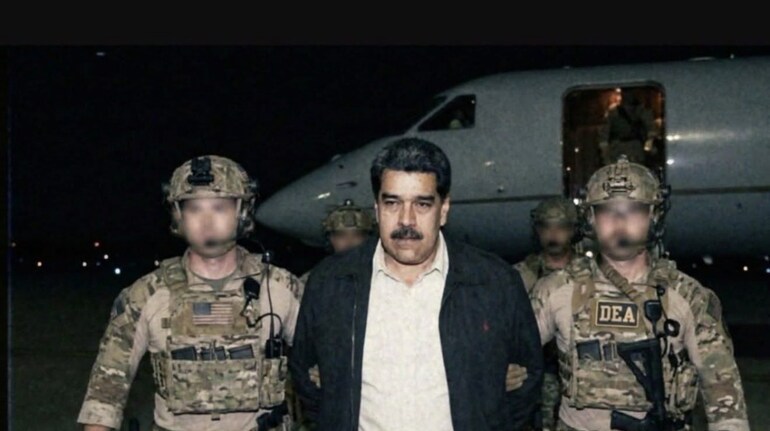

The dramatic capture of Venezuelan President Nicolas Maduro by US forces on January 3 has not only reshaped geopolitics in Latin America but has also ignited a fierce debate around prediction markets, after a little-known trader made an extraordinary profit by betting on Maduro’s removal just hours before it happened.
A bet placed before the announcement
In the hours leading up to US President Donald Trump publicly confirming that Maduro had been taken into custody, unusual trading activity appeared on Polymarket, an online platform where users wager on real-world outcomes.
One trader placed more than $32,000 (approx. Rs 29 lakh) on a contract predicting that Maduro would no longer be president of Venezuela by January 31, 2026. When Trump announced the capture at around 4:30 am Eastern Time, the contract resolved almost instantly. The trader walked away with profits exceeding $400,000 (approx. Rs 3.6 crore), with some estimates placing the gain at about $436,759.61 (approx. Rs 4 crore).
The account had joined Polymarket only weeks earlier, initially using the name “Burdensome Mix” before switching to a random string of letters and numbers. Despite intense online scrutiny, the trader’s real identity remains unknown.
Market signals before the capture
Polymarket data shows how sharply expectations shifted in the hours before the announcement. At 3 pm GMT on January 2, the implied probability of Maduro being out of office by the end of the month stood at just 5.5 percent. By 6 am GMT on January 3, it had risen to 11 percent. Thirty minutes later, it jumped to 28.5 percent, and by 7:30 am, it crossed 56 percent.
After Trump’s statement, the probability surged to nearly 99 percent, treating Maduro’s removal as a near certainty.
A related contract asking whether Maduro would be in US custody by January 31 followed a similar pattern, with early bets implying modest odds before soaring above 99 percent once the capture was confirmed.
Across Polymarket, about $56.6 million was wagered on Maduro-related outcomes. Including bets on Kalshi, a rival platform, the total amount staked rose to roughly $64.3 million.
Luck or inside information
The scale and timing of the profit has raised a central question. Was the trader simply lucky, or did they have access to nonpublic information about a planned US military operation.
So far, there is no evidence of insider knowledge. Prediction market users typically operate under pseudonyms, and while transactions are recorded on blockchains, linking wallets to real people is difficult.
Blockchain analytics firm Chainalysis told NPR that it could not identify who controlled the account. However, it noted that the trader appeared to use several US-based cryptocurrency exchanges to cash out winnings.
According to Chainalysis, this pattern does not resemble typical crypto fraud schemes, which often involve routing funds through obscure offshore exchanges.
Daniel Taylor, a professor at the Wharton School, urged caution in interpreting the outcome.
“Was it insider trading. Hard to say,” Taylor told NPR. “It’s easier in hindsight to pick out things that look suspicious than to pick them out in real time.”
Taylor also questioned whether such a case would be legally actionable. “How would the US government be harmed by someone trading on advanced warning of the Maduro operation,” he asked. “If you can’t show that you’re depriving someone of value, it’s going to be a very difficult case.”
A regulatory grey area
Prediction markets in the US fall under the oversight of the Commodity Futures Trading Commission, not the Securities and Exchange Commission, which aggressively prosecutes insider trading in stock markets.
While the CFTC has authority to enforce anti-fraud rules, it operates with far fewer resources. Kalshi alone reportedly processed over $2 billion in trades in a single week, yet the CFTC has roughly one-eighth the staff of the SEC.
Kalshi said it bans insider trading, including government employees trading on contracts linked to government actions. Polymarket’s rules similarly prohibit manipulation.
Prediction markets under Trump
Under former president Joe Biden, US regulators took a tougher stance on prediction markets, challenging election-related betting and scrutinising the sector. Since Trump returned to office, that posture has shifted.
Investigations by the Justice Department and the CFTC have been dropped, and Trump’s social media company, Truth Social has announced plans to launch its own prediction market. Trump’s eldest son, Donald Trump Jr, serves as an adviser to both Polymarket and Kalshi.
Supporters argue that prediction markets aggregate public information efficiently. Critics say they create incentives to exploit sensitive or classified knowledge, especially when national security is involved.
Congress steps in
On January 5, 2026, US Representative Ritchie Torres introduced the Public Integrity in Financial Prediction Markets Act of 2026. The bill would bar government employees from trading on prediction market contracts if they possess material nonpublic information or if their roles give them access to such information.
The proposed restrictions would apply to elected officials, political appointees, and executive branch employees.
A fast-growing industry
Once a niche form of online gambling, prediction markets have exploded in scale. According to data from crypto firms Dune and Keyrock, total US trading volume jumped from under $100 million in early 2024 to more than $13 billion.
Users now bet on everything from political outcomes to stock market movements. As The Guardian has noted, prediction markets have existed for decades, but today’s platforms combine speed, scale, and cryptocurrency-based settlement.
The Maduro episode is not the first controversy. In an earlier case, a Polymarket user reportedly earned nearly $1 million by correctly predicting 22 of Google’s top search terms in a single year.
Whether the Maduro trade proves to be a case of remarkable foresight or something more troubling, it has ensured that prediction markets are now firmly under the spotlight.
Discover the latest Business News, Sensex, and Nifty updates. Obtain Personal Finance insights, tax queries, and expert opinions on Moneycontrol or download the Moneycontrol App to stay updated!
Find the best of Al News in one place, specially curated for you every weekend.
Stay on top of the latest tech trends and biggest startup news.





